Wu Guoju, Liu Xiaohong, Chen Tuo, Xu Guobao, Wang Wenzhi, Zeng Xiaomin, Zhang Xuanwen
State Key Laboratory of Cryospheric Sciences, Cold and Arid Regions Environmental and Engineering Research Institute, Chinese Academy of Sciences Lanzhou, China ; College of Resources and Environment, University of the Chinese Academy of Sciences Beijing, China.
State Key Laboratory of Cryospheric Sciences, Cold and Arid Regions Environmental and Engineering Research Institute, Chinese Academy of Sciences Lanzhou, China.
Front Plant Sci. 2015 May 6;6:309. doi: 10.3389/fpls.2015.00309. eCollection 2015.
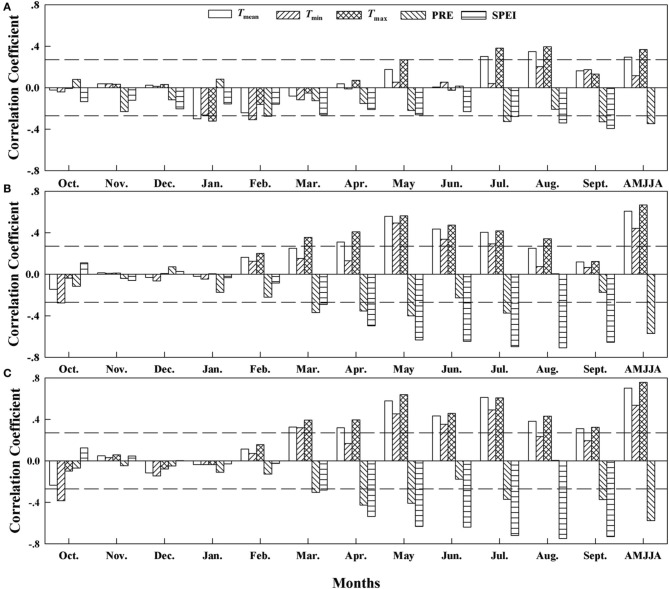
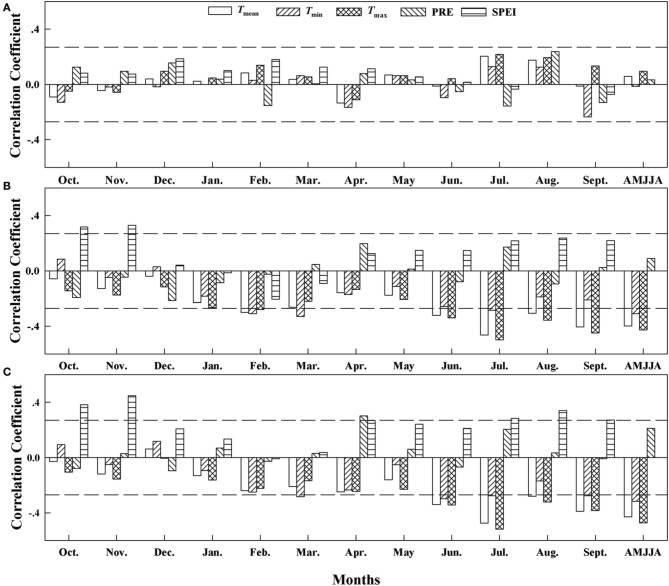
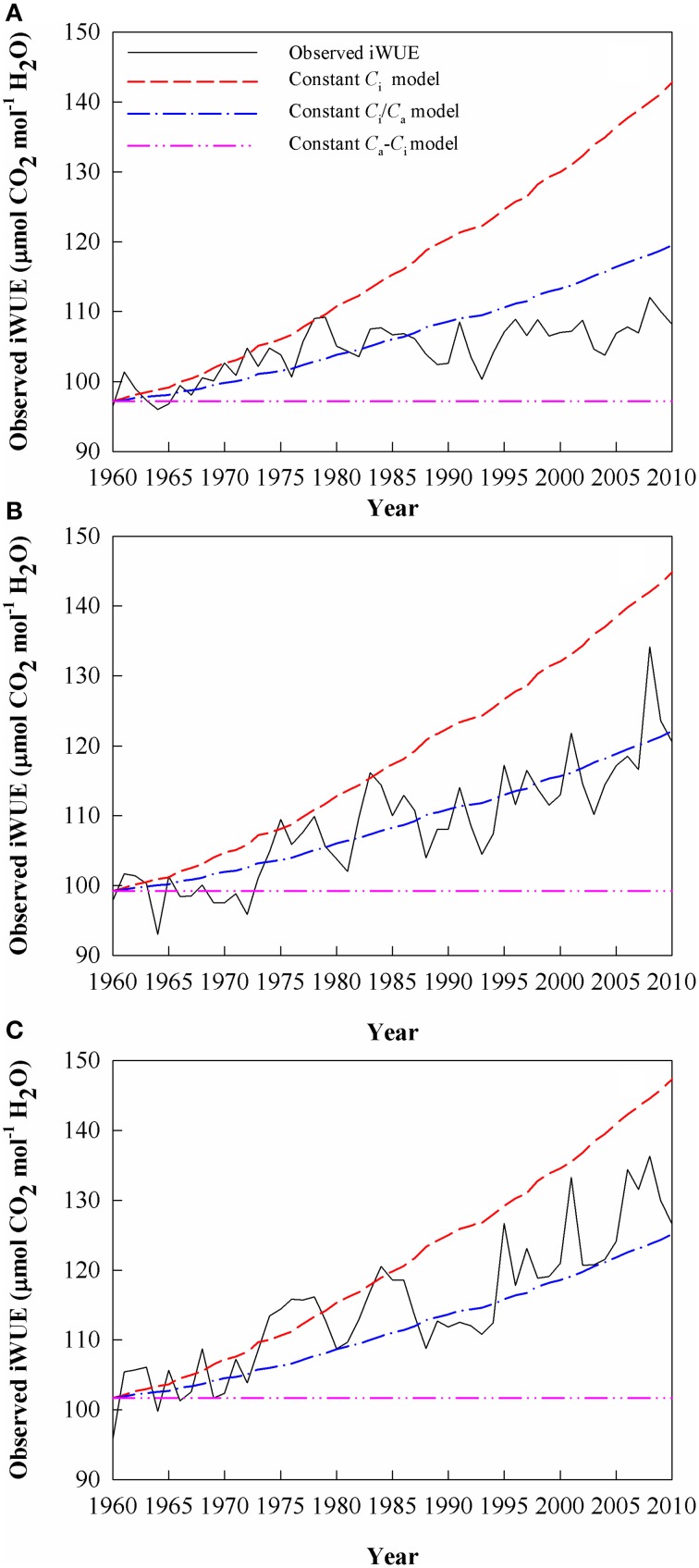
Rising atmospheric CO2 concentration (C a) is expected to accelerate tree growth by enhancing photosynthesis and increasing intrinsic water-use efficiency (iWUE). However, the extent of this effect on long-term iWUE and its interactions with climate remains unclear in trees along an elevation gradient. Therefore, we investigated the variation in the radial growth and iWUE of mature Picea schrenkiana trees located in the upper tree-line (A1: 2700 m a.s.l.), middle elevation (A2: 2400 m a.s.l.), and lower forest limit (A3: 2200 m a.s.l.), in relation to the rising C a and changing climate in the Wusun Mountains of northwestern China, based on the basal area increment (BAI) and tree-ring δ(13)C chronologies from 1960 to 2010. We used the CRU TS3.22 dataset to analyze the general response of tree growth to interannual variability of regional climate, and found that BAI and δ(13)C are less sensitive to climate at A1 than at A2 and A3. The temporal trends of iWUE were calculated under three theoretical scenarios, as a baseline for interpreting the observed gas exchange at increasing C a. We found that iWUE increased by 12-32% from A1 to A3 over the last 50 years, and showed an elevation-dependent variation in physiological response. The significant negative relationship between BAI and iWUE at A2 and A3 showed that tree growth has been decreasing despite long-term increases in iWUE. However, BAI remained largely stable throughout the study period despite the strongest iWUE increase [at constant intercellular CO2 concentration (C i) before 1980] at A1. Our results indicate a drought-induced limitation of tree growth response to rising CO2 at lower elevations, and no apparent change in tree growth and diminished iWUE improvement since 1980 in the upper tree-line. This study may contradict the expectation that combined effects of elevated C a and rising temperatures have increased forest productivity, especially in high-elevation forests.
预计大气中二氧化碳浓度(Ca)上升将通过增强光合作用和提高内在水分利用效率(iWUE)来加速树木生长。然而,在沿海拔梯度分布的树木中,这种对长期iWUE的影响程度及其与气候的相互作用仍不清楚。因此,我们基于1960年至2010年的胸高断面积增量(BAI)和树木年轮δ(13)C年表,研究了位于中国西北乌孙山高海拔树线(A1:海拔2700米)、中海拔(A2:海拔2400米)和低海拔森林下限(A3:海拔2200米)的成熟天山云杉树木的径向生长和iWUE变化,以探讨Ca上升和气候变化的关系。我们使用CRU TS3.22数据集分析树木生长对区域气候年际变化的总体响应,发现A1处的BAI和δ(13)C对气候的敏感性低于A2和A3处。在三种理论情景下计算了iWUE的时间趋势,作为解释在Ca增加时观测到的气体交换的基线。我们发现,在过去50年中,iWUE从A1到A3增加了12% - 32%,并且在生理响应上呈现出随海拔变化的趋势。A2和A3处BAI与iWUE之间显著的负相关关系表明,尽管iWUE长期增加,但树木生长一直在下降。然而,尽管A1处的iWUE增加最为强烈(1980年前细胞间二氧化碳浓度(Ci)恒定),但在整个研究期间BAI基本保持稳定。我们的结果表明,低海拔地区干旱导致树木生长对二氧化碳上升的响应受到限制,高海拔树线地区自1980年以来树木生长没有明显变化,iWUE改善减弱。这项研究可能与Ca升高和温度上升共同作用会提高森林生产力的预期相矛盾,尤其是在高海拔森林中。