Ghaneei Azam, Jowkar Akram, Hasani Ghavam Mohammad Reza, Ghaneei Mohammad Ebrahim
Department of Endocrinology, Shahid Sadoughi Hospital, Shahid Sadoughi University of Medical Sciences, Yazd, Iran.
Shahid Sadoughi University of Medical Sciences, Yazd, Iran.
Iran J Reprod Med. 2015 Feb;13(2):93-100.
30% of patients with polycystic ovary syndrome (PCOS) show mild, transient hyperprolactinemia. It is suggested that a reduction of the dopamine inhibitory effect might raise both prolactin and luteinizing hormone.
To investigate the adjuvant cabergoline therapy effects on menstrual irregularity and androgen system in PCOS women with hyperprolactinemia.
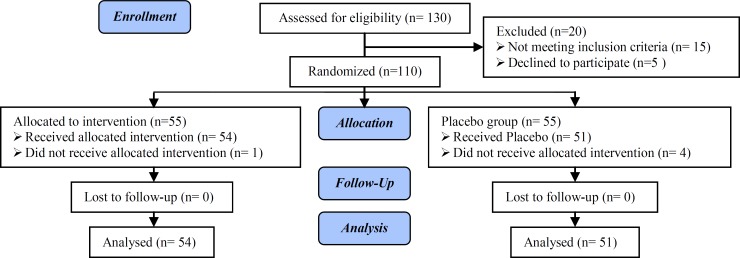
This randomized clinical trial was done on 110 polycystic ovary syndrome women with increased serum prolactin concentration [1.5 fold more than normal level (>37.5 ng/ml)]. Participants were divided into two groups: Case group (n=55) treated with metformin 1gr/day and cabergoline 0.5 mg/week for 4 months and control group (n=55) treated with metformin 1g/day and placebo weekly. Testosterone, prolactin, and dehydroepiandrosterone sulfate level were measured before and four months after intervention in two groups. Also, situation of menstrual cycles asked and recorded before and after intervention.
We found decrease in the mean of dehydroepiandrosterone sulfate, weight and total testosterone level in the two groups after intervention but their changes were not significant. Patients in case group showed a significant decrease in serum prolactin level before and after intervention (p<0.001), but no difference was found in control group. All patients in both studied groups had irregular menstrual cycles, which regulate after intervention and the difference was significant (p=0.02).
The results showed that cabergoline can be used as a safe administration in PCOS patients with hyperprolactinemia to improve the menstrual cycles. Considering that the administration of cabergoline plus metformin may reduce the required duration and dose of metformin, patient acceptability of this approach is higher.
30%的多囊卵巢综合征(PCOS)患者表现出轻度、短暂的高催乳素血症。有人认为多巴胺抑制作用的降低可能会使催乳素和促黄体生成素升高。
探讨卡麦角林辅助治疗对高催乳素血症的PCOS女性月经不调和雄激素系统的影响。
本随机临床试验对110名血清催乳素浓度升高(比正常水平高1.5倍,>37.5 ng/ml)的多囊卵巢综合征女性进行。参与者分为两组:病例组(n = 55),每天服用1克二甲双胍和每周服用0.5毫克卡麦角林,持续4个月;对照组(n = 55),每天服用1克二甲双胍和每周服用安慰剂。在两组干预前和干预4个月后测量睾酮、催乳素和硫酸脱氢表雄酮水平。此外,询问并记录干预前后的月经周期情况。
我们发现两组干预后硫酸脱氢表雄酮、体重和总睾酮水平的平均值均下降,但其变化不显著。病例组患者干预前后血清催乳素水平显著下降(p<0.001),但对照组未发现差异。两个研究组的所有患者月经周期均不规律,干预后月经周期得到调节,差异有统计学意义(p = 0.02)。
结果表明,卡麦角林可安全用于高催乳素血症的PCOS患者以改善月经周期。考虑到卡麦角林加二甲双胍的给药方式可能会减少二甲双胍所需的疗程和剂量,这种方法的患者接受度更高。