Hartmann Ulrike, Forsgren Eva, Charrière Jean-Daniel, Neumann Peter, Gauthier Laurent
Agroscope, Swiss Bee Research Center, Schwarzenburgstrasse 161, Bern 3003, Switzerland.
Department of Ecology, Swedish University of Agricultural Sciences, Uppsala 750 07, Sweden.
Viruses. 2015 May 22;7(5):2654-67. doi: 10.3390/v7052654.
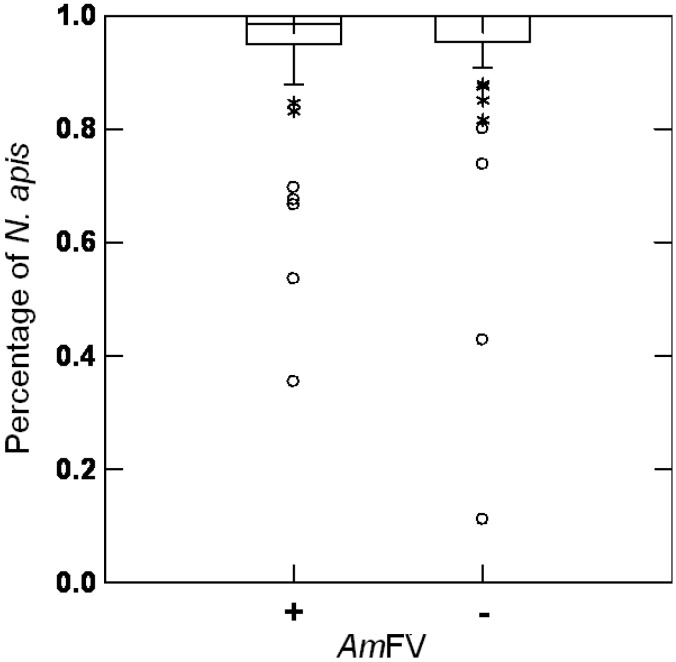
Apis mellifera filamentous virus (AmFV) is a large double stranded DNA virus of honey bees, but its relationship with other parasites and prevalence are poorly known. We analyzed individual honey bees from three colonies at different times post emergence in order to monitor the dynamics of the AmFV gut colonization under natural conditions. Prevalence and loads of microsporidia and trypanosomes were also recorded, as well as five common honey bee RNA viruses. The results show that a high proportion of bees get infected with AmFV during the first week post-emergence (75%) and that AmFV DNA levels remained constant. A similar pattern was observed for microsporidia while trypanosomes seem to require more time to colonize the gut. No significant associations between these three infections were found, but significant positive correlations were observed between AmFV and RNA viruses. In parallel, the prevalence of AmFV in France and Sweden was assessed from pooled honey bee workers. The data indicate that AmFV is almost ubiquitous, and does not seem to follow seasonal patterns, although higher viral loads were significantly detected in spring. A high prevalence of AmFV was also found in winter bees, without obvious impact on overwintering of the colonies.
蜜蜂丝状病毒(AmFV)是蜜蜂的一种大型双链DNA病毒,但其与其他寄生虫的关系及流行情况却鲜为人知。我们分析了来自三个蜂群的刚羽化后不同时间的单个蜜蜂,以监测自然条件下AmFV在肠道定殖的动态变化。还记录了微孢子虫和锥虫的流行率及载量,以及五种常见的蜜蜂RNA病毒。结果表明,很大比例的蜜蜂在羽化后的第一周就感染了AmFV(75%),且AmFV的DNA水平保持稳定。微孢子虫呈现出类似的模式,而锥虫似乎需要更多时间来定殖于肠道。这三种感染之间未发现显著关联,但AmFV与RNA病毒之间存在显著的正相关。同时,从汇集的蜜蜂工蜂样本评估了法国和瑞典的AmFV流行情况。数据表明,AmFV几乎无处不在,似乎不遵循季节性模式,尽管在春季显著检测到更高的病毒载量。在越冬蜂中也发现了较高的AmFV流行率,但对蜂群越冬没有明显影响。