Xie Junjun, Lei Bo, Niu Mengliang, Huang Yuan, Kong Qiusheng, Bie Zhilong
College of Horticulture and Forestry, Huazhong Agricultural University/Key Laboratory of Horticultural Plant Biology, Ministry of Education, Wuhan, 430070, P. R. China.
PLoS One. 2015 May 26;10(5):e0127412. doi: 10.1371/journal.pone.0127412. eCollection 2015.
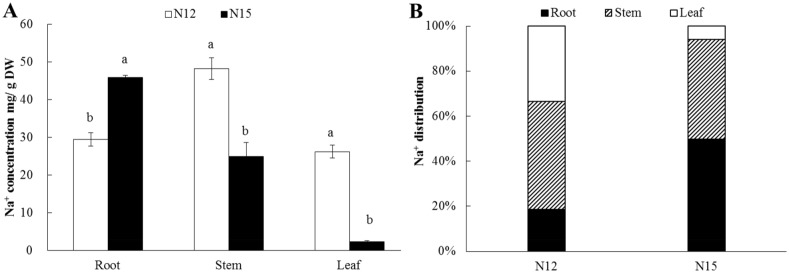
MicroRNAs (miRNAs), a class of small non-coding RNAs, recognize their mRNA targets based on perfect sequence complementarity. MiRNAs lead to broader changes in gene expression after plants are exposed to stress. High-throughput sequencing is an effective method to identify and profile small RNA populations in non-model plants under salt stresses, significantly improving our knowledge regarding miRNA functions in salt tolerance. Cucurbits are sensitive to soil salinity, and the Cucurbita genus is used as the rootstock of other cucurbits to enhance salt tolerance. Several cucurbit crops have been used for miRNA sequencing but salt stress-related miRNAs in cucurbit species have not been reported. In this study, we subjected two Cucurbita germplasm, namely, N12 (Cucurbita. maxima Duch.) and N15 (Cucurbita. moschata Duch.), with different sodium accumulation patterns, to Illumina sequencing to determine small RNA populations in root tissues after 4 h of salt treatment and control. A total of 21,548,326 and 19,394,108 reads were generated from the control and salt-treated N12 root tissues, respectively. By contrast, 19,108,240 and 20,546,052 reads were obtained from the control and salt-treated N15 root tissues, respectively. Fifty-eight conserved miRNA families and 33 novel miRNAs were identified in the two Cucurbita germplasm. Seven miRNAs (six conserved miRNAs and one novel miRNAs) were up-regulated in salt-treated N12 and N15 samples. Most target genes of differentially expressed novel miRNAs were transcription factors and salt stress-responsive proteins, including dehydration-induced protein, cation/H+ antiporter 18, and CBL-interacting serine/threonine-protein kinase. The differential expression of miRNAs between the two Cucurbita germplasm under salt stress conditions and their target genes demonstrated that novel miRNAs play an important role in the response of the two Cucurbita germplasm to salt stress. The present study initially explored small RNAs in the response of pumpkin to salt stress, and provided valuable information on novel miRNAs and their target genes in Cucurbita.
微小RNA(miRNA)是一类小的非编码RNA,它们基于完美的序列互补性识别其mRNA靶标。植物在遭受胁迫后,miRNA会导致基因表达发生更广泛的变化。高通量测序是鉴定和分析盐胁迫下非模式植物中小RNA群体的有效方法,显著增进了我们对miRNA在耐盐性方面功能的了解。葫芦科植物对土壤盐分敏感,南瓜属被用作其他葫芦科植物的砧木以增强耐盐性。几种葫芦科作物已被用于miRNA测序,但葫芦科物种中与盐胁迫相关的miRNA尚未见报道。在本研究中,我们对两种具有不同钠积累模式的南瓜种质,即N12(笋瓜)和N15(南瓜)进行了Illumina测序,以确定盐处理4小时后和对照时根组织中的小RNA群体。对照和盐处理的N12根组织分别产生了21,548,326和19,394,108条读数。相比之下,对照和盐处理的N15根组织分别获得了19,108,240和20,546,052条读数。在这两种南瓜种质中鉴定出了58个保守的miRNA家族和33个新的miRNA。在盐处理的N12和N15样品中,有7个miRNA(6个保守miRNA和1个新miRNA)上调。差异表达的新miRNA的大多数靶基因是转录因子和盐胁迫响应蛋白,包括脱水诱导蛋白、阳离子/H+反向转运蛋白18和CBL相互作用的丝氨酸/苏氨酸蛋白激酶。盐胁迫条件下两种南瓜种质之间miRNA及其靶基因的差异表达表明,新miRNA在两种南瓜种质对盐胁迫的响应中起重要作用。本研究初步探索了南瓜对盐胁迫响应中的小RNA,并提供了有关南瓜中新miRNA及其靶基因的有价值信息。