Yokoyama Shigeru, Al Mahmuda Naila, Munesue Toshio, Hayashi Kenshi, Yagi Kunimasa, Yamagishi Masakazu, Higashida Haruhiro
Research Center for Child Mental Development, Kanazawa University, Kanazawa 920-8640, Japan.
MEXT Strategic Research Program for Brain Sciences (SRPBS), Okazaki 444-0840, Japan.
Brain Sci. 2015 May 20;5(2):188-200. doi: 10.3390/brainsci5020188.
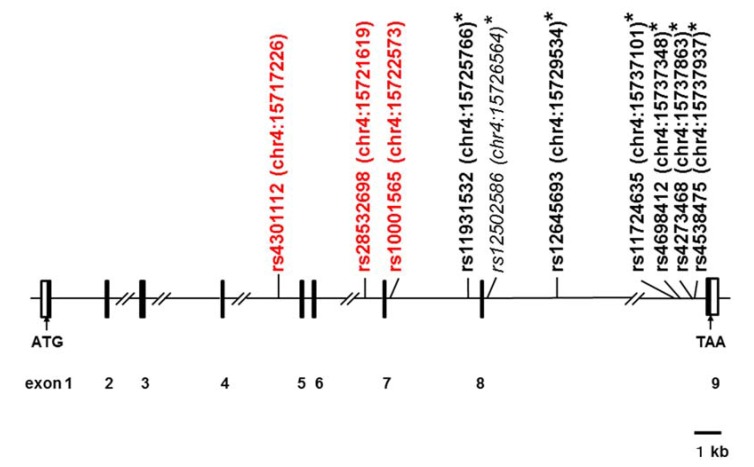
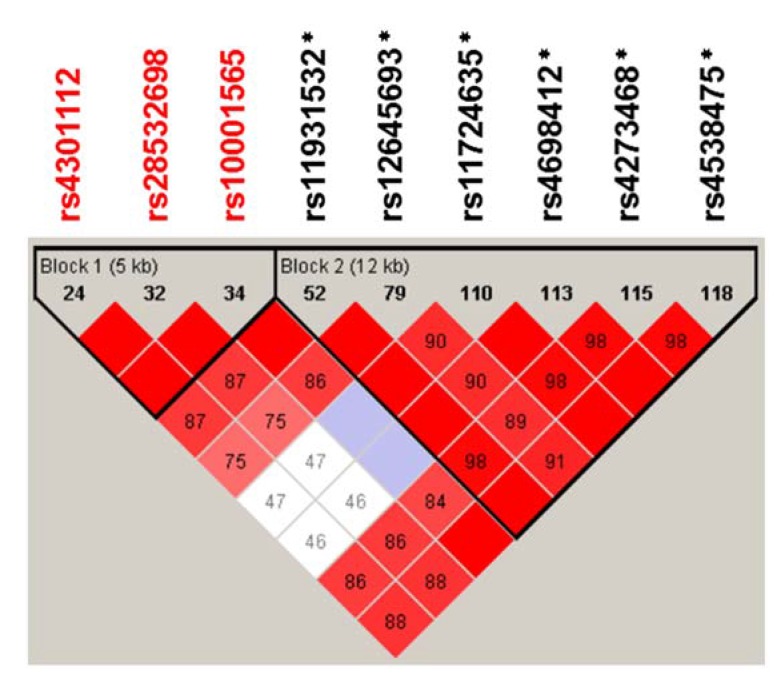
CD157, also referred to as bone marrow stromal cell antigen-1 (BST-1), is a glycosylphosphatidylinositol-anchored molecule that promotes pre-B-cell growth. Previous studies have reported associations between single-nucleotide polymorphisms (SNPs) of the CD157/BST1 gene with Parkinson's disease. In an attempt to determine whether SNPs or haplotypes in the CD157/BST1 are associated with other brain disorders, we performed a case-control study including 147 autism spectrum disorder (ASD) patients at Kanazawa University Hospital in Japan and 150 unselected Japanese volunteers by the sequence-specific primer-polymerase chain reaction method combined with fluorescence correlation spectroscopy. Of 93 SNPs examined, two SNPs showed significantly higher allele frequencies in cases with ASDs than in unaffected controls (rs4301112, OR = 6.4, 95% CI = 1.9 to 22, p = 0.0007; and rs28532698, OR = 6.2, 95% CI = 1.8 to 21, p = 0.0012; Fisher's exact test; p < 0.002 was considered significant after multiple testing correction). In addition, CT genotype in rs10001565 was more frequently observed in the ASD group than in the control group (OR = 15, 95% CI = 2.0 to 117, p = 0.0007; Fisher's exact test). The present data indicate that genetic variation of the CD157/BST1 gene might confer susceptibility to ASDs.
CD157,也被称为骨髓基质细胞抗原-1(BST-1),是一种糖基磷脂酰肌醇锚定分子,可促进前B细胞生长。先前的研究报道了CD157/BST1基因的单核苷酸多态性(SNP)与帕金森病之间的关联。为了确定CD157/BST1中的SNP或单倍型是否与其他脑部疾病相关,我们采用序列特异性引物-聚合酶链反应方法结合荧光相关光谱技术,对日本金泽大学医院的147例自闭症谱系障碍(ASD)患者和150名未经过挑选的日本志愿者进行了病例对照研究。在所检测的93个SNP中,有两个SNP在ASD患者中的等位基因频率显著高于未受影响的对照组(rs4301112,比值比[OR]=6.4,95%置信区间[CI]=1.9至22,p=0.0007;以及rs28532698,OR=6.2,95%CI=1.8至21,p=0.0012;Fisher精确检验;经过多重检验校正后,p<0.002被认为具有显著性)。此外,rs10001565的CT基因型在ASD组中的出现频率高于对照组(OR=15,95%CI=2.0至117,p=0.0007;Fisher精确检验)。目前的数据表明,CD157/BST1基因的遗传变异可能会使个体易患ASD。