Karsanina Marina V, Gerke Kirill M, Skvortsova Elena B, Mallants Dirk
Institute of Geospheres Dynamics of the Russian Academy of Sciences, Moscow, Russia; AIR Technology, Moscow, Russia.
CSIRO Land and Water, Adelaide, South Australia, Australia.
PLoS One. 2015 May 26;10(5):e0126515. doi: 10.1371/journal.pone.0126515. eCollection 2015.
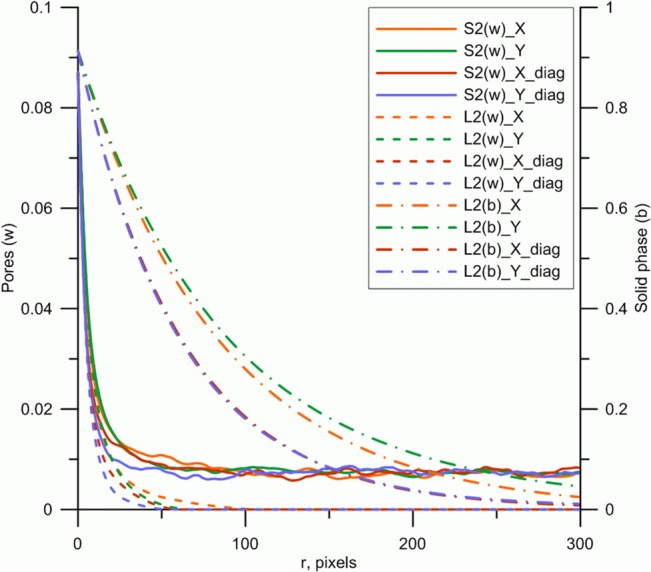
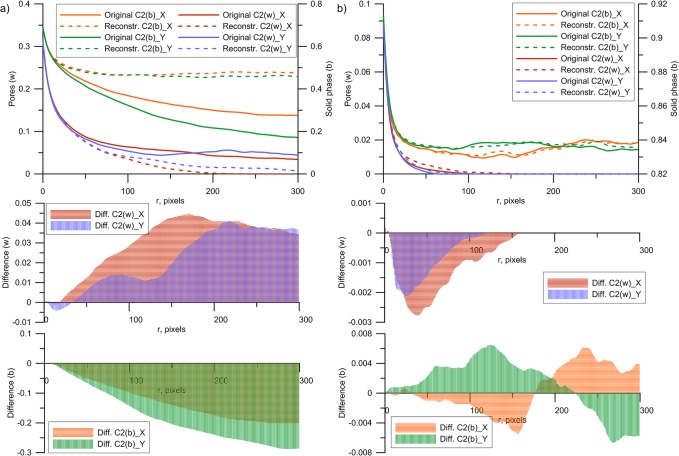
Structural features of porous materials such as soil define the majority of its physical properties, including water infiltration and redistribution, multi-phase flow (e.g. simultaneous water/air flow, or gas exchange between biologically active soil root zone and atmosphere) and solute transport. To characterize soil microstructure, conventional soil science uses such metrics as pore size and pore-size distributions and thin section-derived morphological indicators. However, these descriptors provide only limited amount of information about the complex arrangement of soil structure and have limited capability to reconstruct structural features or predict physical properties. We introduce three different spatial correlation functions as a comprehensive tool to characterize soil microstructure: 1) two-point probability functions, 2) linear functions, and 3) two-point cluster functions. This novel approach was tested on thin-sections (2.21×2.21 cm2) representing eight soils with different pore space configurations. The two-point probability and linear correlation functions were subsequently used as a part of simulated annealing optimization procedures to reconstruct soil structure. Comparison of original and reconstructed images was based on morphological characteristics, cluster correlation functions, total number of pores and pore-size distribution. Results showed excellent agreement for soils with isolated pores, but relatively poor correspondence for soils exhibiting dual-porosity features (i.e. superposition of pores and micro-cracks). Insufficient information content in the correlation function sets used for reconstruction may have contributed to the observed discrepancies. Improved reconstructions may be obtained by adding cluster and other correlation functions into reconstruction sets. Correlation functions and the associated stochastic reconstruction algorithms introduced here are universally applicable in soil science, such as for soil classification, pore-scale modelling of soil properties, soil degradation monitoring, and description of spatial dynamics of soil microbial activity.
诸如土壤之类的多孔材料的结构特征决定了其大部分物理性质,包括水分入渗和再分布、多相流(例如水/气同时流动,或生物活性土壤根区与大气之间的气体交换)以及溶质运移。为了表征土壤微观结构,传统土壤科学使用诸如孔径和孔径分布以及薄片衍生的形态学指标等度量。然而,这些描述符仅提供了关于土壤结构复杂排列的有限信息,并且重建结构特征或预测物理性质的能力有限。我们引入了三种不同的空间相关函数作为表征土壤微观结构的综合工具:1)两点概率函数,2)线性函数,3)两点聚类函数。这种新方法在代表具有不同孔隙空间构型的八种土壤的薄片(2.21×2.21平方厘米)上进行了测试。随后,两点概率和线性相关函数被用作模拟退火优化程序的一部分来重建土壤结构。基于形态特征、聚类相关函数、孔隙总数和孔径分布对原始图像和重建图像进行了比较。结果表明,对于具有孤立孔隙的土壤,一致性极佳,但对于具有双孔隙特征(即孔隙与微裂纹叠加)的土壤,对应性相对较差。用于重建的相关函数集中信息含量不足可能是导致观察到的差异的原因。通过将聚类和其他相关函数添加到重建集中,可能会获得更好的重建效果。这里介绍的相关函数和相关的随机重建算法在土壤科学中具有普遍适用性,例如用于土壤分类、土壤性质的孔隙尺度建模、土壤退化监测以及土壤微生物活动空间动态的描述。