Martins-Júnior Helio A, Simas Rosineide C, Brolio Marina P, Ferreira Christina R, Perecin Felipe, Nogueira Guilherme de P, Miglino Maria A, Martins Daniele S, Eberlin Marcos N, Ambrósio Carlos E
ThoMSon Mass Spectrometry Laboratory-Institute of Chemistry, University of Campinas (UNICAMP), Campinas, São Paulo, Brazil; AB SCIEX of Brazil, São Paulo, São Paulo, Brazil.
ThoMSon Mass Spectrometry Laboratory-Institute of Chemistry, University of Campinas (UNICAMP), Campinas, São Paulo, Brazil; DAPSA, Faculty of Veterinary Medicine, São Paulo State University-UNESP, Araçatuba, São Paulo, Brazil.
PLoS One. 2015 May 26;10(5):e0126585. doi: 10.1371/journal.pone.0126585. eCollection 2015.
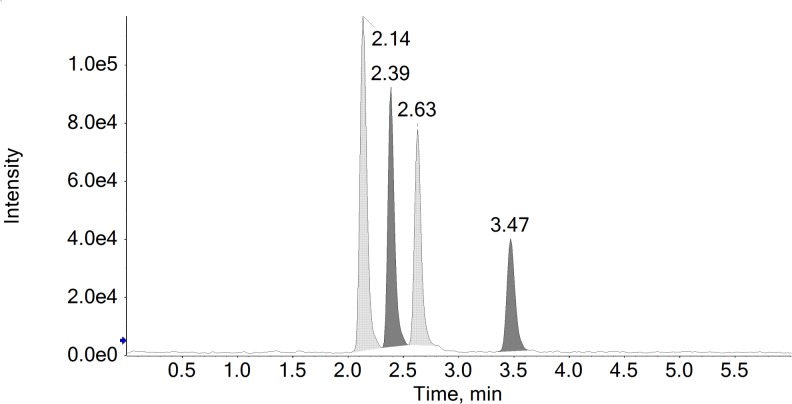
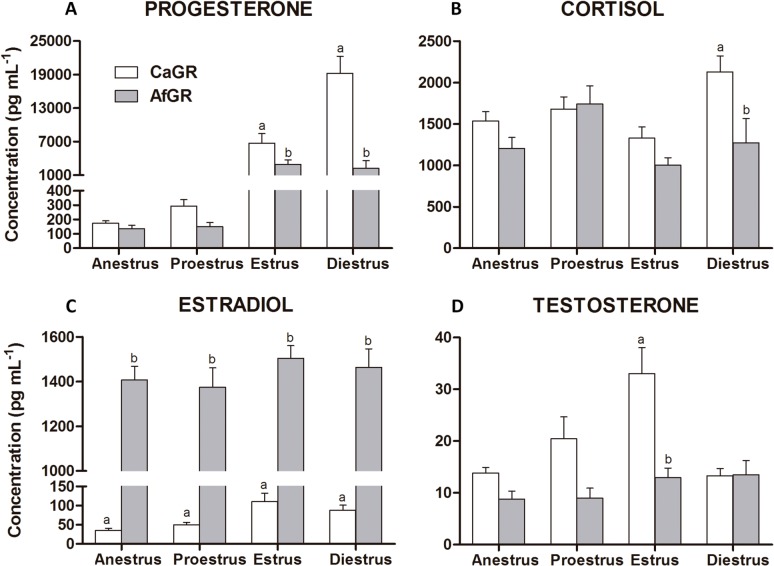
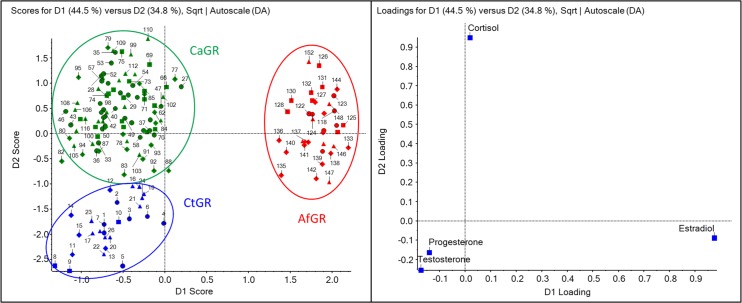
Golden retriever muscular dystrophy (GRMD) provides the best animal model for characterizing the disease progress of the human disorder, Duchenne muscular dystrophy (DMD). The purpose of this study was to determine steroid hormone concentration profiles in healthy golden retriever dogs (control group - CtGR) versus GRMD-gene carrier (CaGR) and affected female dogs (AfCR). Therefore, a sensitive and specific analytical method was developed and validated to determine the estradiol, progesterone, cortisol, and testosterone levels in the canine serum by isotope dilution liquid chromatography coupled with tandem mass spectrometry (LC-MS/MS). To more accurately understand the dynamic nature of the serum steroid profile, the fluctuating levels of these four steroid hormones over the estrous cycle were compared across the three experimental groups using a multivariate statistical analysis. The concentration profiles of estradiol, cortisol, progesterone, and testosterone revealed a characteristic pattern for each studied group at each specific estrous phase. Additionally, several important changes in the serum concentrations of cortisol and estradiol in the CaGR and AfCR groups seem to be correlated with the status and progression of the muscular dystrophy. A comprehensive and quantitative monitoring of steroid profiles throughout the estrous cycle of normal and GRMD dogs were achieved. Significant differences in these profiles were observed between GRMD and healthy animals, most notably for estradiol. These findings contribute to a better understanding of both dog reproduction and the muscular dystrophy pathology. Our data open new venues for hormonal behavior studies in dystrophinopathies and that may affect the quality of life of DMD patients.
金毛寻回犬肌营养不良症(GRMD)为表征人类疾病杜兴氏肌营养不良症(DMD)的疾病进展提供了最佳动物模型。本研究的目的是确定健康金毛寻回犬(对照组 - CtGR)与GRMD基因携带者(CaGR)及患病母犬(AfCR)的类固醇激素浓度概况。因此,开发并验证了一种灵敏且特异的分析方法,通过同位素稀释液相色谱 - 串联质谱法(LC-MS/MS)测定犬血清中的雌二醇、孕酮、皮质醇和睾酮水平。为了更准确地了解血清类固醇概况的动态性质,使用多变量统计分析比较了这三种实验组在发情周期中这四种类固醇激素的波动水平。雌二醇、皮质醇、孕酮和睾酮的浓度概况在每个特定发情阶段显示出每个研究组的特征模式。此外,CaGR组和AfCR组中皮质醇和雌二醇血清浓度的一些重要变化似乎与肌营养不良症的状态和进展相关。实现了对正常犬和GRMD犬整个发情周期类固醇概况的全面定量监测。在GRMD犬和健康动物之间观察到这些概况存在显著差异,最明显的是雌二醇。这些发现有助于更好地理解犬类繁殖和肌营养不良症病理学。我们的数据为肌营养不良症的激素行为研究开辟了新途径,这可能会影响DMD患者的生活质量。