Chebli K, Gattoni R, Schmitt P, Hildwein G, Stevenin J
Unité 184 de Biologie Moléculaire et de Génie Génétique de l'Institut National de la Santé et de la Recherche Médicale, Faculté de Médecine, Strasbourg, France.
Mol Cell Biol. 1989 Nov;9(11):4852-61. doi: 10.1128/mcb.9.11.4852-4861.1989.
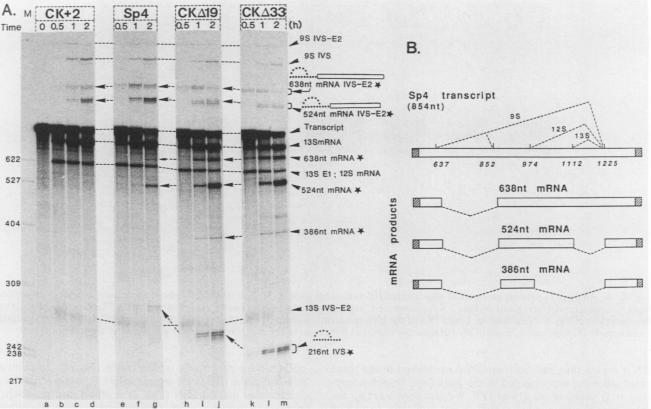
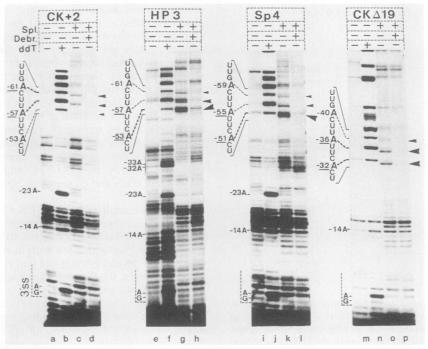
A recently characterized 216-nucleotide intron-splicing reaction occurs within the adenovirus E1A pre-mRNA through the use of three branch acceptor sites, located at 59, 55, and 51 nucleotides from the 3' splice site. To investigate the role of the cis-acting sequence elements in the selection of such unusually distant branch sites, transcripts differing in sequence downstream of the branch sites were analyzed for in vitro splicing. Initial results suggested that secondary structure could be involved in the use of distant branch sites. The involvement of a hairpin structure, including a nine-G C-base-pair stem, was supported by the results of site-directed mutagenesis analyses. Mutations that destroyed or weakened this hairpin resulted in an inefficient splicing reaction. In contrast, complementary mutation or deletion of two bulges, which involved a restoration or reinforcement of the hairpin, resulted in a reactivation or improvement of the splicing efficiency, respectively. Therefore, we conclude that the hairpin structure shortens the operational distance between the 3' splice site and the branch acceptors and brings the branch sites into the branch-permissive window, 18 to 40 nucleotides upstream of the 3' splice site. Our results confirm the importance of the constraint of distance for the splicing reaction and show that this constraint may be overcome by means of a stable hairpin formation.
最近发现腺病毒E1A前体mRNA内发生了一种216个核苷酸的内含子剪接反应,该反应利用了三个分支接受位点,它们位于距3'剪接位点59、55和51个核苷酸处。为了研究顺式作用序列元件在选择如此异常遥远的分支位点中的作用,对分支位点下游序列不同的转录本进行了体外剪接分析。初步结果表明,二级结构可能参与了遥远分支位点的利用。定点诱变分析结果支持了一种发夹结构的参与,该结构包括一个九个G-C碱基对的茎。破坏或削弱这种发夹的突变导致剪接反应效率低下。相反,涉及发夹恢复或增强的两个凸起的互补突变或缺失,分别导致剪接效率的重新激活或提高。因此,我们得出结论,发夹结构缩短了3'剪接位点与分支接受位点之间的操作距离,并将分支位点带入3'剪接位点上游18至40个核苷酸的分支允许窗口。我们的结果证实了距离限制对剪接反应的重要性,并表明这种限制可以通过稳定的发夹形成来克服。