Todorovska Elena, Ivanova Albena, Ganeva Daniela, Pevicharova Galina, Molle Emil, Bojinov Bojin, Radkova Mariana, Danailov Zhivko
Agricultural Academy, AgroBioInstitute , Sofia , Bulgaria.
Agricultural Academy, Maritsa Vegetable Crops Research Institute , Plovdiv , Bulgaria.
Biotechnol Biotechnol Equip. 2014 Jan 2;28(1):68-76. doi: 10.1080/13102818.2014.901683.
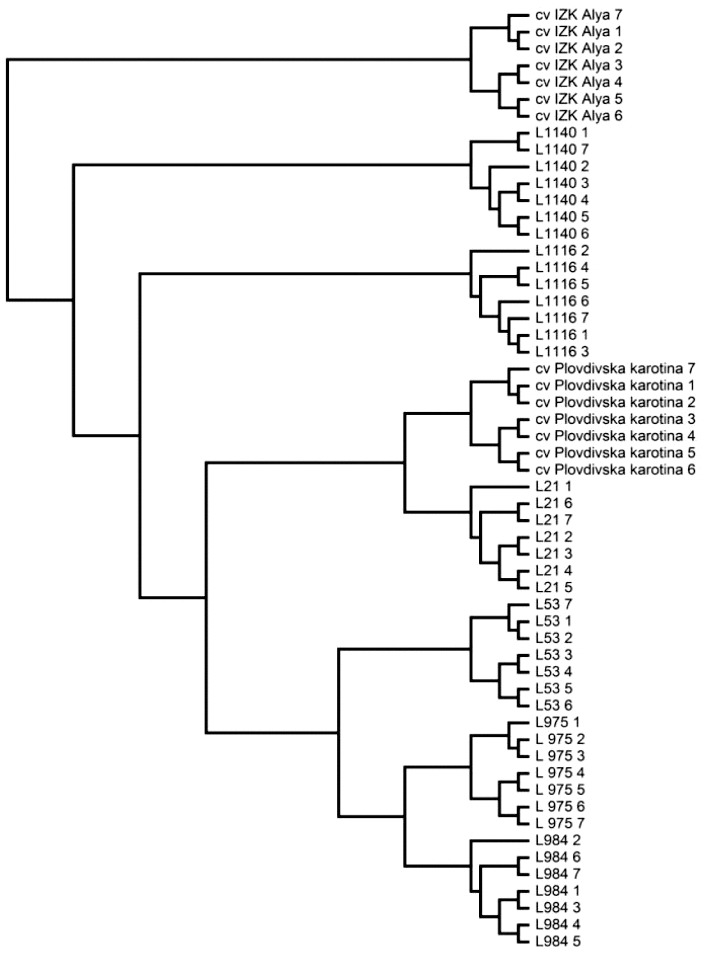
Genetic variability in modern crops is limited due to domestication and selection processes. Genetic variation in eight Bulgarian tomato varieties and breeding lines (variety Plovdivska karotina, variety IZK Alya, L21β, L53β, L1140, L1116, L975, L984) differing in their morphological and biochemical composition was assessed using a highly efficient and low-cost fluorescent simple sequence repeat (SSR) genotyping platform. Genotyping was conducted with 165 publicly available microsatellite markers developed from different research groups under a number of projects in tomato (SOL Genomics SSRs, Kazusa TGS and TES, SLM, TMS and LEMDDNa) among which only five (3.03%) failed to amplify the expected PCR fragments. Of the remaining markers, 81 (50.62%) were polymorphic in the whole collection of eight genotypes. Among the marker groups used, SLM markers were most polymorphic, followed by TMS and SOL Genomics SSR markers. The total number of amplified alleles was 299, with a mean of 1.869; and the average polymorphic information content () was 0.196. The genetic diversity within the collection was relatively low (0.2222). Nei's genetic distance varied from 0.0953 to 0.3992. Cluster analysis using the un-weighted pair group method with arithmetic mean (UPGMA) method indicated that the studied tomato genotypes are grouped in four main clusters, which is to some extent consistent with the morpho- and hemo-types of the studied tomatoes. Variety IZK Alya (cherry type) and two of the breeding lines (L1140, L1116) formed three separate and more distant clusters. The fourth cluster includes the other five genotypes. The observed grouping of these genotypes in two sub-clusters reflects their similar morphological and biochemical composition. The genetic distance information from this study might be useful for further implementation of breeding strategies and crosses among these inbred lines.
由于驯化和选择过程,现代作物的遗传变异性有限。利用高效低成本的荧光简单序列重复(SSR)基因分型平台,对八个保加利亚番茄品种和育种系(品种Plovdivska karotina、品种IZK Alya、L21β、L53β、L1140、L1116、L975、L984)在形态和生化组成上的遗传变异进行了评估。使用了165个公开可用的微卫星标记进行基因分型,这些标记由不同研究小组在多个番茄项目(SOL基因组SSR、Kazusa TGS和TES、SLM、TMS和LEMDDNa)下开发,其中只有五个(3.03%)未能扩增出预期的PCR片段。在其余标记中,81个(50.62%)在八个基因型的整个集合中具有多态性。在所使用的标记组中,SLM标记多态性最高,其次是TMS和SOL基因组SSR标记。扩增等位基因的总数为299个,平均为1.869个;平均多态信息含量()为0.196。该集合内的遗传多样性相对较低(0.2222)。Nei氏遗传距离在0.0953至0.3992之间。使用非加权组平均法(UPGMA)进行的聚类分析表明,所研究的番茄基因型分为四个主要聚类,这在一定程度上与所研究番茄的形态和血型一致。品种IZK Alya(樱桃型)和两个育种系(L1140、L1116)形成了三个独立且距离较远的聚类。第四个聚类包括其他五个基因型。这些基因型在两个子聚类中的观察分组反映了它们相似的形态和生化组成。本研究的遗传距离信息可能有助于进一步实施育种策略以及这些自交系之间的杂交。