
利用附着有表达有机磷水解酶的大肠杆菌的单壁碳纳米管薄膜对对氧磷进行光学检测。
Optical detection of paraoxon using single-walled carbon nanotube films with attached organophosphorus hydrolase-expressed Escherichia coli.
作者信息
Kim Intae, Kim Geon Hwee, Kim Chang Sup, Cha Hyung Joon, Lim Geunbae
机构信息
Department of Mechanical Engineering, Pohang University of Science and Technology, 77 Cheongam-Ro, Nam-Gu, Pohang, Gyeongbuk 790-784, Korea.
School of Biotechnology and Graduate School of Biochemistry, Yeungnam Univerisity, 280 Daehak-Ro, Gyeongsan, Gyeongbuk 712-749, Korea.
出版信息
Sensors (Basel). 2015 May 27;15(6):12513-25. doi: 10.3390/s150612513.
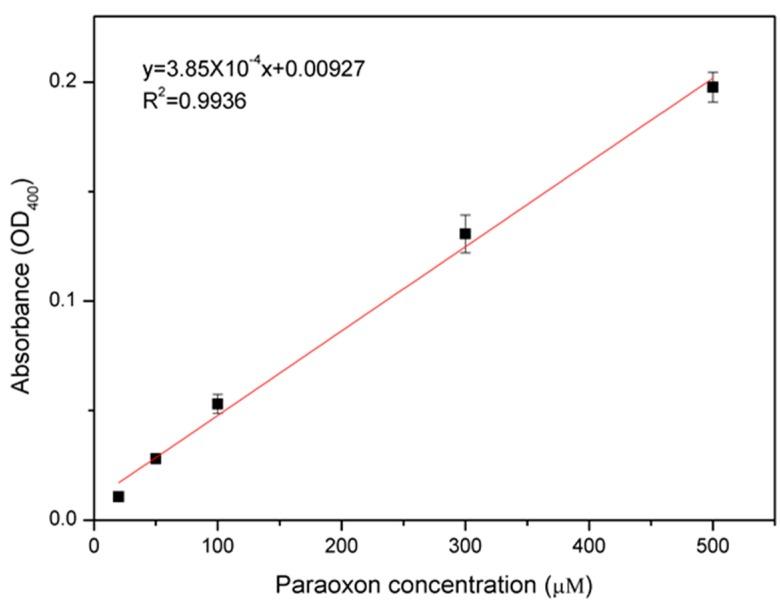
In whole-cell based biosensors, spectrophotometry is one of the most commonly used methods for detecting organophosphates due to its simplicity and reliability. The sensor performance is directly affected by the cell immobilization method because it determines the amount of cells, the mass transfer rate, and the stability. In this study, we demonstrated that our previously-reported microbe immobilization method, a microbe-attached single-walled carbon nanotube film, can be applied to whole-cell-based organophosphate sensors. This method has many advantages over other whole-cell organophosphate sensors, including high specific activity, quick cell immobilization, and excellent stability. A device with circular electrodes was fabricated for an enlarged cell-immobilization area. Escherichia coli expressing organophosphorus hydrolase in the periplasmic space and single-walled carbon nanotubes were attached to the device by our method. Paraoxon was hydrolyzed using this device, and detected by measuring the concentration of the enzymatic reaction product, p-nitrophenol. The specific activity of our device was calculated, and was shown to be over 2.5 times that reported previously for other whole-cell organophosphate sensors. Thus, this method for generation of whole-cell-based OP biosensors might be optimal, as it overcomes many of the caveats that prevent the widespread use of other such devices.
在基于全细胞的生物传感器中,分光光度法因其简单性和可靠性,是检测有机磷化合物最常用的方法之一。传感器性能直接受细胞固定方法影响,因为该方法决定了细胞数量、传质速率和稳定性。在本研究中,我们证明了我们先前报道的微生物固定方法——附着微生物的单壁碳纳米管薄膜,可应用于基于全细胞的有机磷传感器。该方法相对于其他基于全细胞的有机磷传感器具有许多优点,包括高比活性、快速细胞固定和出色的稳定性。制造了一种带有圆形电极的装置,以扩大细胞固定面积。通过我们的方法将在周质空间表达有机磷水解酶的大肠杆菌和单壁碳纳米管附着到该装置上。使用该装置水解对氧磷,并通过测量酶促反应产物对硝基苯酚的浓度进行检测。计算了我们装置的比活性,结果表明其比活性是先前报道的其他基于全细胞的有机磷传感器的2.5倍以上。因此,这种用于生成基于全细胞的有机磷生物传感器的方法可能是最佳的,因为它克服了许多阻碍其他此类装置广泛应用的问题。


 Zotero 插件