Hoffmann Anke, Zimmermann Christoph A, Spengler Dietmar
Translational Research, Max Planck Society, Max Planck Institute of Psychiatry Munich, Bavaria, Germany.
Front Behav Neurosci. 2015 May 13;9:120. doi: 10.3389/fnbeh.2015.00120. eCollection 2015.
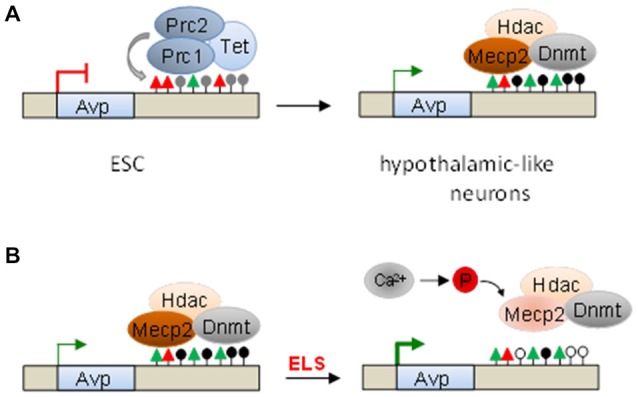
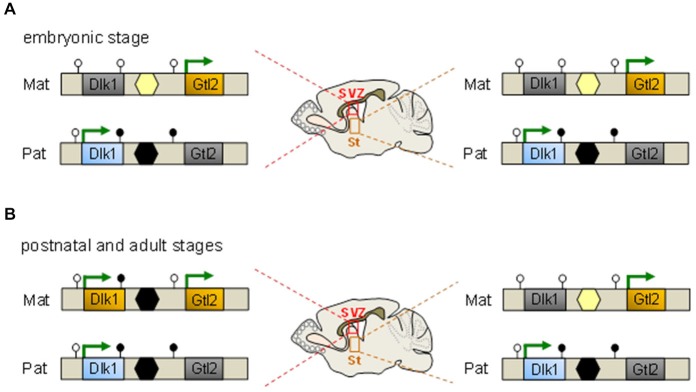
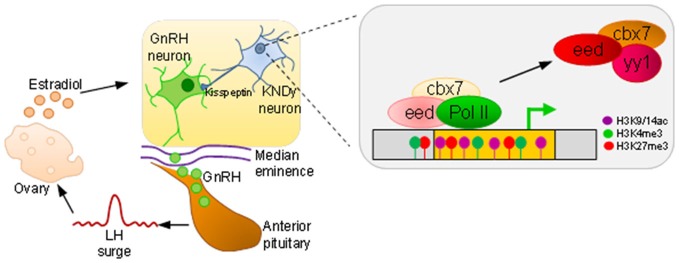
Epigenetic mechanisms encode information above and beyond DNA sequence and play a critical role in brain development and the long-lived effects of environmental cues on the pre- and postnatal brain. Switch-like, rather than graded changes, illustrate par excellence how epigenetic events perpetuate altered activity states in the absence of the initial cue. They occur from early neural development to maturation and can give rise to distinct diseases upon deregulation. Many neurodevelopmental genes harbor bivalently marked chromatin domains, states of balanced inhibition, which guide dynamic "ON or OFF" decisions once the balance is tilted in response to developmental or environmental cues. Examples discussed in this review include neuronal differentiation of embryonic stem cells (ESC) into progenitors and beyond, activation of Kiss1 at puberty onset, and early experience-dependent programming of Avp, a major stress gene. At the genome-scale, genomic imprinting can be epigenetically switched on or off at select genes in a tightly controlled temporospatial manner and provides a versatile mechanism for dosage regulation of genes with important roles in stem cell quiescence or differentiation. Moreover, retrotransposition in neural progenitors provides an intriguing example of an epigenetic-like switch, which is stimulated by bivalently marked neurodevelopmental genes and possibly results in increased genomic flexibility regarding unprecedented challenge. Overall, we propose that molecular epigenetic switches illuminate the catalyzing function of epigenetic mechanisms in guiding dynamic changes in gene expression underpinning robust transitions in cellular and organismal phenotypes as well as in the mediation between dynamically changing environments and the static genetic blueprint.
表观遗传机制编码的信息超越了DNA序列,在大脑发育以及环境线索对产前和产后大脑的长期影响中发挥着关键作用。类似开关的变化,而非渐变,最能说明表观遗传事件如何在初始线索不存在的情况下使改变的活动状态持续存在。它们发生于早期神经发育到成熟阶段,一旦失调,可能引发不同的疾病。许多神经发育基因具有双价标记的染色质结构域,即平衡抑制状态,一旦这种平衡因发育或环境线索而倾斜,就会引导动态的“开或关”决策。本综述中讨论的例子包括胚胎干细胞(ESC)向祖细胞及更高级细胞的神经元分化、青春期开始时Kiss1的激活,以及主要应激基因Avp的早期经验依赖性编程。在基因组尺度上,基因组印记可以在特定基因上以严格控制的时空方式通过表观遗传进行开启或关闭,为在干细胞静止或分化中起重要作用的基因剂量调节提供了一种通用机制。此外,神经祖细胞中的逆转座提供了一个类似表观遗传开关的有趣例子,它受到双价标记的神经发育基因的刺激,可能导致基因组在应对前所未有的挑战时具有更大的灵活性。总体而言,我们认为分子表观遗传开关阐明了表观遗传机制在指导基因表达动态变化中的催化功能,这种变化支撑着细胞和生物体表型的稳健转变,以及动态变化的环境与静态遗传蓝图之间的调节作用。