Oue Naohide, Sentani Kazuhiro, Sakamoto Naoya, Yasui Wataru
Department of Molecular Pathology, Institute of Biomedical and Health Sciences, Hiroshima University, Hiroshima, Japan.
Cancer Sci. 2015 Aug;106(8):951-8. doi: 10.1111/cas.12706. Epub 2015 Jul 7.
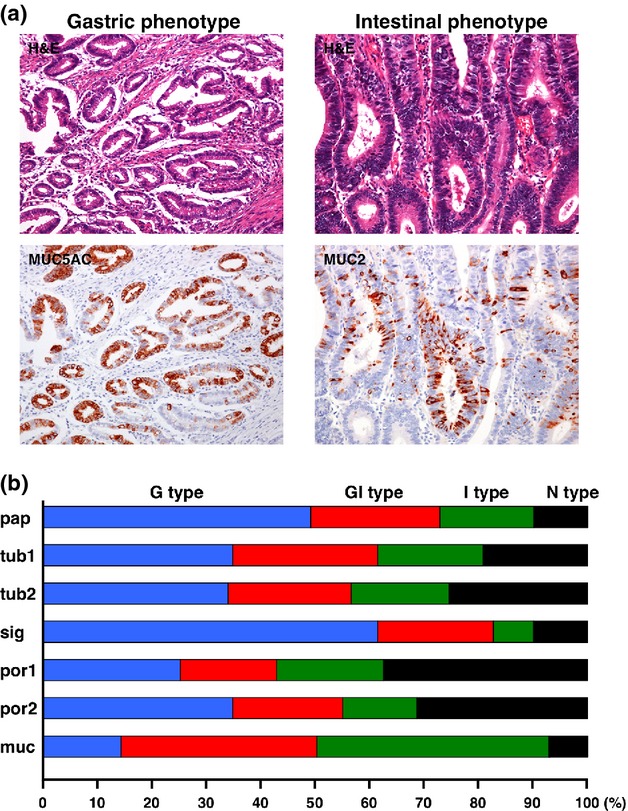
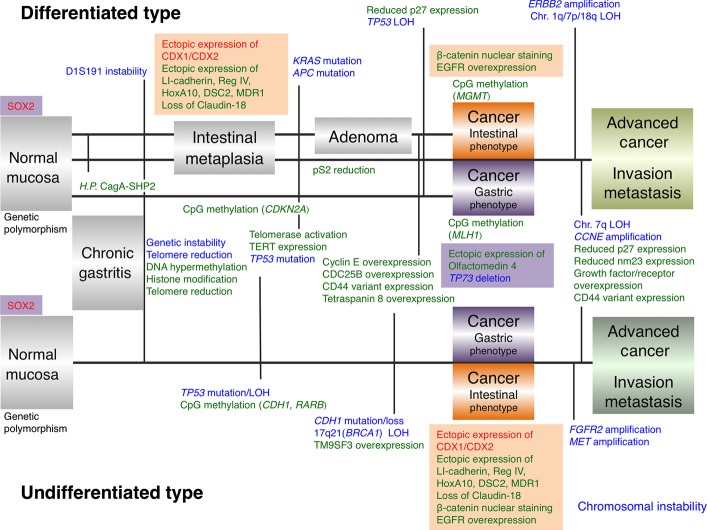
Gastric cancer (GC), one of the most common human cancers, can be classified into gastric or intestinal phenotype according to mucin expression. TP53 mutation, allelic deletion of the APC gene and nuclear staining of β-catenin are frequently detected in the intestinal phenotype of GC, whereas CDH1 gene mutation, microsatellite instability and DNA hypermethylation of MLH1 are common events in the gastric phenotype of GC. Our Serial Analysis of Gene Expression (SAGE) and Escherichia coli ampicillin secretion trap (CAST) analyses revealed that CDH17, REG4, OLFM4, HOXA10, DSC2, TSPAN8 and TM9SF3 are upregulated in GC and that CLDN18 is downregulated in GC. Expression of CDH17, REG4, HOXA10 and DSC2 and downregulation of CLDN18 are observed in the intestinal phenotype of GC. In contrast, OLFM4 is expressed in the gastric phenotype of GC. Expression of TSPAN8, TM9SF3 and HER2 are not associated with either gastric or intestinal phenotypes. Ectopic CDX2 expression plays a key function in the GC intestinal phenotype. MUC2, CDH17, REG4, DSC2 and ABCB1 are direct targets of CDX2. Importantly, these genes encode transmembrane/secretory proteins, indicating that the microenvironment as well as cancer cells are also different between gastric and intestinal phenotypes of GC.
胃癌(GC)是人类最常见的癌症之一,可根据黏蛋白表达分为胃型或肠型。TP53突变、APC基因的等位基因缺失以及β-连环蛋白的核染色在GC的肠型中经常被检测到,而CDH1基因突变、微卫星不稳定性和MLH1的DNA高甲基化是GC胃型中的常见事件。我们的基因表达系列分析(SAGE)和大肠杆菌氨苄青霉素分泌陷阱(CAST)分析显示,CDH17、REG4、OLFM4、HOXA10、DSC2、TSPAN8和TM9SF3在GC中上调,而CLDN18在GC中下调。在GC的肠型中观察到CDH17、REG4、HOXA10和DSC2的表达以及CLDN18的下调。相反,OLFM4在GC的胃型中表达。TSPAN8、TM9SF3和HER2的表达与胃型或肠型均无关。异位CDX2表达在GC肠型中起关键作用。MUC2、CDH17、REG4、DSC2和ABCB1是CDX2的直接靶点。重要的是,这些基因编码跨膜/分泌蛋白,表明GC的胃型和肠型之间的微环境以及癌细胞也存在差异。