Loprinzi Paul D, Cardinal Bradley J, Lee Hyo, Tudor-Locke Catrine
Department of Health, Exercise Science, and Recreation Management, Center for Health Behavior Research, School of Applied Sciences, The University of Mississippi, 215 Turner Center, University, MS USA.
Program in Exercise and Sport Science, School of Biological and Population Health Sciences, College of Public Health and Human Sciences, Oregon State University, Corvallis, OR USA.
J Diabetes Metab Disord. 2015 May 27;14:46. doi: 10.1186/s40200-015-0175-9. eCollection 2015.
The purpose of this study was to examine the association between daily movement patterns and dual energy X-ray absorptiometry-determined body fat percent (DXA-BF%) among children and adolescents while applying both traditional and novel analytical procedures.
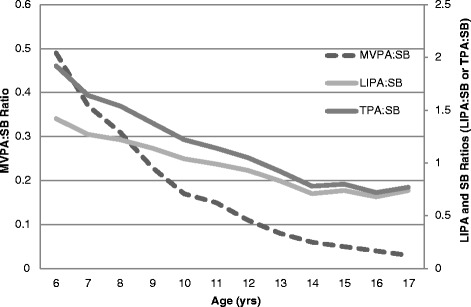
Using data from the cross-sectional 2003-2006 National Health and Nutrition Examination Survey (n = 5607), physical activity was assessed via accelerometry, with the following movement patterns assessed: 1) meeting moderate-to-vigorous physical activity (MVPA) guidelines and engaging in more light-intensity physical activity (LIPA) than sedentary behavior (SB); 2) meeting MVPA guidelines, but engaging in less LIPA than SB; 3) not meeting MVPA guidelines, but engaging in more LIPA than SB; and 4) not meeting MVPA guidelines and engaging in less LIPA than SB. Various markers of adiposity (e.g., DXA-BF%) were assessed.
Children in movement pattern 1 (52 %), compared to those in movement pattern 4, had significantly lower levels of BMI (∆ 2.2 kg/m(2)), waist circumference (∆ 6.5 cm), tricep skinfold (∆ 4.2 mm), subscapularis skinfold (∆ 2.6 mm), android BF% (∆ 7.6 %), gynoid BF% (∆ 5.1 %), and total BF% (∆ 5.2 %). Substituting 60 min/day of SB with MVPA resulted in a 4.6 % decreased estimate of total DXA-BF%. No findings were significant for adolescents.
The low proportion of children engaging in ≥ 60 min/day of MVPA and accumulating relatively more LIPA than SB had the lowest DXA-BF%.
本研究旨在运用传统和新颖的分析方法,探究儿童和青少年的日常运动模式与双能X线吸收法测定的体脂百分比(DXA-BF%)之间的关联。
利用2003 - 2006年横断面全国健康与营养检查调查(n = 5607)的数据,通过加速度计评估身体活动情况,并对以下运动模式进行评估:1)达到中度至剧烈身体活动(MVPA)指南要求,且进行的轻度身体活动(LIPA)多于久坐行为(SB);2)达到MVPA指南要求,但进行的LIPA少于SB;3)未达到MVPA指南要求,但进行的LIPA多于SB;4)未达到MVPA指南要求,且进行的LIPA少于SB。评估了各种肥胖指标(如DXA-BF%)。
与运动模式4的儿童相比,运动模式1的儿童(52%)的BMI水平显著更低(差值2.2 kg/m²)、腰围(差值6.5 cm)、肱三头肌皮褶厚度(差值4.2 mm)、肩胛下皮褶厚度(差值2.6 mm)、男性型体脂百分比(差值7.6%)、女性型体脂百分比(差值5.1%)和总体脂百分比(差值5.2%)。用MVPA替代每天60分钟的SB,使总DXA-BF%的估计值降低了4.6%。青少年未发现显著结果。
每天进行≥60分钟MVPA且积累的LIPA相对多于SB的儿童比例较低,其DXA-BF%最低。