Church Samuel H, Siebert Stefan, Bhattacharyya Pathikrit, Dunn Casey W
Department of Ecology and Evolutionary Biology, Brown University, Providence, Rhode Island.
J Exp Zool B Mol Dev Evol. 2015 Jul;324(5):435-49. doi: 10.1002/jez.b.22629. Epub 2015 Jun 2.
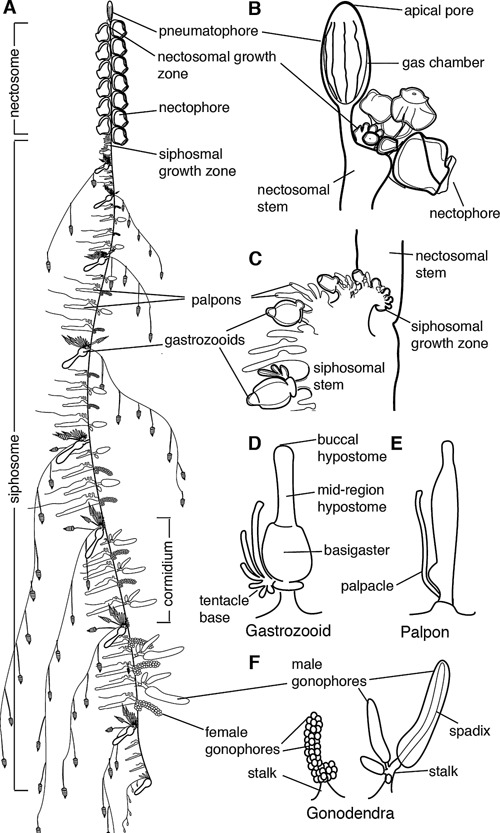
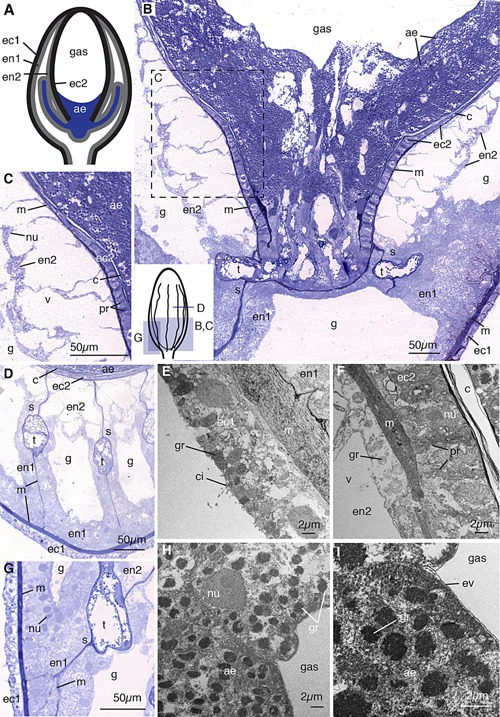
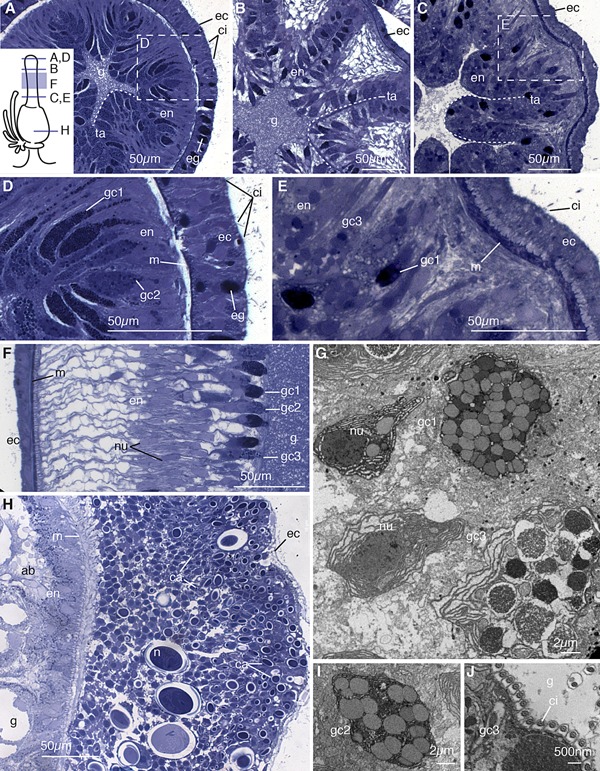
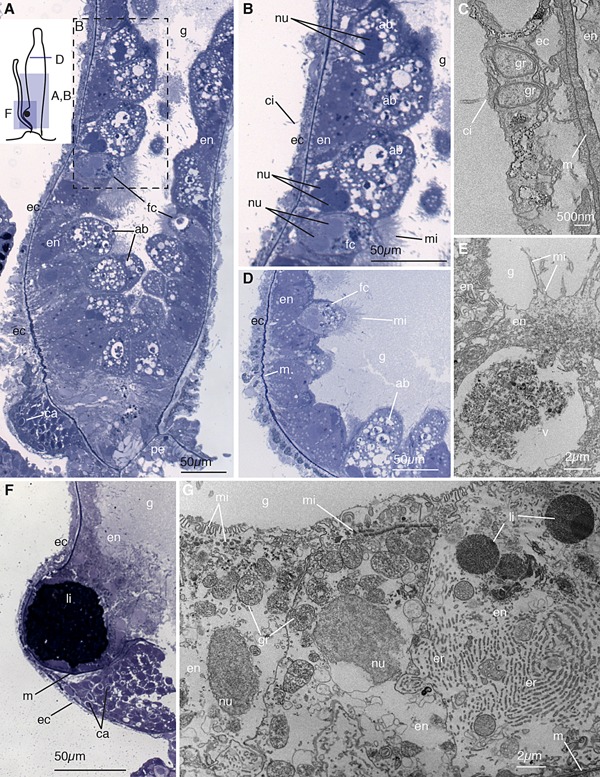
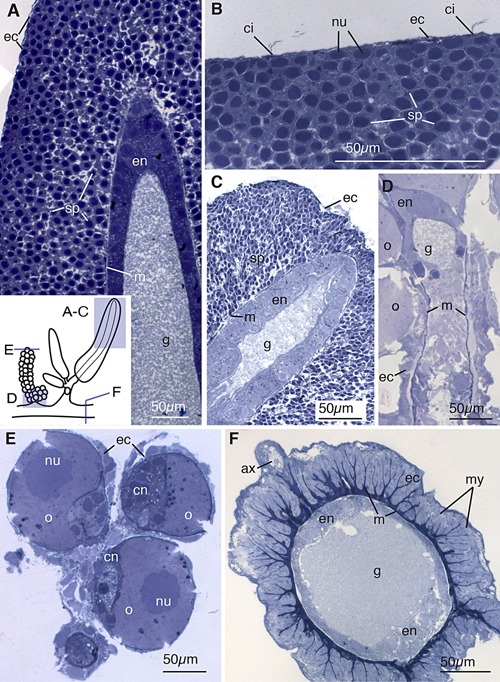
The siphonophore Nanomia bijuga is a pelagic hydrozoan (Cnidaria) with complex morphological organization. Each siphonophore is made up of many asexually produced, genetically identical zooids that are functionally specialized and morphologically distinct. These zooids predominantly arise by budding in two growth zones, and are arranged in precise patterns. This study describes the cellular anatomy of several zooid types, the stem, and the gas-filled float, called the pneumatophore. The distribution of cellular morphologies across zooid types enhances our understanding of zooid function. The unique absorptive cells in the palpon, for example, indicate specialized intracellular digestive processing in this zooid type. Though cnidarians are usually thought of as mono-epithelial, we characterize at least two cellular populations in this species which are not connected to a basement membrane. This work provides a greater understanding of epithelial diversity within the cnidarians, and will be a foundation for future studies on N. bijuga, including functional assays and gene expression analyses.
管水母Nanomia bijuga是一种具有复杂形态结构的远洋水螅虫(刺胞动物门)。每个管水母由许多通过无性繁殖产生的、基因相同的游动孢子组成,这些游动孢子在功能上具有特异性,形态上也各不相同。这些游动孢子主要在两个生长区域通过出芽产生,并以精确的模式排列。本研究描述了几种游动孢子类型、茎以及称为浮囊体的充气浮囊的细胞解剖结构。细胞形态在不同游动孢子类型中的分布增进了我们对游动孢子功能的理解。例如,触须中独特的吸收细胞表明了这种游动孢子类型中专门的细胞内消化过程。尽管刺胞动物通常被认为是单上皮的,但我们在该物种中鉴定出至少两种不与基底膜相连的细胞群体。这项工作使我们对刺胞动物体内上皮多样性有了更深入的了解,并将为未来对Nanomia bijuga的研究奠定基础,包括功能测定和基因表达分析。