Department of Ecology and Evolutionary Biology, Brown University, Providence, RI, USA.
Department of Ecology and Evolutionary Biology, University of California Los Angeles, Los Angeles, CA, USA.
Mol Biol Evol. 2022 Feb 3;39(2). doi: 10.1093/molbev/msac027.
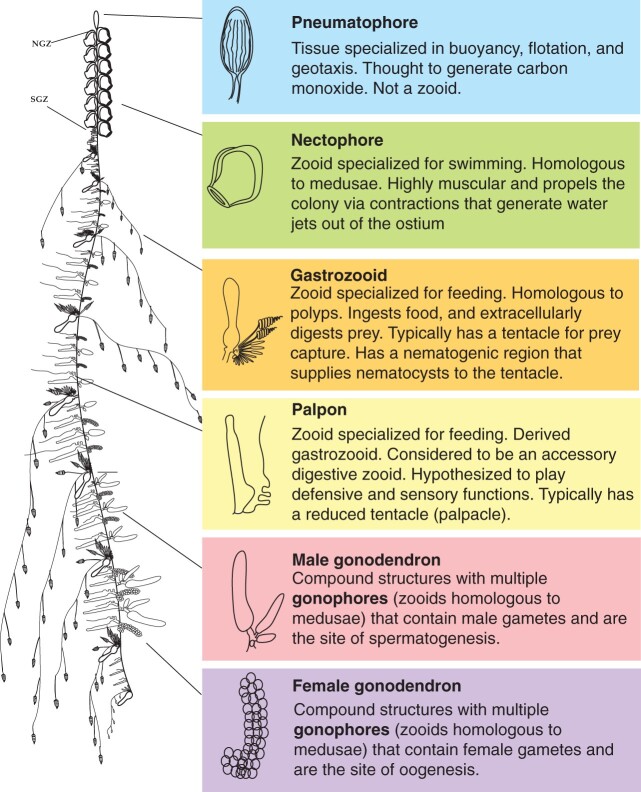
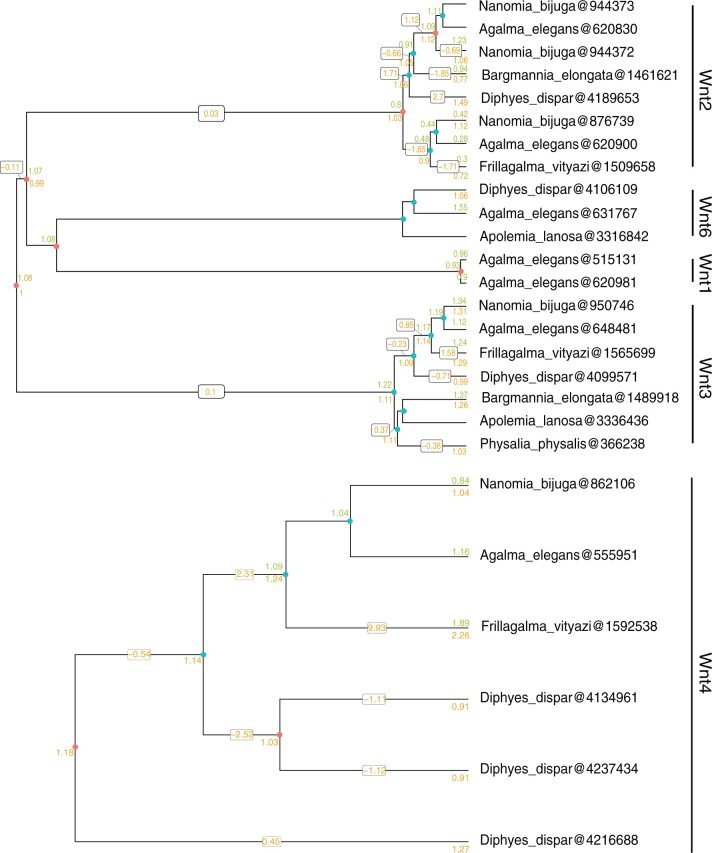
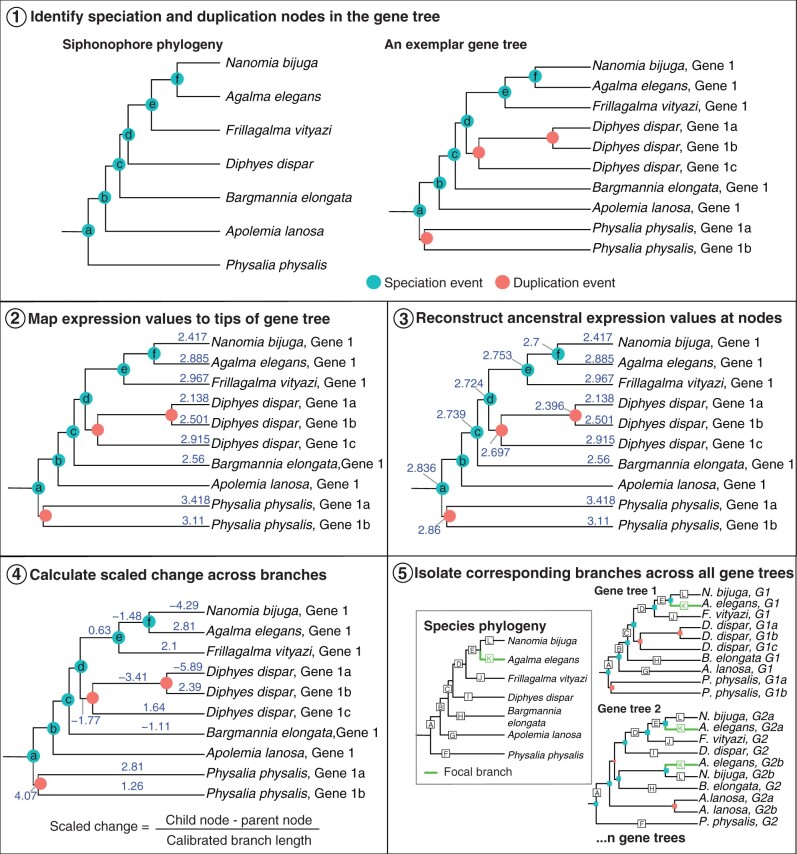
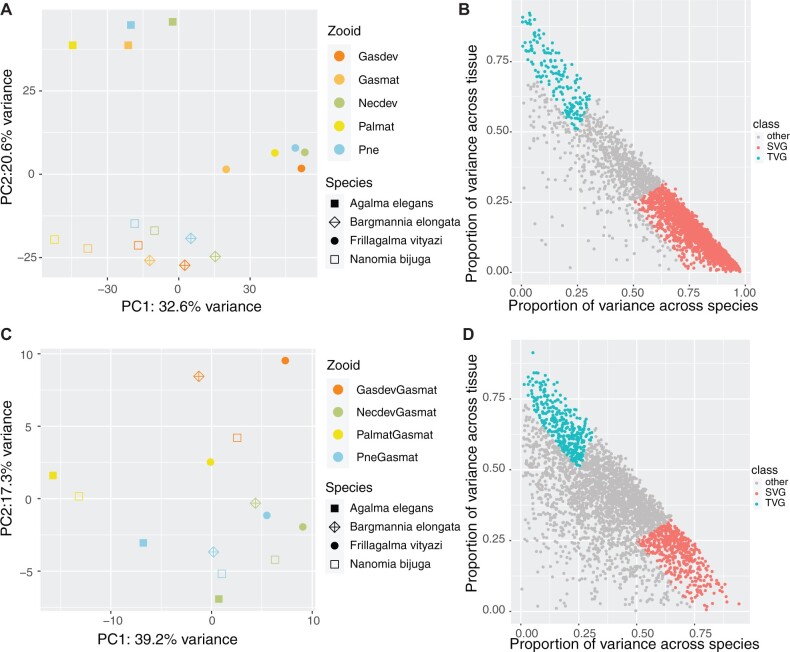
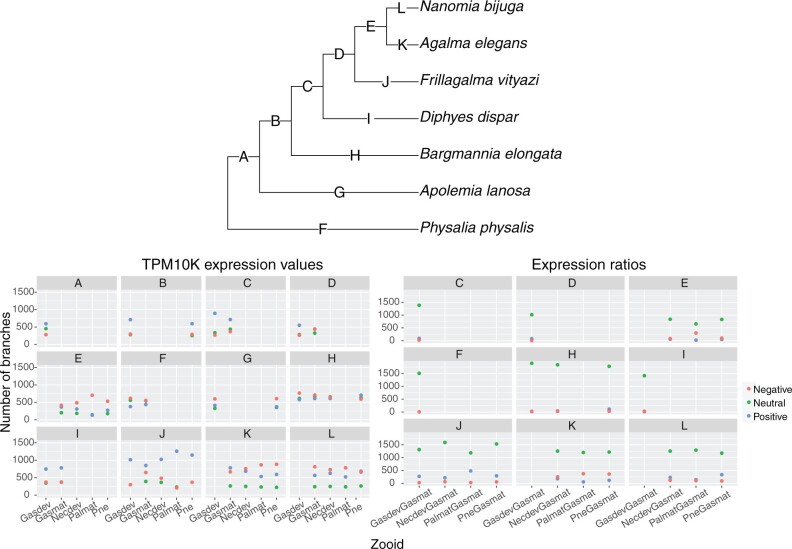
Siphonophores are complex colonial animals, consisting of asexually produced bodies (zooids) that are functionally specialized for specific tasks, including feeding, swimming, and sexual reproduction. Though this extreme functional specialization has captivated biologists for generations, its genomic underpinnings remain unknown. We use RNA-seq to investigate gene expression patterns in five zooids and one specialized tissue across seven siphonophore species. Analyses of gene expression across species present several challenges, including identification of comparable expression changes on gene trees with complex histories of speciation, duplication, and loss. We examine gene expression within species, conduct classical analyses examining expression patterns between species, and introduce species branch filtering, which allows us to examine the evolution of expression across species in a phylogenetic framework. Within and across species, we identified hundreds of zooid-specific and species-specific genes, as well as a number of putative transcription factors showing differential expression in particular zooids and developmental stages. We found that gene expression patterns tended to be largely consistent in zooids with the same function across species, but also some large lineage-specific shifts in gene expression. Our findings show that patterns of gene expression have the potential to define zooids in colonial organisms. Traditional analyses of the evolution of gene expression focus on the tips of gene phylogenies, identifying large-scale expression patterns that are zooid or species variable. The new explicit phylogenetic approach we propose here focuses on branches (not tips) offering a deeper evolutionary perspective into specific changes in gene expression within zooids along all branches of the gene (and species) trees.
水螅体是复杂的群体动物,由无性繁殖的个体(水螅体)组成,这些个体在功能上专门化,用于执行特定任务,包括进食、游泳和有性繁殖。尽管这种极端的功能特化吸引了几代生物学家的注意,但它的基因组基础仍不清楚。我们使用 RNA-seq 来研究七个水螅体物种中的五个水螅体和一个专门组织的基因表达模式。跨物种的基因表达分析存在几个挑战,包括在具有复杂物种形成、复制和丢失历史的基因树上识别可比的表达变化。我们检查了物种内的基因表达,进行了经典分析,研究了物种间的表达模式,并引入了物种分支过滤,这使我们能够在系统发育框架内研究跨物种的表达进化。在物种内和跨物种内,我们鉴定了数百个水螅体特异性和物种特异性基因,以及一些假定的转录因子,它们在特定的水螅体和发育阶段表现出差异表达。我们发现,在具有相同功能的水螅体中,基因表达模式往往在很大程度上是一致的,但也存在一些与大谱系特异性基因表达有关的大变化。我们的研究结果表明,基因表达模式有可能定义群体生物中的水螅体。传统的基因表达进化分析侧重于基因系统发育树的末端,鉴定出具有水螅体或物种变异性的大规模表达模式。我们在这里提出的新的明确的系统发育方法侧重于分支(而不是末端),为特定基因(和物种)树的所有分支内的水螅体中的基因表达的具体变化提供了更深入的进化视角。