Perrin Amandine, Varré Jean-Stéphane, Blanquart Samuel, Ouangraoua Aïda
BMC Genomics. 2015;16 Suppl 5(Suppl 5):S6. doi: 10.1186/1471-2164-16-S5-S6. Epub 2015 May 26.
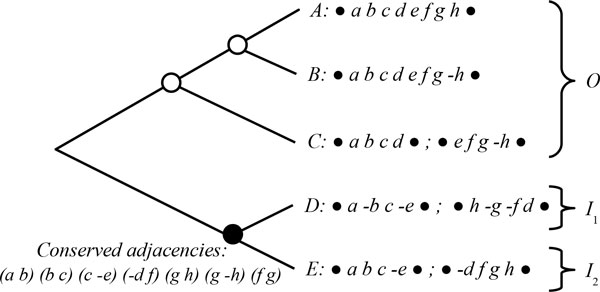
In the context of ancestral gene order reconstruction from extant genomes, there exist two main computational approaches: rearrangement-based, and homology-based methods. The rearrangement-based methods consist in minimizing a total rearrangement distance on the branches of a species tree. The homology-based methods consist in the detection of a set of potential ancestral contiguity features, followed by the assembling of these features into Contiguous Ancestral Regions (CARs).
In this paper, we present a new homology-based method that uses a progressive approach for both the detection and the assembling of ancestral contiguity features into CARs. The method is based on detecting a set of potential ancestral adjacencies iteratively using the current set of CARs at each step, and constructing CARs progressively using a 2-phase assembling method.
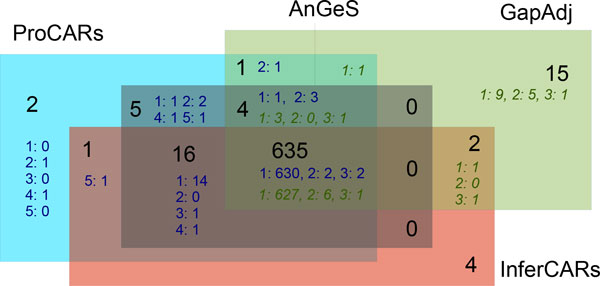
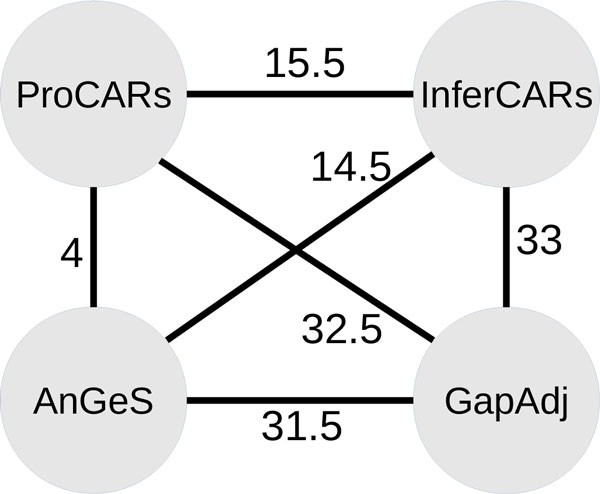
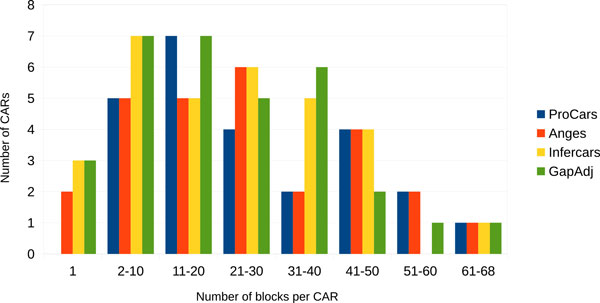
We show the usefulness of the method through a reconstruction of the boreoeutherian ancestral gene order, and a comparison with three other homology-based methods: AnGeS, InferCARs and GapAdj. The program, written in Python, and the dataset used in this paper are available at http://bioinfo.lifl.fr/procars/.
在从现存基因组重建祖先基因顺序的背景下,存在两种主要的计算方法:基于重排的方法和基于同源性的方法。基于重排的方法在于使物种树分支上的总重排距离最小化。基于同源性的方法在于检测一组潜在的祖先邻接特征,然后将这些特征组装成连续祖先区域(CARs)。
在本文中,我们提出了一种新的基于同源性的方法,该方法使用渐进方法来检测祖先邻接特征并将其组装成CARs。该方法基于在每一步使用当前的CARs集迭代检测一组潜在的祖先邻接,并使用两阶段组装方法逐步构建CARs。
我们通过重建北方真兽类祖先基因顺序并与其他三种基于同源性的方法:AnGeS、InferCARs和GapAdj进行比较,展示了该方法的实用性。用Python编写的程序以及本文中使用的数据集可在http://bioinfo.lifl.fr/procars/获取。