Roy-Zokan Eileen M, Cunningham Christopher B, Hebb Lauren E, McKinney Elizabeth C, Moore Allen J
Department of Genetics, University of Georgia, Athens, GA 30602, USA.
Department of Genetics, University of Georgia, Athens, GA 30602, USA
Proc Biol Sci. 2015 Jun 22;282(1809):20150787. doi: 10.1098/rspb.2015.0787.
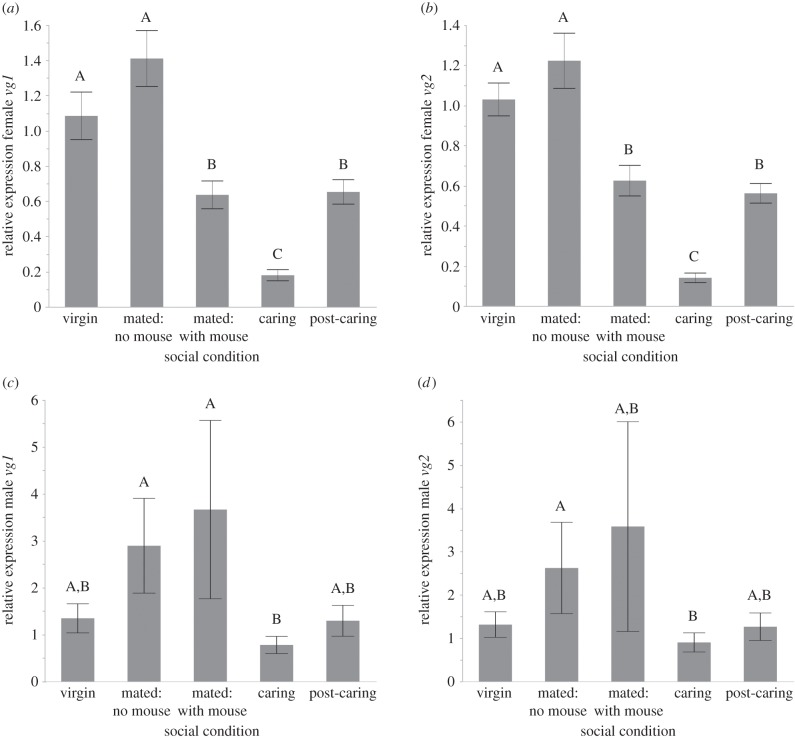
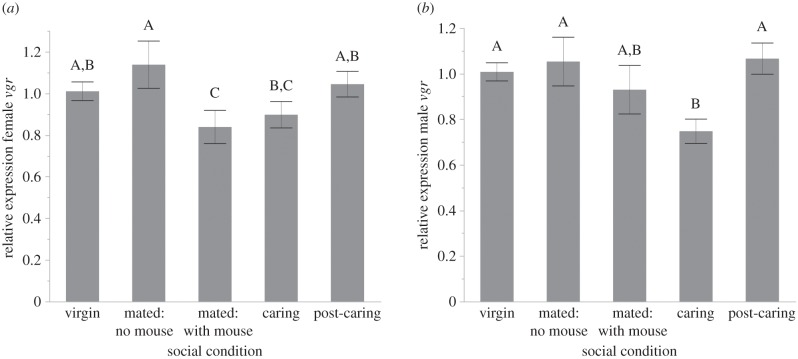
Complex social behaviour in Hymenoptera has been hypothesized to evolve by co-opting reproductive pathways (the ovarian ground plan hypothesis, OGPH) and gene networks (the reproductive ground plan hypothesis, RGPH). In support of these hypotheses, in eusocial Hymenoptera where there is reproductive division of labour, the yolk precursor protein vitellogenin (Vg) influences the expression of worker social behaviour. We suggest that co-opting genes involved in reproduction may occur more generally than just in the evolution of eusociality; i.e. underlie earlier stages of social evolution such as the evolution of parental care, given that reproduction and parental care rarely overlap. We therefore examined vitellogenin (vg) gene expression associated with parental care in the subsocial beetle Nicrophorus vespilloides. We found a significant reduction in the expression of vg and its receptor, vgr, in head tissue during active parental care, and confirmed that the receptor is expressed in the brains of both sexes. Ours is the first study to show that vgr is expressed in the brain of a non-eusocial insect. Given the association between behaviour and gene expression in both sexes, and the presence of vitellogenin receptors in the brain, we suggest that Vg was co-opted early in the evolution of sociality to have a regulatory function. This extends the association of Vg in parenting to subsocial species and outside of the Hymenoptera, and supports the hypothesis that the OGPH is general and that heterochrony in gene expression is important in the evolution of social behaviour and precedes subsequent evolutionary specialization of social roles.
膜翅目昆虫的复杂社会行为被认为是通过采用生殖途径(卵巢基本模式假说,OGPH)和基因网络(生殖基本模式假说,RGPH)进化而来的。为支持这些假说,在存在生殖分工的群居膜翅目昆虫中,卵黄前体蛋白卵黄原蛋白(Vg)会影响工蚁社会行为的表达。我们认为,参与生殖的基因的采用可能比仅在群居性进化中更为普遍;也就是说,鉴于生殖和亲代抚育很少重叠,它是社会进化早期阶段(如亲代抚育的进化)的基础。因此,我们研究了亚社会性埋葬甲Nicrophorus vespilloides中与亲代抚育相关的卵黄原蛋白(vg)基因表达。我们发现,在积极进行亲代抚育期间,头部组织中vg及其受体vgr的表达显著降低,并证实该受体在两性大脑中均有表达。我们的研究首次表明vgr在非群居性昆虫的大脑中表达。鉴于两性的行为与基因表达之间的关联,以及大脑中存在卵黄原蛋白受体,我们认为Vg在社会性进化早期就被采用以发挥调节功能。这将Vg在育儿中的关联扩展到亚社会性物种以及膜翅目之外,并支持了OGPH具有普遍性以及基因表达的异时性在社会行为进化中很重要且先于社会角色随后的进化特化这一假说。