Zakiyah Neily, Postma Maarten J, Baker Philip N, van Asselt Antoinette D I
Unit of PharmacoEpidemiology and PharmacoEconomics, Department of Pharmacy, University of Groningen, A. Deusinglaan 1, 9713 AV, Groningen, The Netherlands.
Health Technology Assessment Unit, Department of Epidemiology, University Medical Center Groningen, Groningen, The Netherlands.
Pharmacoeconomics. 2015 Oct;33(10):1069-82. doi: 10.1007/s40273-015-0291-x.
Pre-eclampsia is a pregnancy complication affecting both mother and fetus. Although there is no proven effective method to prevent pre-eclampsia, early identification of women at risk of pre-eclampsia could enhance appropriate application of antenatal care, management and treatment. Very little is known about the cost effectiveness of these and other tests for pre-eclampsia, mainly because there is no clear treatment path. The aim of this study was to provide a comprehensive overview of the existing evidence on the health economics of screening, diagnosis and treatment options in pre-eclampsia.
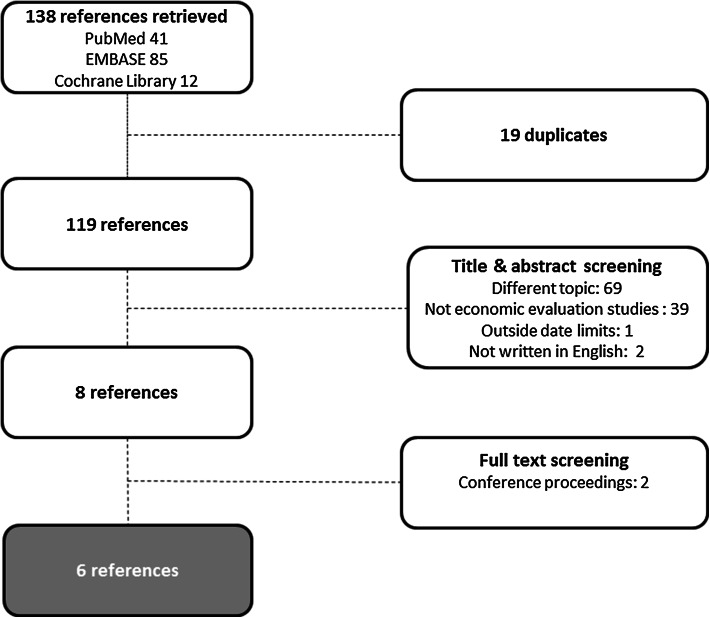
We searched three electronic databases (PubMed, EMBASE and the Cochrane Library) for studies on screening, diagnosis, treatment or prevention of pre-eclampsia, published between 1994 and 2014. Only full papers written in English containing complete economic assessments in pre-eclampsia were included.
From an initial total of 138 references, six papers fulfilled the inclusion criteria. Three studies were on the cost effectiveness of treatment of pre-eclampsia, two of which evaluated magnesium sulphate for prevention of seizures and the third evaluated the cost effectiveness of induction of labour versus expectant monitoring. The other three studies were aimed at screening and diagnosis, in combination with subsequent preventive measures. The two studies on magnesium sulphate were equivocal on the cost effectiveness in non-severe cases, and the other study suggested that induction of labour in term pre-eclampsia was more cost effective than expectant monitoring. The screening studies were quite diverse in their objectives as well as in their conclusions. One study concluded that screening is probably not worthwhile, while two other studies stated that in certain scenarios it may be cost effective to screen all pregnant women and prophylactically treat those who are found to be at high risk of developing pre-eclampsia.
This study is the first to provide a comprehensive overview on the economic aspects of pre-eclampsia in its broadest sense, ranging from screening to treatment options. The main limitation of the present study lies in the variety of topics in combination with the limited number of papers that could be included; this restricted the comparisons that could be made. In conclusion, novel biomarkers in screening for and diagnosing pre-eclampsia show promise, but their accuracy is a major driver of cost effectiveness, as is prevalence. Universal screening for pre-eclampsia, using a biomarker, will be feasible only when accuracy is significantly increased.
子痫前期是一种影响母亲和胎儿的妊娠并发症。尽管尚无经证实的有效方法来预防子痫前期,但早期识别有子痫前期风险的女性可加强产前护理、管理和治疗的合理应用。对于子痫前期的这些及其他检测方法的成本效益知之甚少,主要是因为没有明确的治疗路径。本研究的目的是全面概述子痫前期筛查、诊断和治疗方案的卫生经济学现有证据。
我们检索了三个电子数据库(PubMed、EMBASE和Cochrane图书馆),以查找1994年至2014年期间发表的关于子痫前期筛查、诊断、治疗或预防的研究。仅纳入用英文撰写的包含子痫前期完整经济评估的全文。
从最初总共138篇参考文献中,有6篇论文符合纳入标准。三项研究是关于子痫前期治疗的成本效益,其中两项评估了硫酸镁预防惊厥的效果,第三项评估了引产与期待监测的成本效益。其他三项研究旨在筛查和诊断,并结合后续预防措施。关于硫酸镁的两项研究在非严重病例的成本效益方面存在不确定性,另一项研究表明足月子痫前期引产比期待监测更具成本效益。筛查研究在目标和结论方面差异很大。一项研究得出结论,筛查可能不值得,而其他两项研究指出,在某些情况下,对所有孕妇进行筛查并对发现有发展为子痫前期高风险的孕妇进行预防性治疗可能具有成本效益。
本研究首次从最广泛的意义上对子痫前期从筛查到治疗方案的经济方面进行了全面概述。本研究的主要局限性在于主题多样,且纳入的论文数量有限;这限制了可进行的比较。总之,子痫前期筛查和诊断中的新型生物标志物显示出前景,但其准确性是成本效益的主要驱动因素,患病率也是如此。只有当准确性显著提高时,使用生物标志物对子痫前期进行普遍筛查才可行。