Division of Ophthalmology, Department of Surgery, Kobe University Graduate School of Medicine, 7-5-2 Kusunoki-cho, Chuo-ku, Kobe, 650-0017, Japan.
BMC Ophthalmol. 2015 Jun 6;15:58. doi: 10.1186/s12886-015-0040-0.
Rebamipide with mucin secretagogue activity was recently approved for the treatment of dry eye. The efficacy and safety in the treatment of rebamipide were shown in two pivotal clinical trials. It was the aim of this study to evaluate the effect of 2% rebamipide ophthalmic suspension in patients with dry eye and analyze relevant factors for favorable effects of rebamipide in clinical practice.
This was a retrospective cohort study of 48 eyes from 24 patients with dry eye treated with 2% rebamipide ophthalmic suspension. Dry eye-related symptom score, tear film break-up time (TBUT), fluorescein ocular surface staining score (FOS) and the Schirmer test were used to collect the data from patients at baseline, and at 2, 4, 8, and 12 week visits. To determine the relevant factors, multiple regression analyses were then performed.
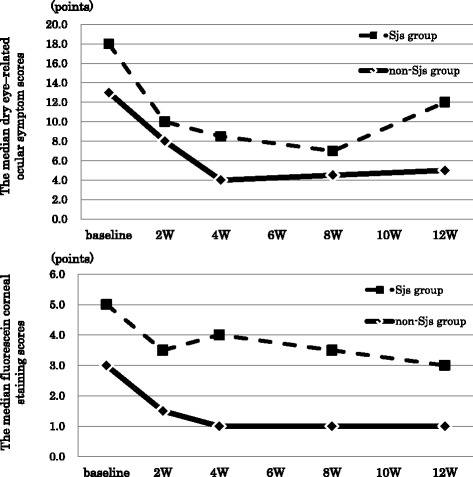
Mean dry eye-related symptom score showed a significant improvement from the baseline (14.5 points) at 2, 4, 8 and 12 weeks (9.80, 7.04, 7.04 and 7.83 points, corrected P value < 0.001, respectively). Median FOS showed a significant improvement from the baseline (3.0 points) at 2, 4, 8 and 12 weeks (2.0, 2.0, 1.0 and 1.0 points, corrected P value < 0.001, respectively). TBUT and Schirmer test values were not significantly improved after the treatment. For ocular symptoms, three parameters (foreign body sensation, dry eye sensation and ocular discomfort) showed significant improvements at all visits. The multiple regression analyses showed that the fluorescein conjunctiva staining score was significantly correlated with the changes of dry eye-related symptom score at 12 weeks (P value = 0.017) and dry eye-related symptom score was significantly correlated with independent variables for the changes of FOS at 12 weeks (P value = 0.0097).
Two percent rebamipide ophthalmic suspension was an effective therapy for dry eye patients. Moreover the fluorescein conjunctiva staining score and dry eye-related symptom score might be good relevant factors for favorable effects of rebamipide.
具有粘蛋白分泌活性的瑞巴派特最近被批准用于治疗干眼症。两项关键性临床试验显示了瑞巴派特在干眼症治疗中的疗效和安全性。本研究旨在评估 2%瑞巴派特滴眼液在干眼症患者中的疗效,并分析临床实践中瑞巴派特疗效的相关因素。
这是一项回顾性队列研究,纳入了 24 例干眼症患者的 48 只眼,这些患者使用 2%瑞巴派特滴眼液治疗。使用干眼相关症状评分、泪膜破裂时间(TBUT)、荧光素眼表面染色评分(FOS)和泪液分泌试验评估患者在基线、治疗后 2、4、8 和 12 周时的眼部数据。然后进行多元回归分析以确定相关因素。
干眼相关症状评分从基线(14.5 分)开始,在 2、4、8 和 12 周时显著改善(分别为 9.80、7.04、7.04 和 7.83 分,校正 P 值<0.001)。FOS 中位数从基线(3.0 分)开始,在 2、4、8 和 12 周时显著改善(分别为 2.0、2.0、1.0 和 1.0 分,校正 P 值<0.001)。治疗后 TBUT 和泪液分泌试验值没有显著改善。对于眼部症状,有三个参数(异物感、干眼感和眼部不适)在所有随访时均有显著改善。多元回归分析显示,在第 12 周时,荧光素结膜染色评分与干眼相关症状评分的变化显著相关(P 值=0.017),而干眼相关症状评分与 FOS 变化的独立变量显著相关(P 值=0.0097)。
2%瑞巴派特滴眼液是治疗干眼症患者的有效疗法。此外,荧光素结膜染色评分和干眼相关症状评分可能是瑞巴派特疗效的良好相关因素。