Ikram Rosemary, Psutka Rebecca, Carter Alison, Priest Patricia
Microbiology, Christchurch School of Medicine University of Otago, Christchurch, New Zealand.
Department of Preventive and Social Medicine, University of Otago, Dunedin, New Zealand.
BMC Infect Dis. 2015 Jun 9;15:224. doi: 10.1186/s12879-015-0974-0.
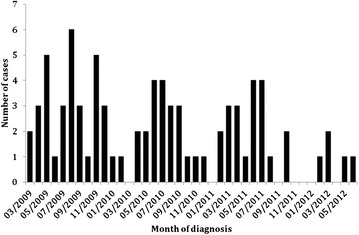
Prevention of infection due to multi-drug resistant organisms is particularly challenging because of the spread of resistant bacteria beyond hospitals into the community, including nursing homes. This study aimed to identify risk factors for the acquisition of a multidrug resistant (MDR) Escherichia coli in a local outbreak.
Study participants were all aged over 65 years. Cases had the MDR E. coli isolated from a routine urine sample, and controls had a urine sample submitted to the laboratory in the same time period but the MDR E. coli was not isolated. Information from clinical records was used to identify risk factors both in the hospital and the community setting for acquisition of the MDR E. coli.
76 cases and 156 controls were identified and included in the study. In a multivariate analysis, risk factors statistically significantly associated with acquisition of the MDR E. coli were female gender (adjusted OR 3.2; 95 % confidence interval 1.5-6.9), level of care (high dependency OR 7.5; 2.2-25.7) compared with living independently), and in hospital prescription of antimicrobials to which the MDR E. coli was resistant (OR 5.6; 2.5-12.9).
The major risk factors for the acquisition of a MDR E. coli were found to be residence in a nursing home and in-hospital prescription of antimicrobials to which the MDR E. coli was resistant. This emphasises that prevention of transmission of MDROs within a community needs to involve both hospitals and also other healthcare organizations, in this case nursing homes.
由于耐药菌从医院传播到社区,包括疗养院,预防多重耐药菌感染极具挑战性。本研究旨在确定本地一次暴发中获得多重耐药(MDR)大肠杆菌的危险因素。
研究参与者均为65岁以上老年人。病例组从常规尿液样本中分离出MDR大肠杆菌,对照组在同一时期提交尿液样本,但未分离出MDR大肠杆菌。利用临床记录信息确定在医院和社区环境中获得MDR大肠杆菌的危险因素。
共确定76例病例和156例对照并纳入研究。在多变量分析中,与获得MDR大肠杆菌有统计学显著关联的危险因素为女性(调整后比值比3.2;95%置信区间1.5 - 6.9)、护理级别(高度依赖组比值比7.5;2.2 - 25.7,与独立生活相比)以及在医院使用MDR大肠杆菌耐药的抗菌药物处方(比值比5.6;2.5 - 12.9)。
发现获得MDR大肠杆菌的主要危险因素是居住在疗养院以及在医院使用MDR大肠杆菌耐药的抗菌药物处方。这强调了在社区内预防多重耐药菌传播需要医院以及其他医疗保健机构(在本案例中为疗养院)共同参与。