Jaiswal Manoj Kumar
Center for Neuroscience and Regenerative Medicine, 4301 Jones Bridge Road, 20814 Bethesda, MD USA ; Department of Anatomy, Physiology and Genetics, School of Medicine, USUHS, 4301 Jones Bridge Road, 20814 Bethesda, MD USA.
Mol Cell Ther. 2014 Aug 14;2:26. doi: 10.1186/2052-8426-2-26. eCollection 2014.
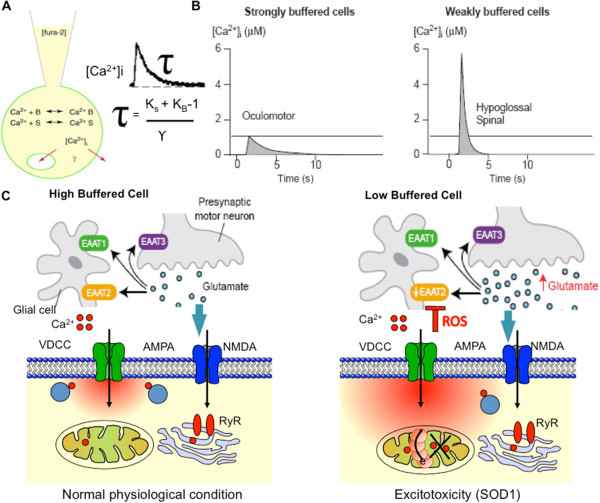
Amyotrophic lateral sclerosis (ALS) is a lethal neurodegenerative disorder characterized by the selective degeneration of defined subgroups of motoneuron in the brainstem, spinal cord and motor cortex with signature hallmarks of mitochondrial Ca(2+) overload, free radical damage, excitotoxicity and impaired axonal transport. Although intracellular disruptions of cytosolic and mitochondrial calcium, and in particular low cytosolic calcium ([Ca(2+)]c) buffering and a strong interaction between metabolic mechanisms and [Ca(2+)]i have been identified predominantly in motoneuron impairment, the causes of these disruptions are unknown. The existing evidence suggests that the mutant superoxide dismutase1 (mtSOD1)-mediated toxicity in ALS acts through mitochondria, and that alteration in cytosolic and mitochondria-ER microdomain calcium accumulation are critical to the neurodegenerative process. Furthermore, chronic excitotoxcity mediated by Ca(2+)-permeable AMPA and NMDA receptors seems to initiate vicious cycle of intracellular calcium dysregulation which leads to toxic Ca(2+) overload and thereby selective neurodegeneration. Recent advancement in the experimental analysis of calcium signals with high spatiotemporal precision has allowed investigations of calcium regulation in-vivo and in-vitro in different cell types, in particular selectively vulnerable/resistant cell types in different animal models of this motoneuron disease. This review provides an overview of latest advances in this field, and focuses on details of what has been learned about disrupted Ca(2+) homeostasis and mitochondrial degeneration. It further emphasizes the critical role of mitochondria in preventing apoptosis by acting as a Ca(2+) buffers, especially in motoneurons, in pathophysiological conditions such as ALS.
肌萎缩侧索硬化症(ALS)是一种致命的神经退行性疾病,其特征是脑干、脊髓和运动皮层中特定亚群的运动神经元选择性退化,伴有线粒体Ca(2+)过载、自由基损伤、兴奋性毒性和轴突运输受损等标志性特征。尽管在运动神经元损伤中主要发现了胞质和线粒体钙的细胞内紊乱,特别是低胞质钙([Ca(2+)]c)缓冲以及代谢机制与[Ca(2+)]i之间的强烈相互作用,但其紊乱的原因尚不清楚。现有证据表明,ALS中突变型超氧化物歧化酶1(mtSOD1)介导的毒性作用通过线粒体发挥,胞质和线粒体-内质网微区钙积累的改变对神经退行性过程至关重要。此外,由Ca(2+)通透性AMPA和NMDA受体介导的慢性兴奋性毒性似乎引发了细胞内钙失调的恶性循环,导致有毒的Ca(2+)过载,从而导致选择性神经退行性变。在具有高时空精度的钙信号实验分析方面的最新进展,使得人们能够在体内和体外研究不同细胞类型中的钙调节,特别是在这种运动神经元疾病的不同动物模型中选择性易损/抗性细胞类型中的钙调节。本综述概述了该领域的最新进展,并重点关注了关于Ca(2+)稳态破坏和线粒体退化所了解到的细节。它进一步强调了线粒体在病理生理条件如ALS中通过作为Ca(2+)缓冲剂来预防细胞凋亡的关键作用,尤其是在运动神经元中。