Krautter Markus, Dittrich Ronja, Safi Annette, Krautter Justine, Maatouk Imad, Moeltner Andreas, Herzog Wolfgang, Nikendei Christoph
Department of Nephrology, University of Heidelberg Medical Hospital, Heidelberg, Germany.
Department of General Internal and Psychosomatic Medicine, University of Heidelberg Medical Hospital, Heidelberg, Germany.
Adv Med Educ Pract. 2015 May 27;6:399-406. doi: 10.2147/AMEP.S81923. eCollection 2015.
Although Peyton's four-step approach is a widely used method for skills-lab training in undergraduate medical education and has been shown to be more effective than standard instruction, it is unclear whether its superiority can be attributed to a specific single step.
We conducted a randomized controlled trial to investigate the differential learning outcomes of the separate steps of Peyton's four-step approach.
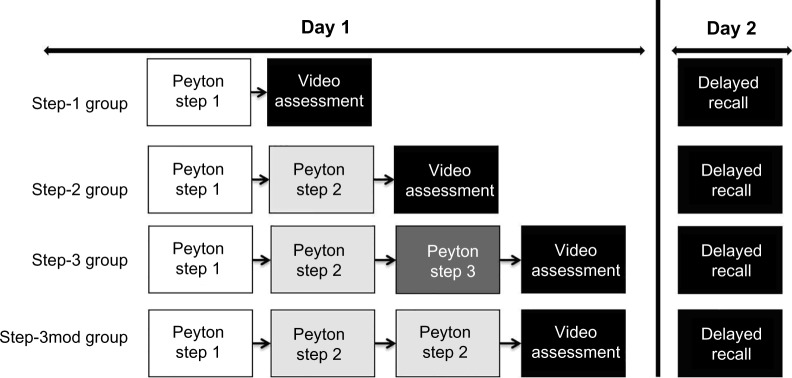
Volunteer medical students were randomly assigned to four different groups. Step-1 group received Peyton's Step 1, Step-2 group received Peyton's Steps 1 and 2, Step-3 group received Peyton's Steps 1, 2, and 3, and Step-3mod group received Peyton's Steps 1 and 2, followed by a repetition of Step 2. Following the training, the first independent performance of a central venous catheter (CVC) insertion using a manikin was video-recorded and scored by independent video assessors using binary checklists. The day after the training, memory performance during delayed recall was assessed with an incidental free recall test.
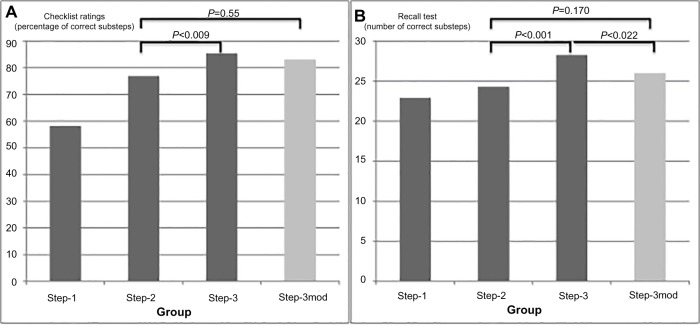
A total of 97 participants agreed to participate in the trial. There were no statistically significant group differences with regard to age, sex, completed education in a medical profession, completed medical clerkships, preliminary memory tests, or self-efficacy ratings. Regarding checklist ratings, Step-2 group showed a superior first independent performance of CVC placement compared to Step-1 group (P<0.001), and Step-3 group showed a superior performance to Step-2 group (P<0.009), while Step-2 group and Step-3mod group did not differ (P=0.055). The findings were similar in the incidental free recall test.
Our study identified Peyton's Step 3 as being the most crucial part within Peyton's four-step approach, contributing significantly more to learning success than the previous steps and reaching beyond the benefit of a mere repetition of skills demonstration.
尽管佩顿四步法是本科医学教育技能实验室培训中广泛使用的方法,且已被证明比标准教学更有效,但尚不清楚其优势是否可归因于特定的单个步骤。
我们进行了一项随机对照试验,以研究佩顿四步法各个步骤的不同学习效果。
志愿医学生被随机分为四组。第一步组接受佩顿第一步,第二步组接受佩顿第一步和第二步,第三步组接受佩顿第一步、第二步和第三步,第三步修改组接受佩顿第一步和第二步,然后重复第二步。培训后,使用人体模型首次独立进行中心静脉导管(CVC)插入操作的过程被录像,并由独立的视频评估员使用二元检查表进行评分。培训后的第二天,通过附带的自由回忆测试评估延迟回忆期间的记忆表现。
共有97名参与者同意参加试验。在年龄、性别、医学专业完成教育情况、完成临床实习情况、初步记忆测试或自我效能评分方面,各组之间无统计学显著差异。关于检查表评分,第二步组在CVC放置的首次独立操作表现上优于第一步组(P<0.001),第三步组优于第二步组(P<0.009),而第二步组和第三步修改组无差异(P=0.055)。在附带的自由回忆测试中,结果相似。
我们的研究确定佩顿第三步是佩顿四步法中最关键的部分,对学习成功的贡献比前几步显著更多,且不仅仅是重复技能演示的好处。