Higa Yukiko, Abílio Ana Paula, Futami Kyoko, Lázaro Manuel Alberto Félix, Minakawa Noboru, Gudo Eduardo Samo
Institute of Tropical Medicine, Nagasaki University , Nagasaki, Japan.
Instituto Nacional de Saúde, Ministério da Saúde , Maputo, Mozambique.
Trop Med Health. 2015 Jun;43(2):107-9. doi: 10.2149/tmh.2014-29. Epub 2015 Jan 19.
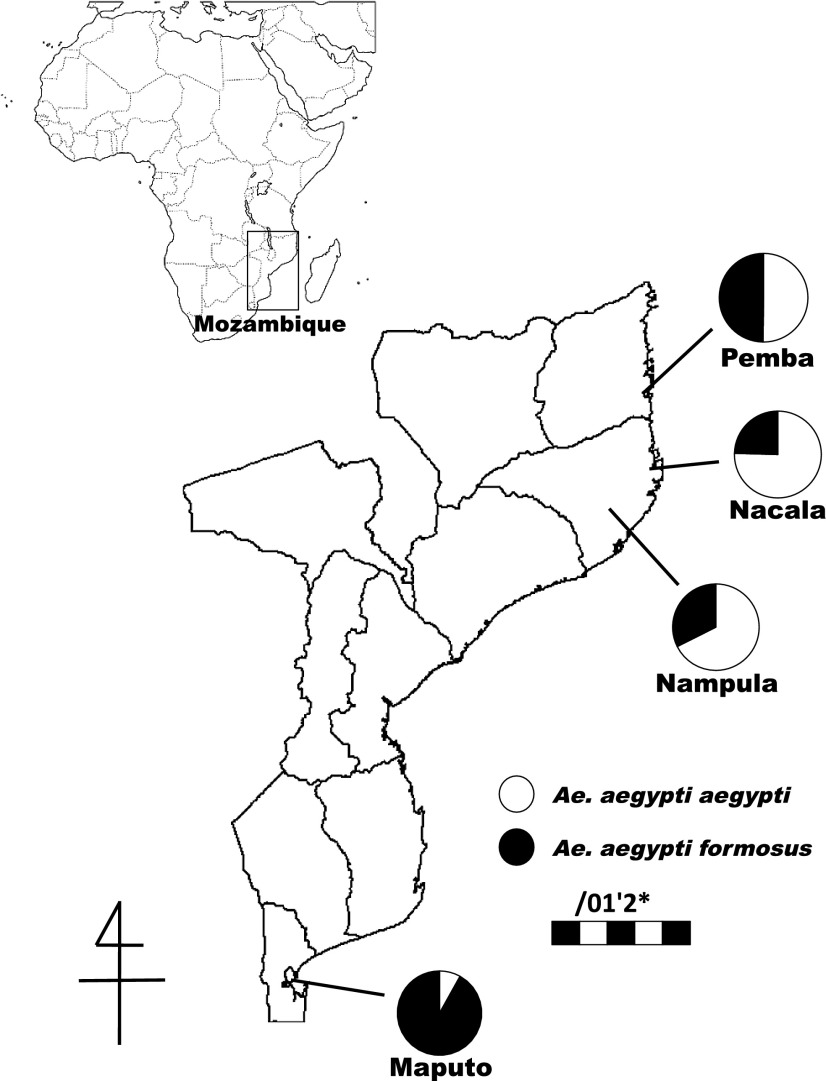
In early 2014, dengue cases were reported from northern Mozambique, 30 years after the last outbreak. We identified potential dengue vector species in three northern towns, Pemba, Nampula and Nacala, and one southern town, Maputo, during the outbreak in April 2014. A major dengue vector species, Aedes (Stegomyia) aegypti, was found in all these towns. The dominant vector subspecies in the northern towns was Aedes aegypti aegypti, while Ae. aegypti formosus was dominant in Maputo. Considering the high proportion of Ae. aegypti aegypti and its high vector competence, the findings from this study suggest that Ae. aegypti aegypti was responsible for the outbreak in northern Mozambique.
2014年初,莫桑比克北部报告了登革热病例,距上次疫情爆发已有30年。2014年4月疫情爆发期间,我们在北部的三个城镇彭巴、楠普拉和纳卡拉以及南部的一个城镇马普托确定了潜在的登革热媒介种类。在所有这些城镇都发现了主要的登革热媒介种类埃及伊蚊(白纹伊蚊)。北部城镇的优势媒介亚种是埃及伊蚊指名亚种,而在马普托,埃及伊蚊美索不达米亚亚种占主导地位。考虑到埃及伊蚊指名亚种的高比例及其高媒介效能,本研究结果表明,埃及伊蚊指名亚种是莫桑比克北部疫情的罪魁祸首。