Larivière Vincent, Haustein Stefanie, Mongeon Philippe
École de bibliothéconomie et des sciences de l'information, Université de Montréal, C.P. 6128, Succ. Centre-Ville, Montréal, QC. H3C 3J7, Canada; Observatoire des Sciences et des Technologies (OST), Centre Interuniversitaire de Recherche sur la Science et la Technologie (CIRST), Université du Québec à Montréal, CP 8888, Succ. Centre-Ville, Montréal, QC. H3C 3P8, Canada.
École de bibliothéconomie et des sciences de l'information, Université de Montréal, C.P. 6128, Succ. Centre-Ville, Montréal, QC. H3C 3J7, Canada.
PLoS One. 2015 Jun 10;10(6):e0127502. doi: 10.1371/journal.pone.0127502. eCollection 2015.
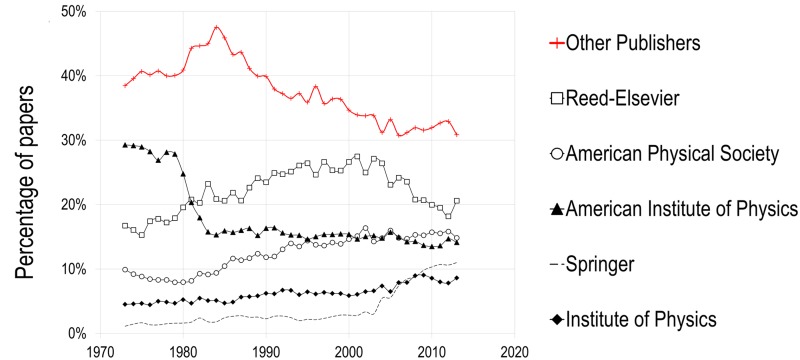
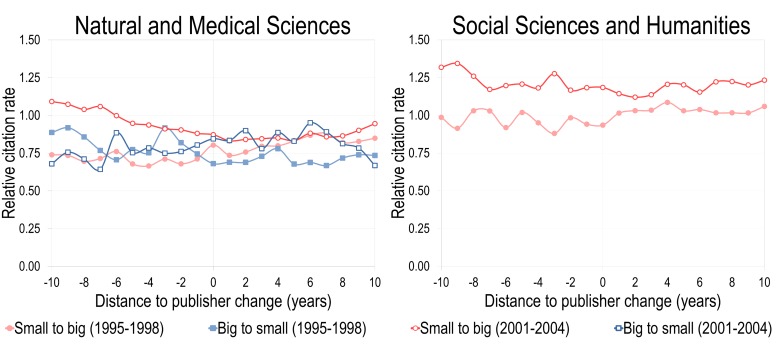
The consolidation of the scientific publishing industry has been the topic of much debate within and outside the scientific community, especially in relation to major publishers' high profit margins. However, the share of scientific output published in the journals of these major publishers, as well as its evolution over time and across various disciplines, has not yet been analyzed. This paper provides such analysis, based on 45 million documents indexed in the Web of Science over the period 1973-2013. It shows that in both natural and medical sciences (NMS) and social sciences and humanities (SSH), Reed-Elsevier, Wiley-Blackwell, Springer, and Taylor & Francis increased their share of the published output, especially since the advent of the digital era (mid-1990s). Combined, the top five most prolific publishers account for more than 50% of all papers published in 2013. Disciplines of the social sciences have the highest level of concentration (70% of papers from the top five publishers), while the humanities have remained relatively independent (20% from top five publishers). NMS disciplines are in between, mainly because of the strength of their scientific societies, such as the ACS in chemistry or APS in physics. The paper also examines the migration of journals between small and big publishing houses and explores the effect of publisher change on citation impact. It concludes with a discussion on the economics of scholarly publishing.
科学出版行业的合并一直是科学界内外诸多讨论的话题,尤其是与大型出版商的高利润率相关。然而,这些大型出版商旗下期刊发表的科研成果份额,以及其随时间和各学科的演变情况,尚未得到分析。本文基于1973年至2013年期间《科学引文索引》中索引的4500万份文献进行了此类分析。结果表明,在自然科学与医学(NMS)以及社会科学与人文科学(SSH)领域,励德·爱思唯尔、威利·布莱克韦尔、施普林格和泰勒与弗朗西斯等出版社提高了其发表成果的份额,尤其是自数字时代(20世纪90年代中期)到来以来。综合来看,2013年发文量最高的前五家出版社发表的论文占所有论文的比例超过50%。社会科学学科的集中度最高(前五家出版社发表的论文占70%),而人文学科相对较为独立(前五家出版社发表的论文占20%)。自然科学与医学学科则介于两者之间,主要是因为其科学学会的影响力,如化学领域的美国化学学会或物理领域的美国物理学会。本文还研究了期刊在大小出版社之间的迁移情况,并探讨了出版商变更对引文影响力的影响。文章最后讨论了学术出版的经济学问题。