Hall Charles B, Liu Xiaoxue, Zeig-Owens Rachel, Webber Mayris P, Aldrich Thomas K, Weakley Jessica, Schwartz Theresa, Cohen Hillel W, Glaser Michelle S, Olivieri Brianne L, Weiden Michael D, Nolan Anna, Kelly Kerry J, Prezant David J
Department of Epidemiology and Population Health and Saul B. Korey Department of Neurology, Albert Einstein College of Medicine, Bronx, New York, USA.
Montefiore Medical Center, Bronx, New York, USA; Fire Department of the City of New York, Brooklyn, New York, USA.
PLoS Curr. 2015 May 20;7:ecurrents.dis.8a93e7682624698558a76a1fa8c5893f. doi: 10.1371/currents.dis.8a93e7682624698558a76a1fa8c5893f.
Adverse respiratory effects of World Trade Center (WTC) exposure have been widely documented, but the length of time that exposure remains associated with disease is uncertain. We estimate the incidence of new cases of physician-diagnosed obstructive airway disease (OAD) as a function of time since 9/11/2001 in WTC-exposed firefighters.
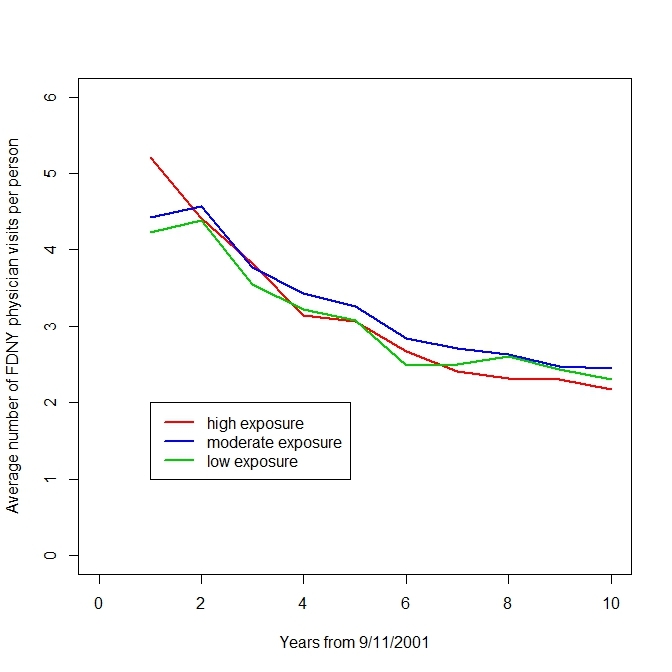
Exposure was categorized by first WTC arrival time: high (9/11/2001 AM); moderate (9/11/2001 PM or 9/12/2001); or low (9/13-24/2001). We modeled relative rates (RR) and 95% confidence intervals (CI) of OAD incidence by exposure over the first 10 years post-9/11/2001, estimating the time(s) of change in the RR with change point models. We further examined the relationship between self-reported lower respiratory symptoms and physician diagnoses.
Change points were observed at 15 and 84 months post-9/11/2001, with relative incidence rates for the high versus low exposure group of 4.02 (95% CI 2.62-6.16) prior to 15 months, 1.90 (95% CI 1.49-2.44) from months 16 to 84, and 1.20 (95% CI 0.92-1.56) thereafter. Incidence in all exposure groups increased after the WTC health program began to offer free coverage of OAD medications in month 63. Self-reported lower respiratory symptoms in the first 15 months had 80.6% sensitivity, but only 35.9% specificity, for eventual OAD diagnoses.
New OAD diagnoses are associated with WTC exposure for at least seven years. Some portion of the extended duration of that association may be due to delayed diagnoses. Nevertheless, our results support recognizing OAD among rescue workers as WTC-related even when diagnosed years after exposure.
世贸中心(WTC)暴露对呼吸系统产生的不良影响已有广泛记录,但暴露与疾病相关的持续时间尚不确定。我们估计自2001年9月11日以来,世贸中心暴露的消防员中,由医生诊断的阻塞性气道疾病(OAD)新发病例的发病率随时间的变化情况。
根据首次抵达世贸中心的时间对暴露情况进行分类:高暴露(2001年9月11日上午);中度暴露(2001年9月11日下午或2001年9月12日);或低暴露(2001年9月13日至24日)。我们对2001年9月11日之后头10年中按暴露情况划分的OAD发病率的相对率(RR)和95%置信区间(CI)进行建模,使用变化点模型估计RR发生变化的时间点。我们进一步研究了自我报告的下呼吸道症状与医生诊断之间的关系。
在2001年9月11日之后的15个月和84个月观察到变化点,高暴露组与低暴露组相比,15个月之前的相对发病率为4.02(95%CI 2.62 - 6.16),16至84个月为1.90(95%CI 1.49 - 2.44),之后为1.20(95%CI 0.92 - 1.56)。在世贸中心健康计划于第63个月开始提供OAD药物免费覆盖后,所有暴露组的发病率均有所上升。在最初的15个月中,自我报告的下呼吸道症状对于最终OAD诊断的敏感性为80.6%,但特异性仅为35.9%。
新的OAD诊断与世贸中心暴露至少七年相关。这种关联持续时间延长的部分原因可能是诊断延迟。尽管如此,我们的结果支持即使在暴露数年之后诊断出OAD,也应将救援人员中的OAD认定为与世贸中心相关。