Department of Mechanical Engineering, Stanford University, Stanford, CA, USA.
Auckland Bioengineering Institute, University of Auckland, Auckland, New Zealand.
Cartilage. 2015 Apr;6(2):113-22. doi: 10.1177/1947603515569529.
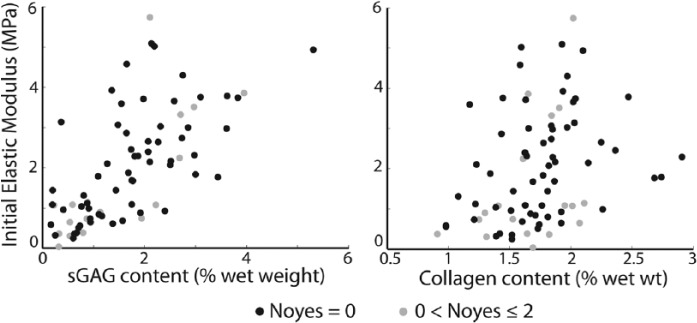
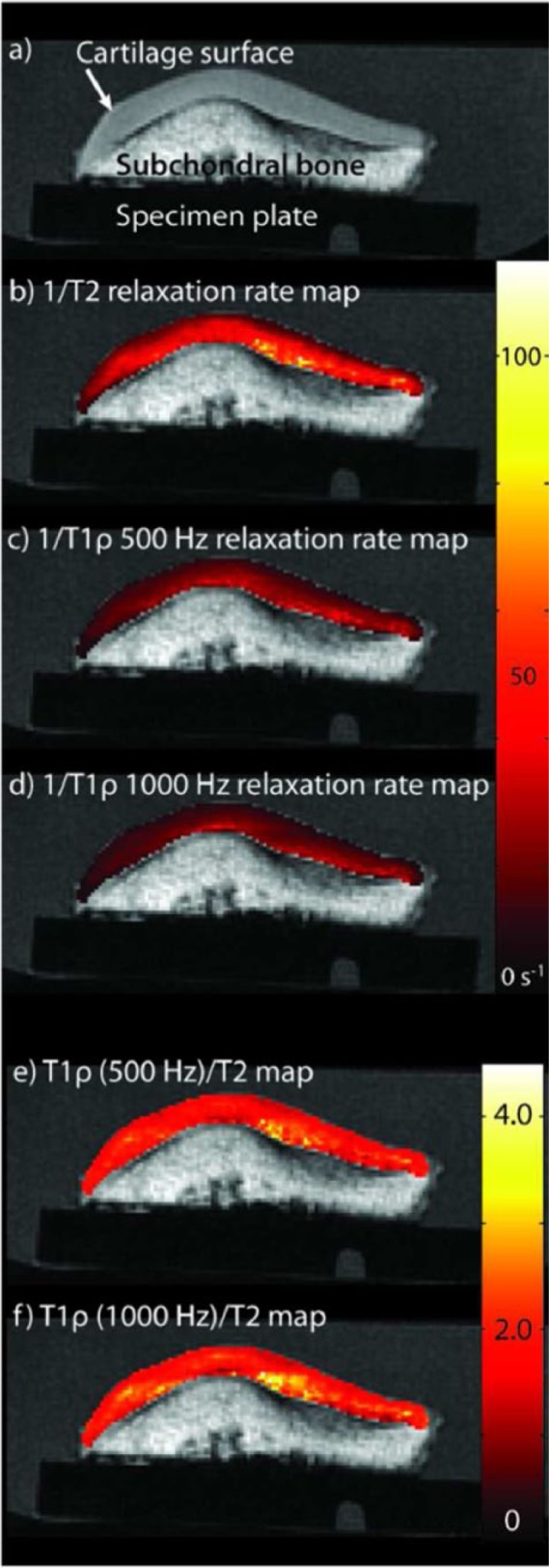
This study assessed T1ρ relaxation dispersion, measured by magnetic resonance imaging (MRI), as a tool to noninvasively evaluate cartilage material and biochemical properties. The specific objective was to answer two questions: (1) does cartilage initial elastic modulus (E 0) correlate with T1ρ dispersion effects and (2) does collagen or proteoglycan content correlate with T1ρ dispersion effects?
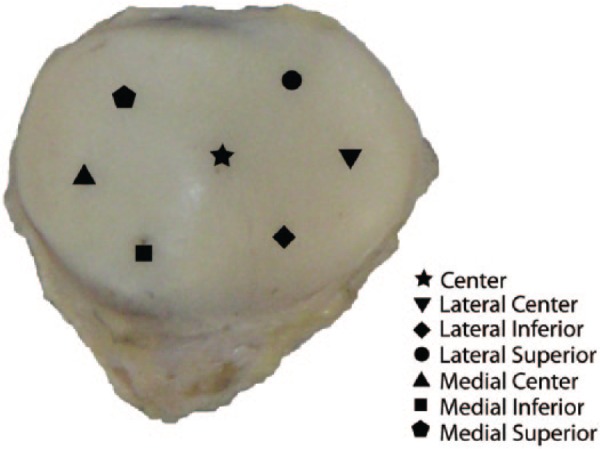
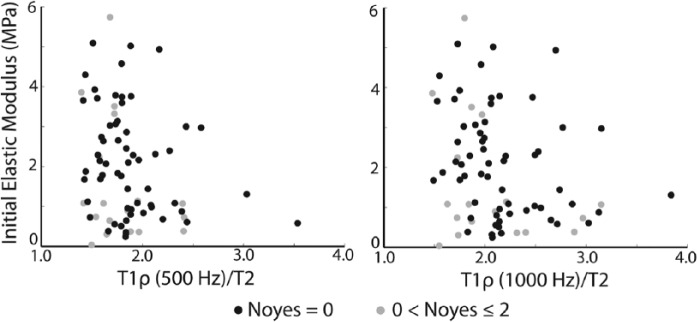
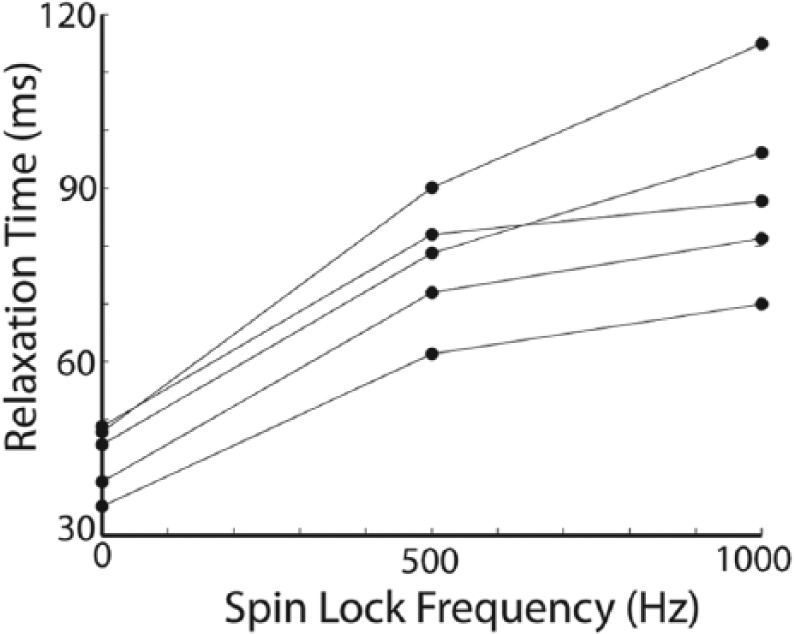
Cadaveric patellae with and without visible cartilage damage on conventional MR were included. T2 and T1ρ relaxation times at 500 and 1000 Hz spin-lock field amplitudes were measured. We estimated T1ρ dispersion effects by measuring T1ρ relaxation time at 500 and 1000 Hz and T2 relaxation time and using a new tool, the ratio T1ρ/T2. Cartilage initial elastic modulus, E 0, was measured from initial response of mechanical indentation creep tests. Collagen and proteoglycan contents were measured at the indentation test sites; proteoglycan content was measured by their covalently linked sulfated glycosaminoglycans (sGAG). Pearson correlation coefficients were determined, taking into account the clustering of multiple samples within a single patella specimen.
Cartilage initial elastic modulus, E 0, increased with decreasing values of T1ρ/T2 measurements at both 500 Hz (P = 0.034) and 1000 Hz (P = 0.022). 1/T1ρ relaxation time (500 Hz) increased with increasing sGAG content (P = 0.041).
T1ρ/T2 ratio, a new tool, and cartilage initial elastic modulus are both measures of water-protein interactions, are dependent on the cartilage structure, and were correlated in this study.
本研究通过磁共振成像(MRI)评估 T1ρ弛豫弥散,以无创评估软骨的物质和生化特性。具体目的是回答两个问题:(1)软骨初始弹性模量(E0)是否与 T1ρ弥散效应相关;(2)胶原或蛋白聚糖含量是否与 T1ρ弥散效应相关。
纳入常规 MRI 有或无可见软骨损伤的髌骨关节。测量 500Hz 和 1000Hz 自旋锁定场幅度下的 T2 和 T1ρ弛豫时间。我们通过测量 500Hz 和 1000Hz 的 T1ρ弛豫时间、T2 弛豫时间,并使用新工具 T1ρ/T2 比来估计 T1ρ 弥散效应。软骨初始弹性模量 E0 是通过机械压痕蠕变试验的初始响应来测量的。在压痕试验部位测量胶原和蛋白聚糖含量;蛋白聚糖含量通过其共价连接的硫酸化糖胺聚糖(sGAG)进行测量。考虑到单个髌骨关节标本内多个样本的聚类,确定了 Pearson 相关系数。
在 500Hz(P = 0.034)和 1000Hz(P = 0.022)时,T1ρ/T2 测量值越低,软骨初始弹性模量 E0 越高。1/T1ρ 弛豫时间(500Hz)与 sGAG 含量呈正相关(P = 0.041)。
T1ρ/T2 比,一种新的工具,以及软骨初始弹性模量都是水-蛋白相互作用的测量指标,依赖于软骨结构,在本研究中是相关的。