Kim Seryoung, Ihara Kohei, Katsube Satoshi, Hori Hatsuhiro, Ando Tasuke, Isogai Emiko, Yoneyama Hiroshi
Laboratory of Animal Microbiology, Department of Microbial Biotechnology, Graduate School of Agricultural Science, Tohoku University, 1-1, Amamiya-machi, Tsutsumidori, Aoba-ku, Sendai, 981-8555, Japan.
Microbiologyopen. 2015 Aug;4(4):632-43. doi: 10.1002/mbo3.269. Epub 2015 Jun 13.
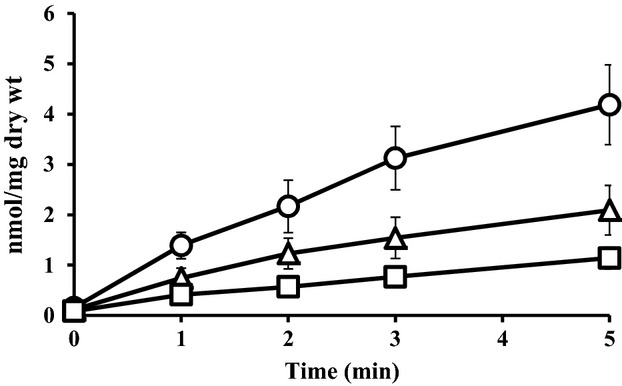
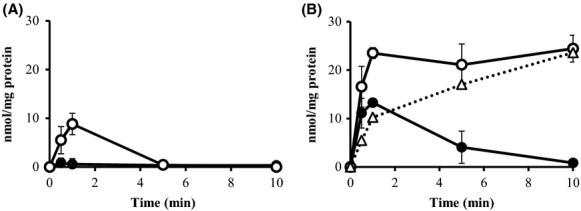
We previously reported that the alaE gene of Escherichia coli encodes the l-alanine exporter AlaE. The objective of this study was to elucidate the mechanism of the AlaE exporter. The minimum inhibitory concentration of l-alanine and l-alanyl-l-alanine in alaE-deficient l-alanine-nonmetabolizing cells MLA301ΔalaE was 4- and >4000-fold lower, respectively, than in the alaE-positive parent cells MLA301, suggesting that AlaE functions as an efflux pump to avoid a toxic-level accumulation of intracellular l-alanine and its derivatives. Furthermore, the growth of the alaE-deficient mutant derived from the l-alanine-metabolizing strain was strongly inhibited in the presence of a physiological level of l-alanyl-l-alanine. Intact MLA301ΔalaE and MLA301ΔalaE/pAlaE cells producing plasmid-borne AlaE, accumulated approximately 200% and 50%, respectively, of the [(3) H]l-alanine detected in MLA301 cells, suggesting that AlaE exports l-alanine. When 200 mmol/L l-alanine-loaded inverted membrane vesicles prepared from MLA301ΔalaE/pAlaE were placed in a solution containing 200 mmol/L or 0.34 μmol/L l-alanine, energy-dependent [(3) H]l-alanine accumulation occurred under either condition. This energy-dependent uphill accumulation of [(3) H]l-alanine was strongly inhibited in the presence of carbonyl cyanide m-chlorophenylhydrazone but not by dicyclohexylcarbodiimide, suggesting that the AlaE-mediated l-alanine extrusion was driven by proton motive force. Based on these results, physiological roles of the l-alanine exporter are discussed.
我们之前报道过,大肠杆菌的alaE基因编码L-丙氨酸转运蛋白AlaE。本研究的目的是阐明AlaE转运蛋白的机制。在缺乏alaE的L-丙氨酸非代谢细胞MLA301ΔalaE中,L-丙氨酸和L-丙氨酰-L-丙氨酸的最低抑菌浓度分别比alaE阳性亲本细胞MLA301低4倍和>4000倍,这表明AlaE作为一种外排泵发挥作用,以避免细胞内L-丙氨酸及其衍生物积累到有毒水平。此外,在生理水平的L-丙氨酰-L-丙氨酸存在下,源自L-丙氨酸代谢菌株的alaE缺陷突变体的生长受到强烈抑制。完整的MLA301ΔalaE和产生质粒携带的AlaE的MLA301ΔalaE/pAlaE细胞分别积累了在MLA301细胞中检测到的[(3)H]L-丙氨酸的约200%和50%,这表明AlaE可输出L-丙氨酸。当将由MLA301ΔalaE/pAlaE制备的加载有200 mmol/L L-丙氨酸的反向膜囊泡置于含有200 mmol/L或0.34 μmol/L L-丙氨酸的溶液中时,在任何一种条件下都会发生能量依赖性的[(3)H]L-丙氨酸积累。[(3)H]L-丙氨酸的这种能量依赖性上坡积累在羰基氰化物间氯苯腙存在下受到强烈抑制,但不受二环己基碳二亚胺抑制,这表明AlaE介导的L-丙氨酸外排是由质子动力驱动的。基于这些结果,讨论了L-丙氨酸转运蛋白的生理作用。