Ceesay Serign J, Koivogui Lamine, Nahum Alain, Taal Makie Abdoulie, Okebe Joseph, Affara Muna, Kaman Lama Eugène, Bohissou Francis, Agbowai Carine, Tolno Benoit Gniouma, Amambua-Ngwa Alfred, Bangoura N Faly, Ahounou Daniel, Muhammad Abdul Khalie, Duparc Stephan, Hamed Kamal, Ubben David, Bojang Kalifa, Achan Jane, D'Alessandro Umberto
Emerg Infect Dis. 2015 Jul;21(7):1114-21. doi: 10.3201/eid2107.142036.
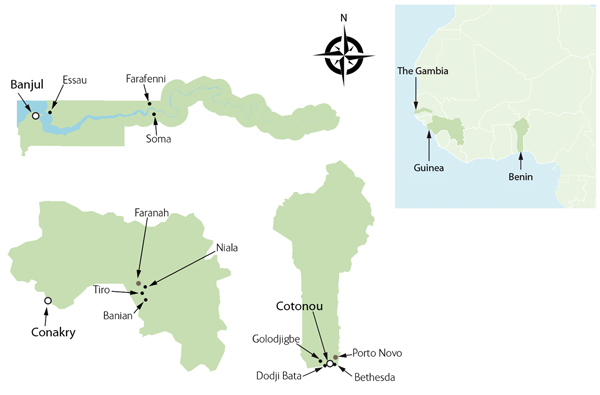
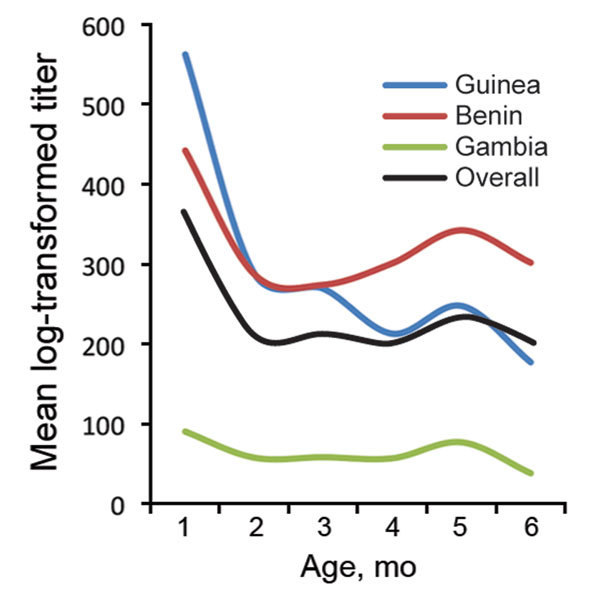
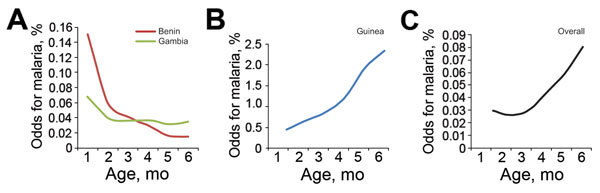
The prevalence and consequences of malaria among infants are not well characterized and may be underestimated. A better understanding of the risk for malaria in early infancy is critical for drug development and informed decision making. In a cross-sectional survey in Guinea, The Gambia, and Benin, countries with different malaria transmission intensities, the overall prevalence of malaria among infants <6 months of age was 11.8% (Guinea, 21.7%; The Gambia, 3.7%; and Benin, 10.2%). Seroprevalence ranged from 5.7% in The Gambia to 41.6% in Guinea. Mean parasite densities in infants were significantly lower than those in children 1-9 years of age in The Gambia (p<0.0001) and Benin (p = 0.0021). Malaria in infants was significantly associated with fever or recent history of fever (p = 0.007) and anemia (p = 0.001). Targeted preventive interventions, adequate drug formulations, and treatment guidelines are needed to address the sizeable prevalence of malaria among young infants in malaria-endemic countries.
疟疾在婴儿中的流行情况及后果尚未得到充分描述,可能被低估。更好地了解婴儿早期患疟疾的风险对于药物研发和明智决策至关重要。在几内亚、冈比亚和贝宁这三个疟疾传播强度不同的国家进行的一项横断面调查中,6个月以下婴儿的疟疾总体患病率为11.8%(几内亚为21.7%;冈比亚为3.7%;贝宁为10.2%)。血清阳性率从冈比亚的5.7%到几内亚的41.6%不等。在冈比亚(p<0.0001)和贝宁(p = 0.0021),婴儿的平均寄生虫密度显著低于1至9岁儿童。婴儿疟疾与发热或近期发热史(p = 0.007)及贫血(p = 0.001)显著相关。在疟疾流行国家,需要有针对性的预防干预措施、合适的药物剂型和治疗指南来应对幼儿中相当高的疟疾患病率。