Keefe Richard S E, Meltzer Herbert A, Dgetluck Nancy, Gawryl Maria, Koenig Gerhard, Moebius Hans J, Lombardo Ilise, Hilt Dana C
Department of Psychiatry and Behavioral Sciences, Duke University Medical Center, Durham, NC, USA.
Department of Psychiatry and Behavioral Sciences Psychiatry, Northwestern University, Feinberg School of Medicine, USA.
Neuropsychopharmacology. 2015 Dec;40(13):3053-60. doi: 10.1038/npp.2015.176. Epub 2015 Jun 19.
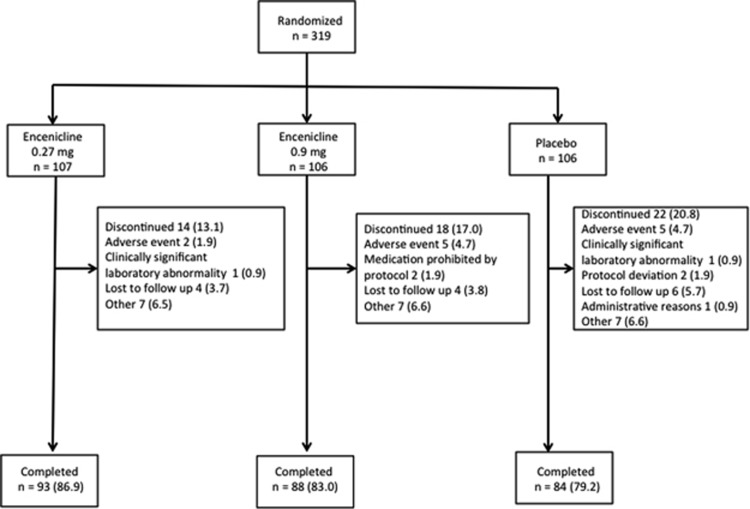
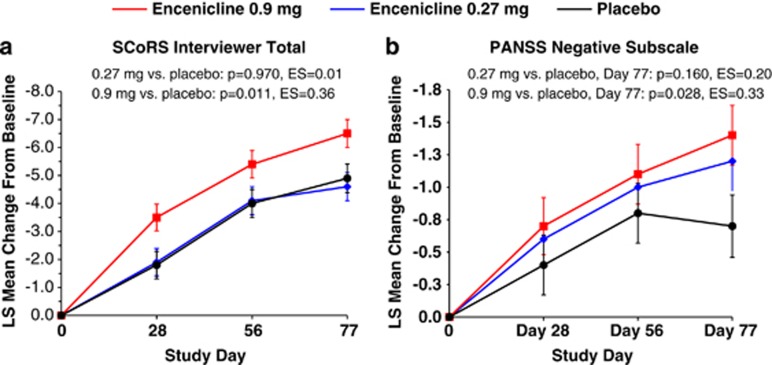
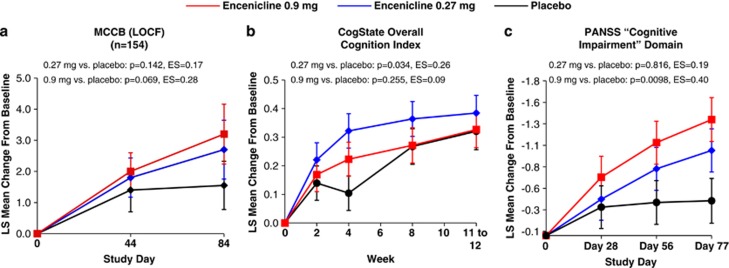
Encenicline is a novel, selective α7 nicotinic acetylcholine receptor agonist in development for treating cognitive impairment in schizophrenia and Alzheimer's disease. A phase 2, double-blind, randomized, placebo-controlled, parallel-design, multinational study was conducted. Patients with schizophrenia on chronic stable atypical antipsychotics were randomized to encenicline 0.27 or 0.9 mg once daily or placebo for 12 weeks. The primary efficacy end point was the Overall Cognition Index (OCI) score from the CogState computerized battery. Secondary end points include MATRICS Consensus Cognitive Battery (MCCB) (in US patients), the Schizophrenia Cognition Rating Scale (SCoRS) total score, SCoRS global rating, and Positive and Negative Syndrome Scale (PANSS) total and subscale and cognition factor scores. Of 319 randomized patients, 317 were included in the safety population, and 307 were included in the intent-to-treat population. Notable trends in improvement were demonstrated across all cognition scales. For the OCI score, the LS mean difference for encenicline 0.27 mg vs placebo was significant (Cohen's d=0.257; P=0.034). Mean SCoRS total scores decreased showing improvement in function over time, and the difference was significant for encenicline 0.9 mg vs placebo (P=0.011). Furthermore, the difference between encenicline 0.9 mg and placebo was significant for the PANSS Cognition Impairment Domain (P=0.0098, Cohen's d=0.40) and for the PANSS Negative scale (P=0.028, Cohen's d=0.33). Treatment-emergent adverse events were reported at similar frequencies across all treatment groups (39.0% with placebo, 23.4% with encenicline 0.27 mg, and 33.3% with encenicline 0.9 mg). Overall, encenicline was generally well tolerated and demonstrated clinically meaningful improvements in cognition and function in patients with schizophrenia.
恩西尼林是一种新型的、选择性α7烟碱型乙酰胆碱受体激动剂,正处于研发阶段,用于治疗精神分裂症和阿尔茨海默病的认知障碍。开展了一项2期、双盲、随机、安慰剂对照、平行设计的多国研究。慢性稳定使用非典型抗精神病药物的精神分裂症患者被随机分为每日一次服用0.27或0.9毫克恩西尼林或安慰剂,为期12周。主要疗效终点是CogState计算机化成套测试的总体认知指数(OCI)评分。次要终点包括MATRICS共识认知成套测试(MCCB)(美国患者)、精神分裂症认知评定量表(SCoRS)总分、SCoRS整体评分以及阳性和阴性症状量表(PANSS)总分、分量表和认知因子评分。在319名随机分组的患者中,317名纳入安全人群,307名纳入意向性治疗人群。所有认知量表均显示出明显的改善趋势。对于OCI评分,0.27毫克恩西尼林与安慰剂的最小二乘均值差异显著(科恩d值=0.257;P=0.034)。SCoRS总分均值下降,表明功能随时间有所改善,0.9毫克恩西尼林与安慰剂的差异显著(P=0.011)。此外,0.9毫克恩西尼林与安慰剂在PANSS认知障碍领域(P=0.0098,科恩d值=0.40)和PANSS阴性量表(P=0.028,科恩d值=0.33)方面的差异显著。所有治疗组报告的治疗中出现的不良事件频率相似(安慰剂组为39.0%,0.27毫克恩西尼林组为23.4%,0.9毫克恩西尼林组为33.3%)。总体而言,恩西尼林耐受性一般良好,在精神分裂症患者的认知和功能方面显示出具有临床意义的改善。