Zhang Yingqiang, Fan Wenzhe, Zhu Kangshun, Lu Ligong, Fu Sirui, Huang Jinhua, Wang Yu, Yang Jianyong, Huang Yonghui, Yao Wang, Li Jiaping
Department of Interventional Oncology, The First Affiliated Hospital, Sun Yat-sen University, Guangzhou, China.
Department of Interventional Radiology, The Third Affiliated Hospital, Sun Yat-sen University, Guangzhou, China.
Oncotarget. 2015 Sep 15;6(27):24550-9. doi: 10.18632/oncotarget.4076.
To assess the efficacy of continued administration of sorafenib for patients with unresectable hepatocellular carcinoma (HCC) treated with local regional therapy (LRT) after a complete response (CR), also, the adverse events of sorafenib after discontinuation of administration were observed.
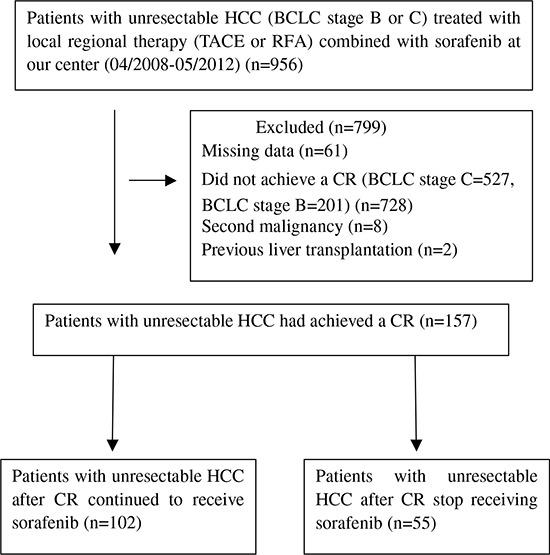
Between April 2008 and May 2012, 956 consecutive patients with unresectable HCC treated with LRT (transarterial chemoembolization, radiofrequency ablation) combined with sorafenib were retrospectively investigated. Of these, 157 patients with a CR were enrolled: 102 of them continued to receive sorafenib (test group) and the other 55 stopped receiving sorafenib (control group).
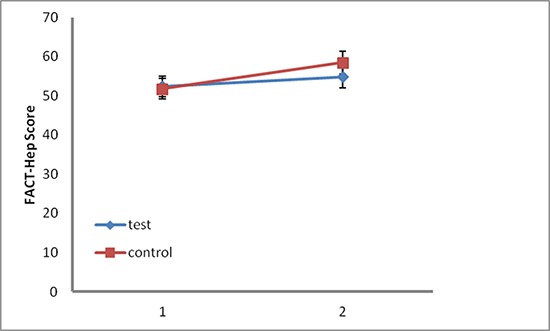
The median recurrence-free survival (RFS), post-complete response overall survival (pOS) and overall survival (OS) in the test and control groups were 11 months (95% CI: 6.1, 15.9), 25 months (95% CI: 20.7, 29.3) and 33 months (95% CI: 29.2, 36.8) and 12 months (95% CI: 10.4, 13.6), 28 months (95% CI 24.2, 31.8) and 34 months (95% CI: 30.8, 37.2) respectively. The differences in RFS, pOS and OS between the groups were not significant (P = 0.768, 0.797 and 0.730, respectively). The adverse events related to sorafenib resolved after discontinuation of administration and the quality of life (QoL) scores improved.
Patients with unresectable HCC who achieved a CR did not benefit from continued sorafenib in terms of RFS, pOS or OS. The adverse events of sorafenib were reversible, and discontinuation of sorafenib may improve the QoL of patients who have achieved a CR.
评估对于经局部区域治疗(LRT)后获得完全缓解(CR)的不可切除肝细胞癌(HCC)患者继续使用索拉非尼的疗效,同时观察停用索拉非尼后的不良事件。
回顾性研究2008年4月至2012年5月期间连续956例接受LRT(经动脉化疗栓塞、射频消融)联合索拉非尼治疗的不可切除HCC患者。其中,157例达到CR的患者被纳入研究:其中102例继续接受索拉非尼治疗(试验组),另外55例停止接受索拉非尼治疗(对照组)。
试验组和对照组的无复发生存期(RFS)、完全缓解后的总生存期(pOS)和总生存期(OS)的中位数分别为11个月(95%CI:6.1,15.9)、25个月(95%CI:20.7,29.3)和33个月(95%CI:29.2,36.8)以及12个月(95%CI:10.4,13.6)、28个月(95%CI 24.2,31.8)和34个月(95%CI:30.8,37.2)。两组之间的RFS、pOS和OS差异无统计学意义(P分别为0.768、0.797和0.730)。与索拉非尼相关的不良事件在停药后得到缓解,生活质量(QoL)评分有所改善。
达到CR的不可切除HCC患者在RFS、pOS或OS方面未从继续使用索拉非尼中获益。索拉非尼的不良事件是可逆的,停用索拉非尼可能改善达到CR患者的生活质量。