Lee Teng-Yu, Lin Chen-Chun, Chen Chiung-Yu, Wang Tsang-En, Lo Gin-Ho, Chang Chi-Sen, Chao Yee
Division of Gastroenterology and Hepatology, Department of Internal Medicine, Taichung Veterans General Hospital Department of Medicine, Chung Shan Medical University, Taichung Division of Hepatology, Liver Research Unit, Department of Gastroenterology and Hepatology, Linkou Chang Gung Memorial Hospital-Chang Gung University, Linkou National Cheng Kung University Hospital, College of Medicine, National Cheng Kung University, Tainan Mackay Memorial Hospital, Taipei Department of Medical Research, E-Da Hospital, School of Medicine for International Students, I-Shou University, Kaohsiung Department of Oncology, Taipei Veterans General Hospital, National Yang-Ming University, Taipei, Taiwan.
Medicine (Baltimore). 2017 Sep;96(37):e7655. doi: 10.1097/MD.0000000000007655.
BACKGROUND/OBJECTIVE: The survival benefit of treatment for unresectable hepatocellular carcinoma (HCC) with transcatheter arterial chemoembolization (TACE) combined with sorafenib remains uncertain. We compared the survival of patients treated with TACE and sorafenib with that of patients treated with TACE alone.
This was a post hoc analysis of the Study in Asia of the Combination of TACE with Sorafenib in Patients with HCC (START) trial. All patients who received TACE and interrupted dosing of sorafenib for early or intermediate-stage HCC in Taiwan from 2009 to 2010 were recruited into the TACE and sorafenib group. They were randomly matched 1:1 by age, sex, Child-Pugh score, tumor size, tumor number, and tumor stage with patients from Taichung Veterans General Hospital in Taiwan who received TACE alone and who fulfilled the selection criteria of the START trial during the same time period (control group). Patient survival [cumulative incidence and hazard ratio (HR)] of the 2 groups were analyzed and compared.
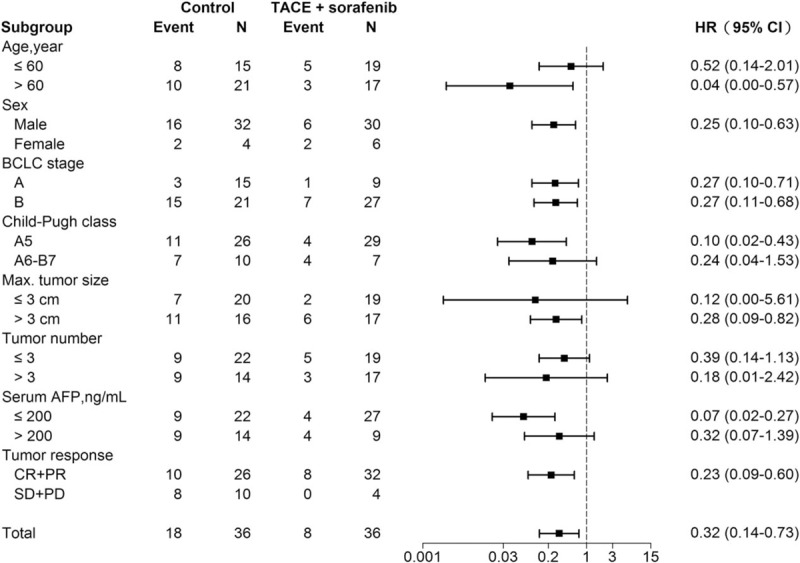
The baseline characteristics of the 36 patients in each group were similar. Tumor response rates were significantly better in the TACE and sorafenib group (P < .04). Overall survival of the TACE and sorafenib group was also significantly better than that of the control (TACE alone) group over the 2 years [78%, 95% confidence interval (95% CI) 64-91 vs 49, 95% CI 32-66; P = .012]. In the multivariate regression analysis, TACE and sorafenib was found to be independently associated with a decreased risk of mortality (HR 0.33, 95% CI 0.12-0.89; P = .015). Multivariate stratified analyses verified this association in each patient subgroup (all HR < 1.0).
With a high patient tolerance to an interrupted sorafenib dosing schedule, the combination of TACE with sorafenib was associated with improved overall survival in early-intermediate stage HCC when compared with treatment with TACE alone.
背景/目的:经动脉化疗栓塞术(TACE)联合索拉非尼治疗不可切除肝细胞癌(HCC)的生存获益仍不确定。我们比较了接受TACE联合索拉非尼治疗的患者与仅接受TACE治疗的患者的生存率。
这是一项对HCC患者TACE与索拉非尼联合治疗亚洲研究(START)试验的事后分析。2009年至2010年在台湾接受TACE并因早期或中期HCC中断索拉非尼给药的所有患者被纳入TACE联合索拉非尼组。他们按年龄、性别、Child-Pugh评分、肿瘤大小、肿瘤数量和肿瘤分期与同期在台湾台中荣民总医院接受单纯TACE且符合START试验选择标准的患者(对照组)进行1:1随机匹配。分析并比较两组患者的生存情况[累积发病率和风险比(HR)]。
每组36例患者的基线特征相似。TACE联合索拉非尼组的肿瘤反应率显著更好(P<0.04)。在2年期间,TACE联合索拉非尼组的总生存率也显著高于对照组(单纯TACE组)[78%,95%置信区间(95%CI)64 - 91 vs 49,95%CI 32 - 66;P = 0.012]。在多变量回归分析中,发现TACE联合索拉非尼与死亡风险降低独立相关(HR 0.33,95%CI 0.12 - 0.89;P = 0.015)。多变量分层分析在每个患者亚组中均证实了这种关联(所有HR<1.0)。
在患者对索拉非尼中断给药方案耐受性较高的情况下,与单纯TACE治疗相比,TACE联合索拉非尼治疗与早期 - 中期HCC患者的总生存率提高相关。