Loening Andreas M, Saranathan Manojkumar, Ruangwattanapaisarn Nichanan, Litwiller Daniel V, Shimakawa Ann, Vasanawala Shreyas S
Department of Radiology, Stanford University School of Medicine, Stanford, California, USA.
Department of Diagnostic and Therapeutic Radiology, Ramathibodi Hospital, Mahidol University, Bangkok, Thailand.
J Magn Reson Imaging. 2015 Dec;42(6):1747-58. doi: 10.1002/jmri.24941. Epub 2015 Jun 19.
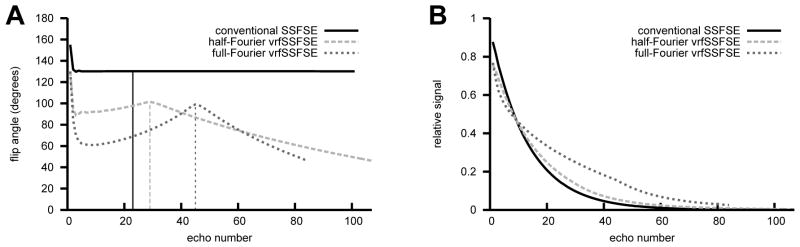
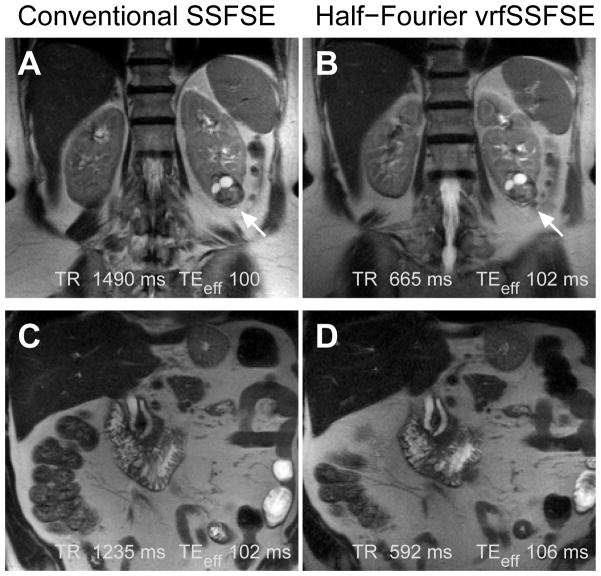
To develop and validate clinically a single-shot fast spin echo (SSFSE) sequence utilizing variable flip angle refocusing pulses to shorten acquisition times via reductions in specific absorption rate (SAR) and improve image quality.
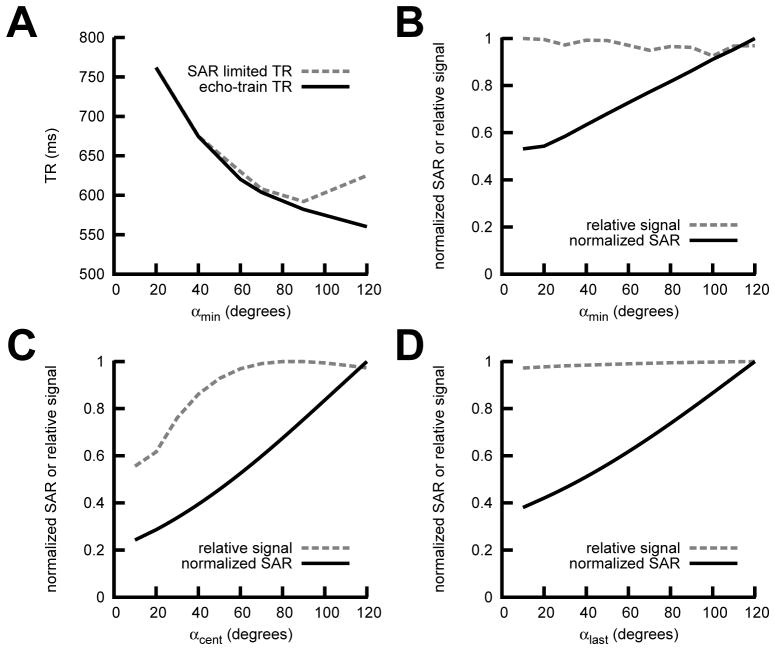
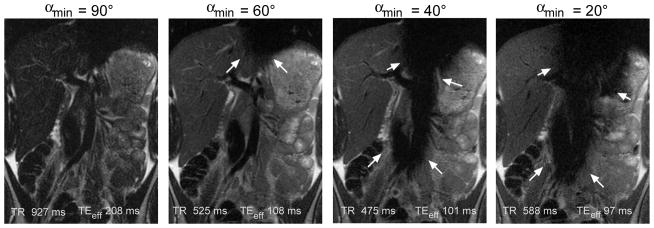
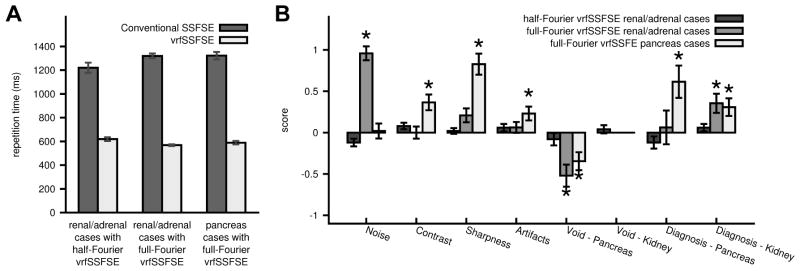
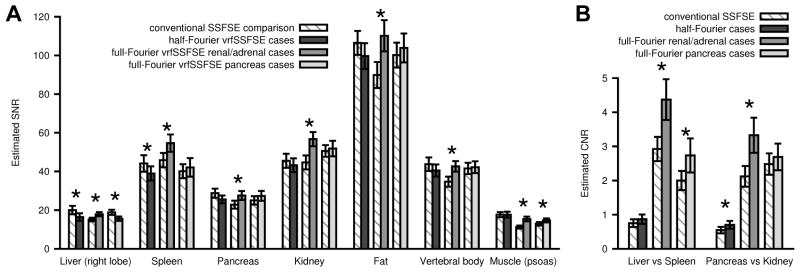
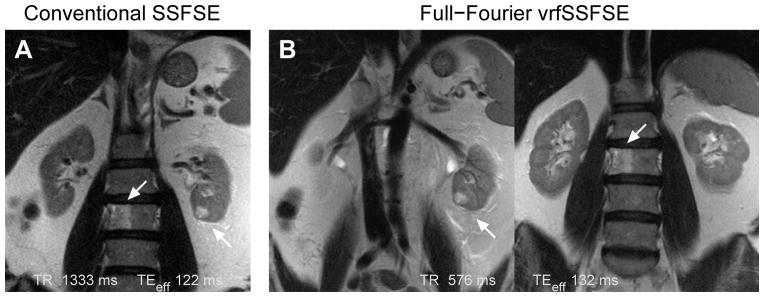
A variable refocusing flip angle SSFSE sequence (vrfSSFSE) was designed and implemented, with simulations and volunteer scans performed to determine suitable flip angle modulation parameters. With Institutional Review Board (IRB) approval/informed consent, patients referred for 3T abdominal magnetic resonance imaging (MRI) were scanned with conventional SSFSE and either half-Fourier (n = 25) or full-Fourier vrfSSFSE (n = 50). Two blinded radiologists semiquantitatively scored images on a scale from -2 to 2 for contrast, noise, sharpness, artifacts, cardiac motion-related signal loss, and the ability to evaluate the pancreas and kidneys.
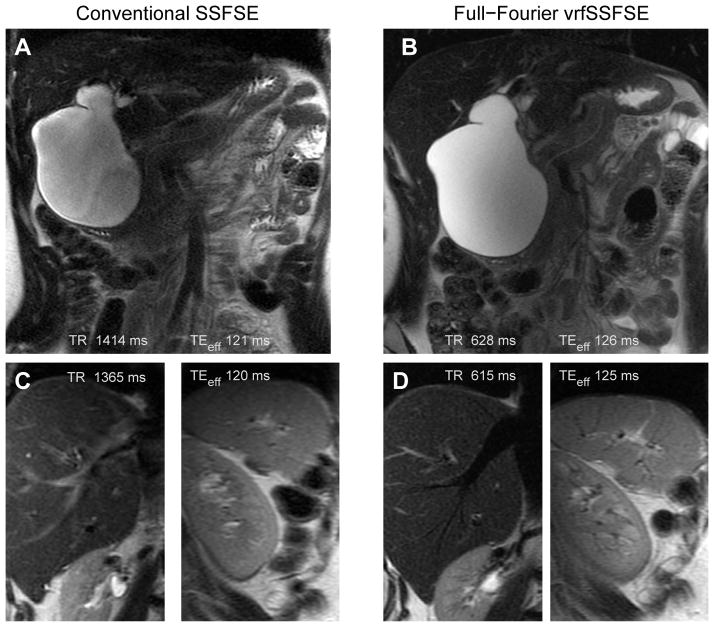
vrfSSFSE demonstrated significantly increased speed (∼2-fold, P < 0.0001). Significant improvements in image quality parameters with full-Fourier vrfSSFSE included increased contrast, sharpness, and visualization of pancreatic and renal structures with higher bandwidth technique (mean scores 0.37, 0.83, 0.62, and 0.31, respectively, P ≤ 0.001), and decreased image noise and improved visualization of renal structures when used with an equal bandwidth technique (mean scores 0.96 and 0.35, respectively, P < 0.001). Increased cardiac motion-related signal loss with full-Fourier vrfSSFSE was seen in the pancreas but not the kidney.
vrfSSFSE increases speed at 3T over conventional SSFSE via reduced SAR, and when combined with full-Fourier acquisition can improve image quality, although with some increased sensitivity to cardiac motion-related signal loss.
研发并在临床上验证一种单次激发快速自旋回波(SSFSE)序列,该序列利用可变翻转角重聚焦脉冲,通过降低比吸收率(SAR)来缩短采集时间,并提高图像质量。
设计并实施了一种可变重聚焦翻转角SSFSE序列(vrfSSFSE),通过模拟和志愿者扫描来确定合适的翻转角调制参数。经机构审查委员会(IRB)批准并获得知情同意后,对因3T腹部磁共振成像(MRI)前来就诊的患者进行扫描,扫描序列包括传统SSFSE以及半傅里叶(n = 25)或全傅里叶vrfSSFSE(n = 50)。两位不知情的放射科医生对图像的对比度、噪声、清晰度、伪影、与心脏运动相关的信号丢失以及评估胰腺和肾脏的能力进行半定量评分,评分范围为-2至2分。
vrfSSFSE显示速度显著提高(约2倍,P < 0.0001)。全傅里叶vrfSSFSE在图像质量参数方面有显著改善,包括使用更高带宽技术时对比度增加、清晰度提高以及胰腺和肾脏结构的可视化(平均得分分别为0.37、0.83、0.62和0.31,P≤0.001),并且在使用相同带宽技术时图像噪声降低以及肾脏结构的可视化得到改善(平均得分分别为0.96和0.35分,P < 0.001)。全傅里叶vrfSSFSE在胰腺中出现了与心脏运动相关的信号丢失增加,但在肾脏中未出现。
vrfSSFSE通过降低SAR在3T时比传统SSFSE速度更快,并且与全傅里叶采集相结合时可提高图像质量,尽管对与心脏运动相关的信号丢失的敏感性有所增加。