Attard S M, Herring A H, Wang H, Howard A-G, Thompson A L, Adair L S, Mayer-Davis E J, Gordon-Larsen P
Department of Nutrition, Gillings School of Global Public Health, UNC-Chapel Hill, Chapel Hill, NC, USA.
1] Carolina Population Center, UNC-Chapel Hill, Chapel Hill, NC, USA [2] Department of Biostatistics, Gillings School of Global Public Health, UNC-Chapel Hill, Chapel Hill, NC, USA.
Nutr Diabetes. 2015 Jun 22;5(6):e166. doi: 10.1038/nutd.2015.16.
BACKGROUND/OBJECTIVES: Nonglycemic factors like iron deficiency (ID) or anemia may interfere with classification of diabetes and prediabetes using hemoglobin A1c (HbA1c). However, few population-based studies of diabetes in areas with endemic ID/anemia have been conducted. We aimed to determine how mutually exclusive categories of ID alone, anemia alone and iron-deficiency anemia (IDA) were each associated with prediabetes and diabetes prevalence using fasting blood glucose (FBG) versus HbA1c in a population-based study of adults with endemic ID/anemia.
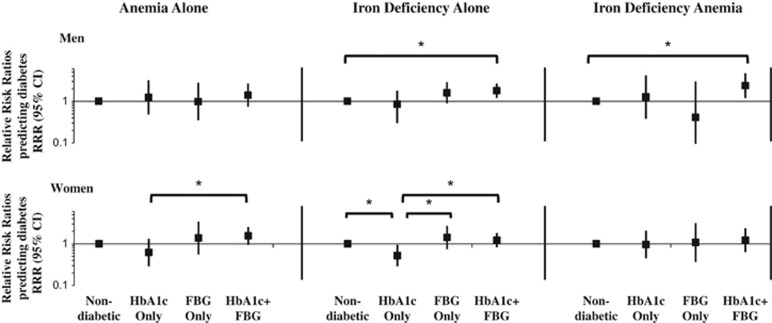
SUBJECTS/METHODS: We used data from the China Health and Nutrition Survey, a longitudinal, population-based study across 228 communities within nine provinces of China. This analysis included 7308 adults seen in the 2009 survey aged 18-75 years. We used descriptive and covariate-adjusted models to examine relative risk of prediabetes and diabetes using FBG alone, HbA1c alone, HbA1c and FBG, or neither (normoglycemia) by anemia alone, ID alone, IDA or normal iron/hemoglobin.
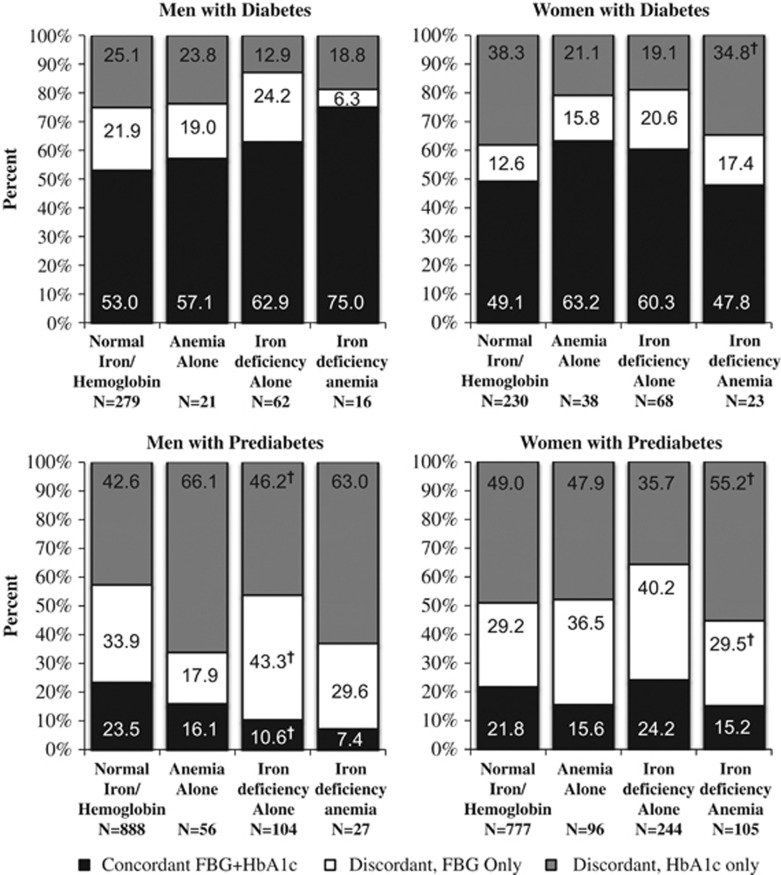
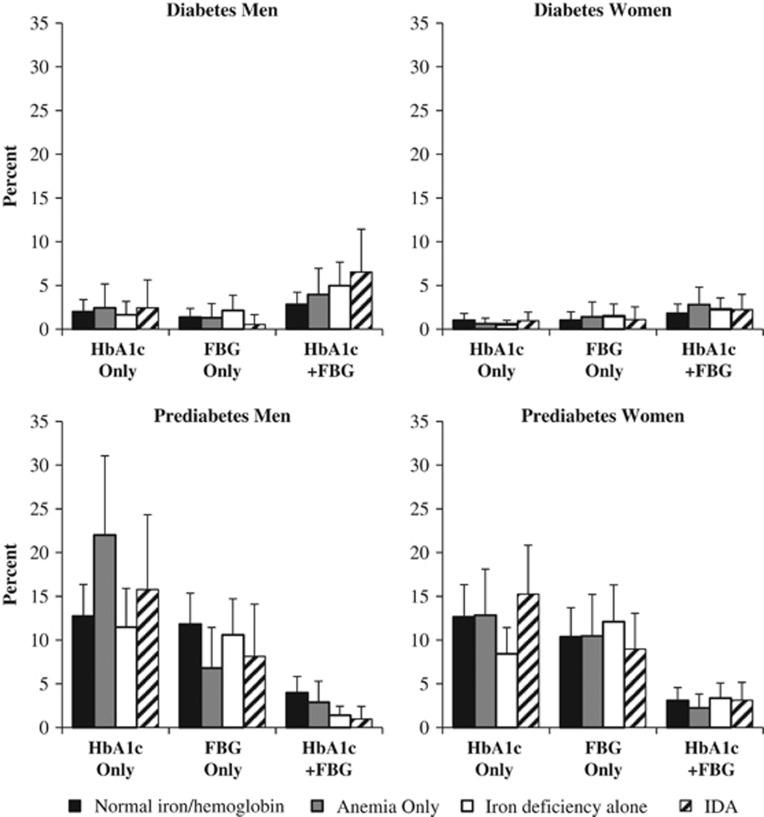
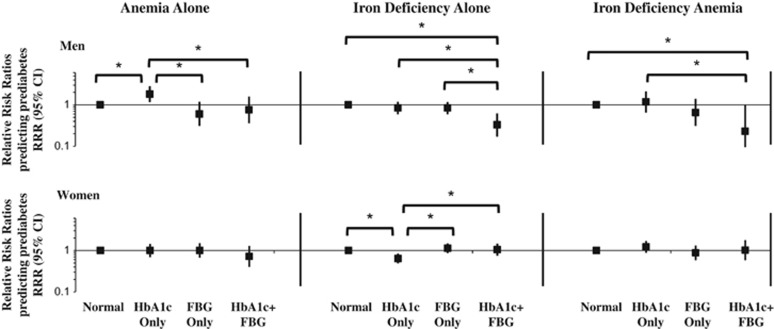
Approximately 65% of individuals with diabetes in our sample were concordantly classified with diabetes using both FBG and HbA1c, while 35% had a discordant diabetes classification: they were classified using either FBG or HbA1c, but not both. Fewer participants with ID alone versus normal iron/hemoglobin were classified with diabetes using HbA1c only. From covariate-adjusted, multinomial regression analyses, the adjusted prevalence of prediabetes using HbA1c only was 22% for men with anemia alone, but 13% for men with normal iron/hemoglobin. In contrast, the predicted prevalence of prediabetes using HbA1c only was 8% for women with ID alone, compared with 13% for women with normal iron/hemoglobin.
These findings suggest potential misclassification of diabetes using HbA1c in areas of endemic ID/anemia. Estimating diabetes prevalence using HbA1c may result in under-diagnosis in women with ID and over-diagnosis in men with anemia.
背景/目的:缺铁(ID)或贫血等非血糖因素可能会干扰使用糖化血红蛋白(HbA1c)对糖尿病和糖尿病前期的分类。然而,在ID/贫血流行地区,基于人群的糖尿病研究较少。我们旨在通过空腹血糖(FBG)与HbA1c,在一项针对ID/贫血流行的成年人群体研究中,确定单独的ID、单独的贫血和缺铁性贫血(IDA)这几种相互排斥的类别与糖尿病前期和糖尿病患病率之间的关联。
对象/方法:我们使用了中国健康与营养调查的数据,这是一项对中国九个省份228个社区进行的纵向人群研究。该分析纳入了2009年调查中7308名年龄在18 - 75岁的成年人。我们使用描述性和协变量调整模型,通过单独的FBG、单独的HbA1c、HbA1c和FBG或两者都不使用(正常血糖),按单独的贫血、单独的ID、IDA或正常铁/血红蛋白情况,来检查糖尿病前期和糖尿病的相对风险。
在我们的样本中,约65%的糖尿病患者使用FBG和HbA1c都被一致分类为糖尿病,而35%的患者糖尿病分类不一致:他们仅通过FBG或HbA1c进行分类,但不是两者都用。与铁/血红蛋白正常的参与者相比,仅使用HbA1c将单独ID的参与者分类为糖尿病的较少。从协变量调整的多项回归分析来看,仅使用HbA1c时,单独贫血的男性糖尿病前期调整患病率为22%,而铁/血红蛋白正常的男性为13%。相比之下,仅使用HbA1c时,单独ID的女性糖尿病前期预测患病率为8%,而铁/血红蛋白正常的女性为13%。
这些发现表明,在ID/贫血流行地区使用HbA1c对糖尿病进行分类可能存在潜在错误分类。使用HbA1c估计糖尿病患病率可能导致ID女性的诊断不足和贫血男性的诊断过度。