McMillan Stuart, Verner-Jeffreys David, Weeks Jason, Austin Brian, Desbois Andrew P
Marine Biotechnology Research Group, Institute of Aquaculture, School of Natural Sciences, University of Stirling, Stirling, UK.
Centre for Environment, Fisheries and Aquaculture Science, Weymouth, UK.
BMC Microbiol. 2015 Jun 23;15:127. doi: 10.1186/s12866-015-0466-9.
Microbial diseases cause considerable economic losses in aquaculture and new infection control measures often rely on a better understanding of pathogenicity. However, disease studies performed in fish hosts often require specialist infrastructure (e.g., aquaria), adherence to strict legislation and do not permit high-throughput approaches; these reasons justify the development of alternative hosts. This study aimed to validate the use of larvae of the greater wax moth (Galleria mellonella) to investigate virulence of the important fish pathogen, Vibrio anguillarum.
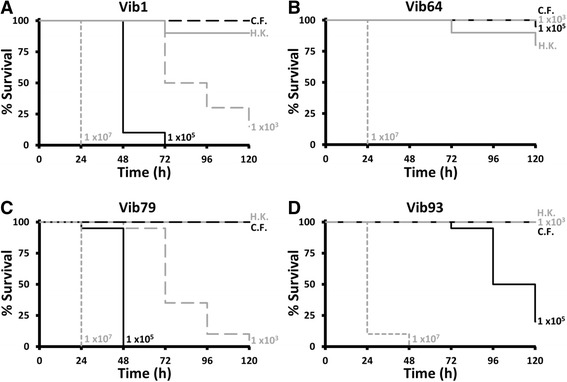
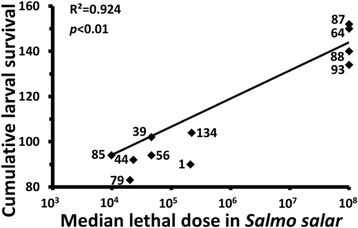
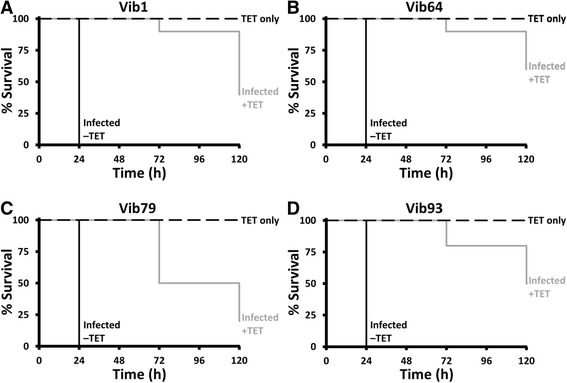
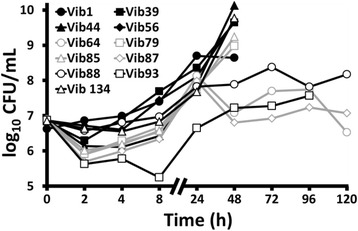
Using 11 wild-type isolates of V. anguillarum, these bacteria killed larvae in a dose-dependent manner and replicated inside the haemolymph, but infected larvae were rescued by antibiotic therapy. Crucially, virulence correlated significantly and positively in larva and Atlantic salmon (Salmo salar) infection models. Challenge studies with mutants knocked out for single virulence determinants confirmed conserved roles in larva and fish infections in some cases (pJM1 plasmid, rtxA), but not all (empA, flaA, flaE).
The G. mellonella model is simple, more ethically acceptable than experiments on vertebrates and, crucially, does not necessitate liquid systems, which reduces infrastructure requirements and biohazard risks associated with contaminated water. The G. mellonella model may aid our understanding of microbial pathogens in aquaculture and lead to the timely introduction of new effective remedies for infectious diseases, while adhering to the principles of replacement, reduction and refinement (3Rs) and considerably reducing the number of vertebrates used in such studies.
微生物疾病在水产养殖中造成了巨大的经济损失,新的感染控制措施往往依赖于对致病性的更好理解。然而,在鱼类宿主中进行的疾病研究通常需要专门的基础设施(如水族箱),遵守严格的法规,并且不允许采用高通量方法;这些原因促使人们开发替代宿主。本研究旨在验证大蜡螟(Galleria mellonella)幼虫用于研究重要鱼类病原体鳗弧菌(Vibrio anguillarum)毒力的可行性。
使用11株鳗弧菌野生型菌株,这些细菌以剂量依赖的方式杀死幼虫,并在血淋巴内复制,但感染的幼虫可通过抗生素治疗获救。至关重要的是,在幼虫和大西洋鲑(Salmo salar)感染模型中,毒力呈显著正相关。对单个毒力决定因素基因敲除的突变体进行的攻毒研究证实,在某些情况下(pJM1质粒、rtxA),幼虫和鱼类感染中存在保守作用,但并非所有情况(empA、flaA、flaE)都是如此。
大蜡螟模型简单,比在脊椎动物上进行的实验更符合伦理,而且至关重要的是,不需要液体系统,这降低了基础设施要求以及与受污染水相关的生物危害风险。大蜡螟模型可能有助于我们了解水产养殖中的微生物病原体,并及时引入针对传染病的新的有效治疗方法,同时坚持替代、减少和优化(3R)原则,并大幅减少此类研究中使用的脊椎动物数量。