
家庭内耐多药结核病和药物敏感结核病的传播:一项前瞻性队列研究
Transmission of Multidrug-Resistant and Drug-Susceptible Tuberculosis within Households: A Prospective Cohort Study.
作者信息
Grandjean Louis, Gilman Robert H, Martin Laura, Soto Esther, Castro Beatriz, Lopez Sonia, Coronel Jorge, Castillo Edith, Alarcon Valentina, Lopez Virginia, San Miguel Angela, Quispe Neyda, Asencios Luis, Dye Christopher, Moore David A J
机构信息
Wellcome Centre for Clinical Tropical Medicine, Imperial College London, London, United Kingdom; Universidad Peruana Cayetano Heredia, Lima, Peru; TB Centre, London School of Hygiene & Tropical Medicine, London, United Kingdom.
Universidad Peruana Cayetano Heredia, Lima, Peru; Johns Hopkins Bloomberg School of Public Health, Baltimore, Maryland, United States of America.
出版信息
PLoS Med. 2015 Jun 23;12(6):e1001843; discussion e1001843. doi: 10.1371/journal.pmed.1001843. eCollection 2015 Jun.
BACKGROUND
The "fitness" of an infectious pathogen is defined as the ability of the pathogen to survive, reproduce, be transmitted, and cause disease. The fitness of multidrug-resistant tuberculosis (MDRTB) relative to drug-susceptible tuberculosis is cited as one of the most important determinants of MDRTB spread and epidemic size. To estimate the relative fitness of drug-resistant tuberculosis cases, we compared the incidence of tuberculosis disease among the household contacts of MDRTB index patients to that among the contacts of drug-susceptible index patients.
METHODS AND FINDINGS
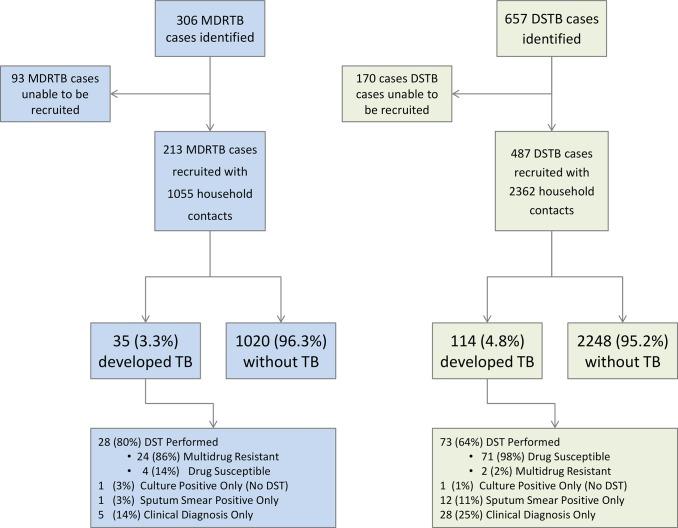
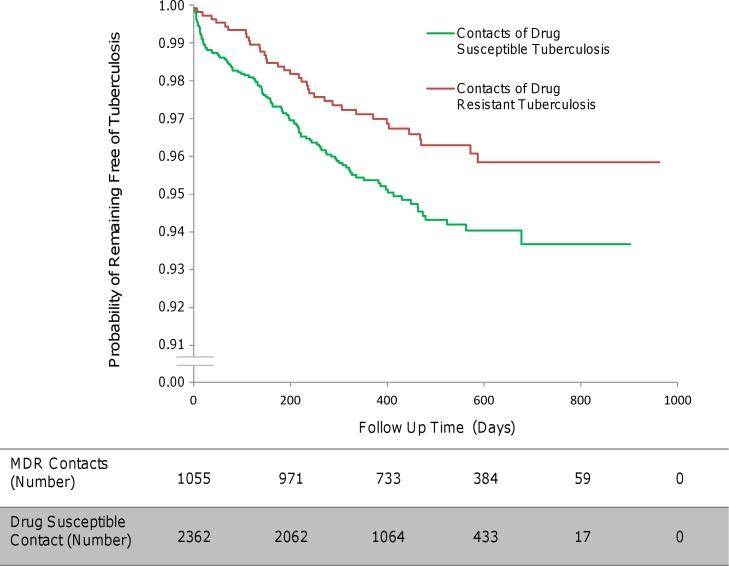
This 3-y (2010-2013) prospective cohort household follow-up study in South Lima and Callao, Peru, measured the incidence of tuberculosis disease among 1,055 household contacts of 213 MDRTB index cases and 2,362 household contacts of 487 drug-susceptible index cases. A total of 35/1,055 (3.3%) household contacts of 213 MDRTB index cases developed tuberculosis disease, while 114/2,362 (4.8%) household contacts of 487 drug-susceptible index patients developed tuberculosis disease. The total follow-up time for drug-susceptible tuberculosis contacts was 2,620 person-years, while the total follow-up time for MDRTB contacts was 1,425 person-years. Using multivariate Cox regression to adjust for confounding variables including contact HIV status, contact age, socio-economic status, and index case sputum smear grade, the hazard ratio for tuberculosis disease among MDRTB household contacts was found to be half that for drug-susceptible contacts (hazard ratio 0.56, 95% CI 0.34-0.90, p = 0.017). The inference of transmission in this study was limited by the lack of genotyping data for household contacts. Capturing incident disease only among household contacts may also limit the extrapolation of these findings to the community setting.
CONCLUSIONS
The low relative fitness of MDRTB estimated by this study improves the chances of controlling drug-resistant tuberculosis. However, fitter multidrug-resistant strains that emerge over time may make this increasingly difficult.
背景
传染性病原体的“适应性”定义为病原体生存、繁殖、传播和致病的能力。耐多药结核病(MDRTB)相对于药物敏感结核病的适应性被认为是耐多药结核病传播和流行规模的最重要决定因素之一。为了估计耐药结核病病例的相对适应性,我们比较了耐多药结核病指示病例的家庭接触者中结核病的发病率与药物敏感指示病例的接触者中的发病率。
方法与结果
这项在秘鲁利马南部和卡亚俄进行的为期3年(2010 - 2013年)的前瞻性队列家庭随访研究,测量了213例耐多药结核病指示病例的1055名家庭接触者和487例药物敏感指示病例的2362名家庭接触者中结核病的发病率。213例耐多药结核病指示病例的1055名家庭接触者中共有35例(3.3%)发生了结核病,而487例药物敏感指示病例的2362名家庭接触者中有114例(4.8%)发生了结核病。药物敏感结核病接触者的总随访时间为2620人年,而耐多药结核病接触者的总随访时间为1425人年。使用多变量Cox回归来调整包括接触者HIV状态、接触者年龄、社会经济状况和指示病例痰涂片等级等混杂变量,发现耐多药结核病家庭接触者中结核病的风险比是药物敏感接触者的一半(风险比0.56,95%可信区间0.34 - 0.90,p = 0.017)。本研究中传播的推断因缺乏家庭接触者的基因分型数据而受到限制。仅在家庭接触者中捕获新发疾病也可能限制这些发现向社区环境的外推。
结论
本研究估计的耐多药结核病相对适应性较低,这增加了控制耐药结核病的机会。然而,随着时间推移出现的适应性更强的耐多药菌株可能会使这一情况越来越困难。



 Zotero 插件