Laboratory of Memory and Cognition, Université Paris Descartes, Boulogne-Billancourt, France ; Center of Psychiatry and Neurosciences, INSERM UMR S894, Université Paris Descartes, Paris, France.
Department of Radiology, Université Paris Descartes, Centre de Psychiatrie et Neuroscience, INSERM U894, Paris, France.
PLoS One. 2013 Dec 18;8(12):e82385. doi: 10.1371/journal.pone.0082385. eCollection 2013.
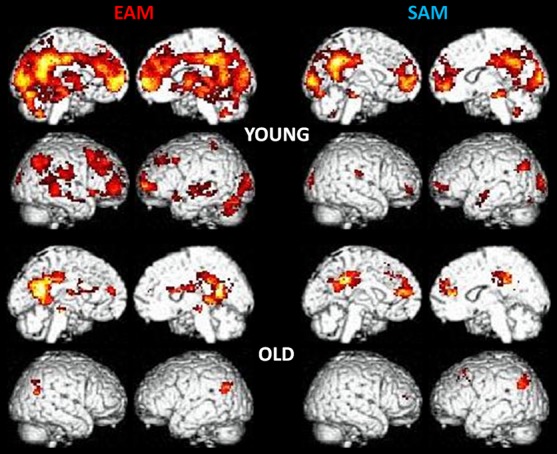
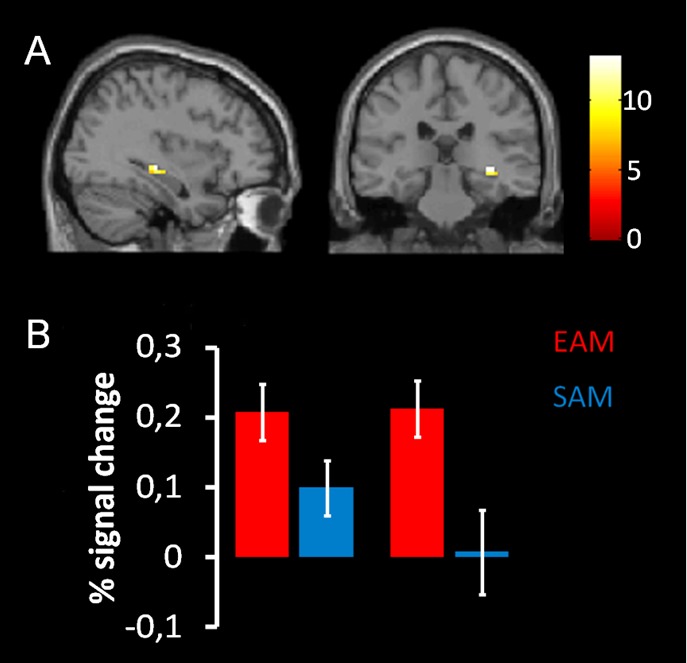
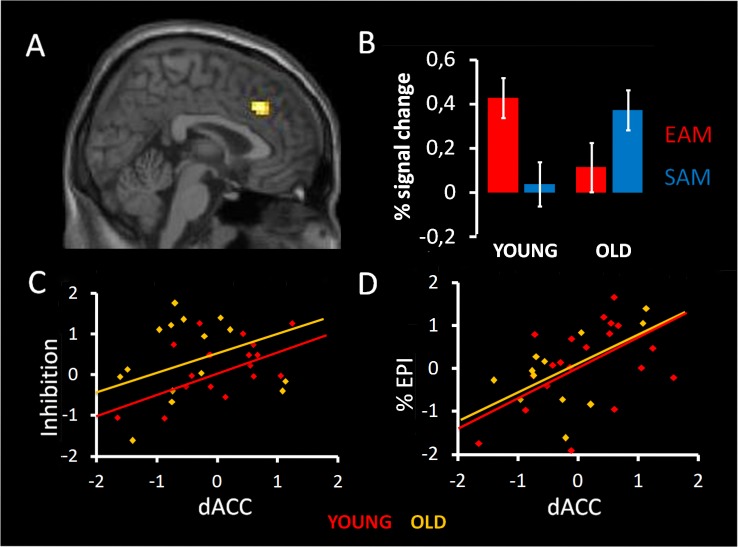
Age-related changes in autobiographical memory (AM) recall are characterized by a decline in episodic details, while semantic aspects are spared. This deleterious effect is supposed to be mediated by an inefficient recruitment of executive processes during AM retrieval. To date, contrasting evidence has been reported on the neural underpinning of this decline, and none of the previous studies has directly compared the episodic and semantic aspects of AM in elderly. We asked 20 young and 17 older participants to recall specific and general autobiographical events (i.e., episodic and semantic AM) elicited by personalized cues while recording their brain activity by means of fMRI. At the behavioral level, we confirmed that the richness of episodic AM retrieval is specifically impoverished in aging and that this decline is related to the reduction of executive functions. At the neural level, in both age groups, we showed the recruitment of a large network during episodic AM retrieval encompassing prefrontal, cortical midline and posterior regions, and medial temporal structures, including the hippocampus. This network was very similar, but less extended, during semantic AM retrieval. Nevertheless, a greater activity was evidenced in the dorsal anterior cingulate cortex (dACC) during episodic, compared to semantic AM retrieval in young participants, and a reversed pattern in the elderly. Moreover, activity in dACC during episodic AM retrieval was correlated with inhibition and richness of memories in both groups. Our findings shed light on the direct link between episodic AM retrieval, executive control, and their decline in aging, proposing a possible neuronal signature. They also suggest that increased activity in dACC during semantic AM retrieval in the elderly could be seen as a compensatory mechanism underpinning successful AM performance observed in aging. These results are discussed in the framework of recently proposed models of neural reorganization in aging.
年龄相关的自传体记忆(AM)回忆的变化特点是情节细节的下降,而语义方面则不受影响。这种有害的影响被认为是由于在 AM 检索过程中执行过程的效率低下而介导的。迄今为止,关于这种下降的神经基础的对比证据已经有报道,但之前的研究都没有直接比较老年人的 AM 的情节和语义方面。我们要求 20 名年轻参与者和 17 名老年参与者在回忆个性化线索诱发的特定和一般自传体事件(即情节和语义 AM)时,通过 fMRI 记录他们的大脑活动。在行为水平上,我们证实情节 AM 回忆的丰富性在衰老中特异性地减少,并且这种下降与执行功能的减少有关。在神经水平上,在两个年龄组中,我们在情节 AM 检索过程中都显示了一个包含前额叶、皮质中线和后区以及内侧颞叶结构(包括海马体)的大型网络的招募。在语义 AM 检索过程中,这个网络非常相似,但扩展较少。然而,在年轻参与者中,与语义 AM 检索相比,在情节 AM 检索过程中 dACC(背侧前扣带皮层)的活动更强,而在老年人中则呈现相反的模式。此外,在两个组中,dACC 在情节 AM 检索过程中的活动与记忆的抑制和丰富度相关。我们的研究结果揭示了情节 AM 检索、执行控制及其在衰老中的下降之间的直接联系,提出了一种可能的神经元特征。它们还表明,在老年人中,在语义 AM 检索过程中 dACC 的活动增加可能被视为支持在衰老中观察到的成功 AM 表现的补偿机制。这些结果在最近提出的衰老中神经重组模型的框架内进行了讨论。