Kutch Jason J, Yani Moheb S, Asavasopon Skulpan, Kirages Daniel J, Rana Manku, Cosand Louise, Labus Jennifer S, Kilpatrick Lisa A, Ashe-McNalley Cody, Farmer Melissa A, Johnson Kevin A, Ness Timothy J, Deutsch Georg, Harris Richard E, Apkarian A Vania, Clauw Daniel J, Mackey Sean C, Mullins Chris, Mayer Emeran A
Division of Biokinesiology and Physical Therapy, University of Southern California, Los Angeles, CA, USA.
Physical Therapy Department, Loma Linda University, Loma Linda, CA, USA.
Neuroimage Clin. 2015 Jun 5;8:493-502. doi: 10.1016/j.nicl.2015.05.013. eCollection 2015.
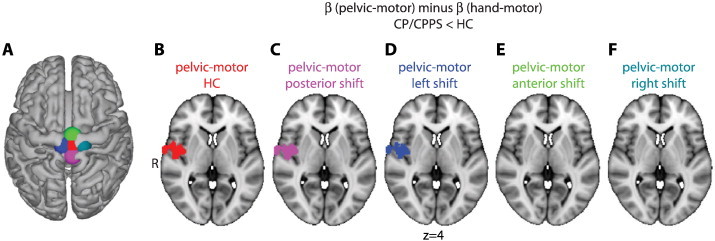
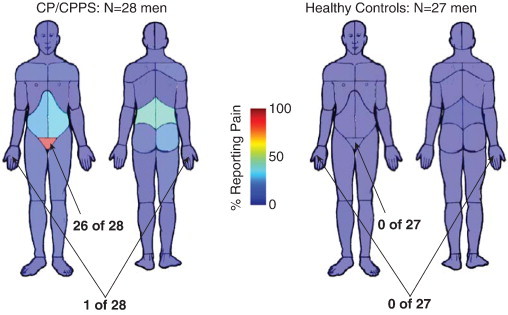
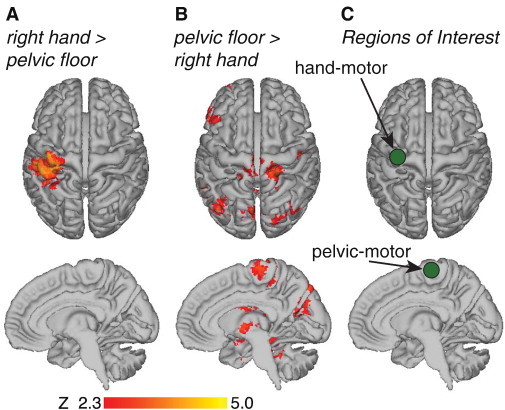
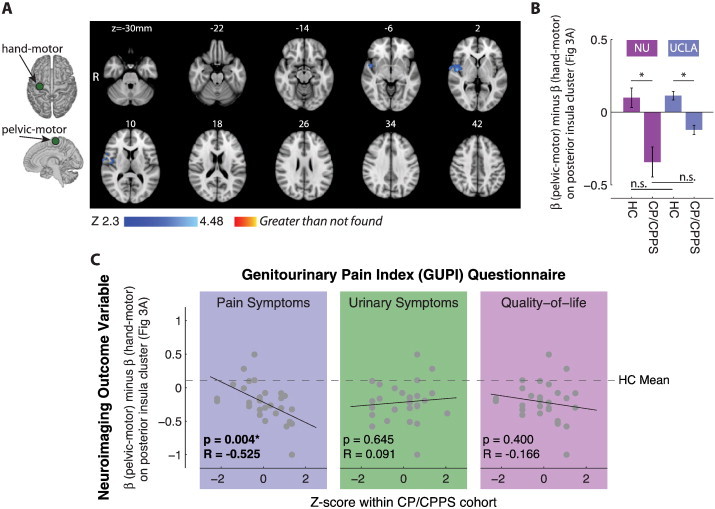
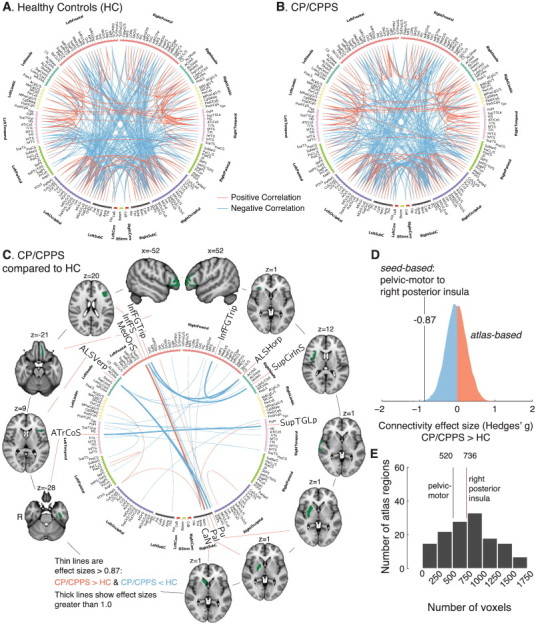
Brain network activity associated with altered motor control in individuals with chronic pain is not well understood. Chronic Prostatitis/Chronic Pelvic Pain Syndrome (CP/CPPS) is a debilitating condition in which previous studies have revealed altered resting pelvic floor muscle activity in men with CP/CPPS compared to healthy controls. We hypothesized that the brain networks controlling pelvic floor muscles would also show altered resting state function in men with CP/CPPS. Here we describe the results of the first test of this hypothesis focusing on the motor cortical regions, termed pelvic-motor, that can directly activate pelvic floor muscles. A group of men with CP/CPPS (N = 28), as well as group of age-matched healthy male controls (N = 27), had resting state functional magnetic resonance imaging scans as part of the Multidisciplinary Approach to the Study of Chronic Pelvic Pain (MAPP) Research Network study. Brain maps of the functional connectivity of pelvic-motor were compared between groups. A significant group difference was observed in the functional connectivity between pelvic-motor and the right posterior insula. The effect size of this group difference was among the largest effect sizes in functional connectivity between all pairs of 165 anatomically-defined subregions of the brain. Interestingly, many of the atlas region pairs with large effect sizes also involved other subregions of the insular cortices. We conclude that functional connectivity between motor cortex and the posterior insula may be among the most important markers of altered brain function in men with CP/CPPS, and may represent changes in the integration of viscerosensory and motor processing.
慢性疼痛患者中与运动控制改变相关的脑网络活动尚未得到充分理解。慢性前列腺炎/慢性盆腔疼痛综合征(CP/CPPS)是一种使人衰弱的病症,此前的研究表明,与健康对照组相比,患有CP/CPPS的男性静息盆底肌肉活动存在改变。我们假设,控制盆底肌肉的脑网络在患有CP/CPPS的男性中也会表现出静息状态功能改变。在此,我们描述了针对这一假设的首次测试结果,该测试聚焦于能够直接激活盆底肌肉的运动皮层区域,即盆部运动区。一组患有CP/CPPS的男性(N = 28)以及一组年龄匹配的健康男性对照组(N = 27)接受了静息态功能磁共振成像扫描,这是慢性盆腔疼痛研究多学科方法(MAPP)研究网络研究的一部分。比较了两组之间盆部运动区功能连接的脑图谱。在盆部运动区与右侧后岛叶之间的功能连接中观察到显著的组间差异。该组间差异的效应大小在大脑165个解剖学定义的子区域所有配对之间的功能连接效应大小中处于最大之列。有趣的是,许多效应大小较大的图谱区域对也涉及岛叶皮质的其他子区域。我们得出结论,运动皮层与后岛叶之间的功能连接可能是患有CP/CPPS的男性脑功能改变的最重要标志之一,并且可能代表内脏感觉和运动处理整合的变化。