Shi Peihua, Tang Liang, Wang Lihuan, Sun Ting, Liu Leilei, Cao Weixing, Zhu Yan
National Engineering and Technology Center for Information Agriculture, Jiangsu Key Laboratory for Information Agriculture, Jiangsu Collaborative Innovation Center for Modern Crop Production, Nanjing Agricultural University, Nanjing, Jiangsu, 210095, P. R. China.
PLoS One. 2015 Jun 25;10(6):e0130642. doi: 10.1371/journal.pone.0130642. eCollection 2015.
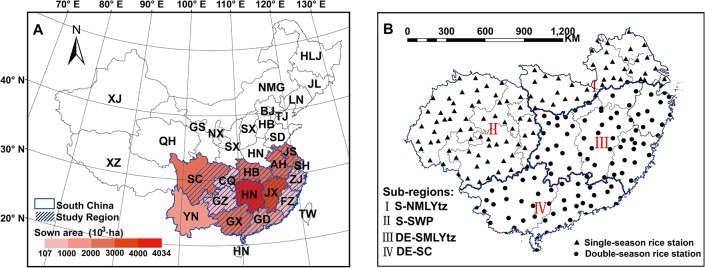
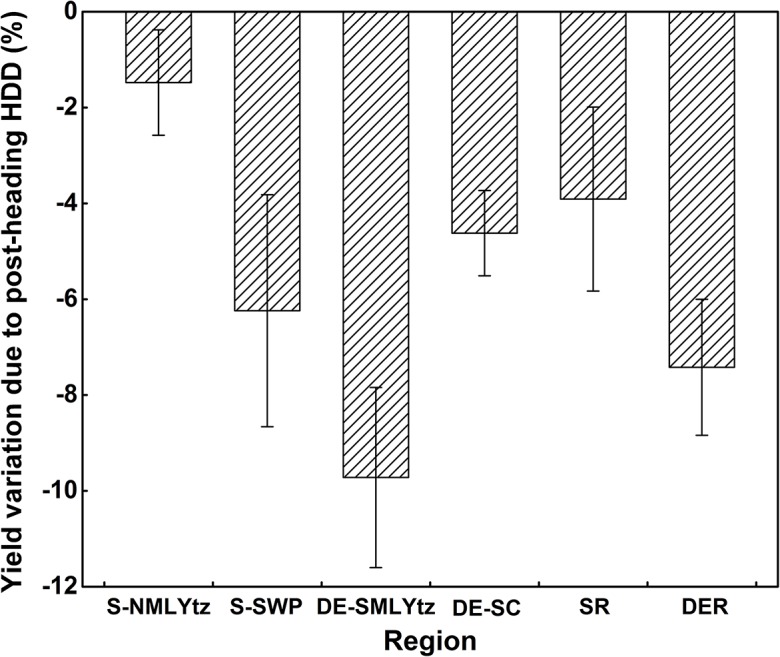
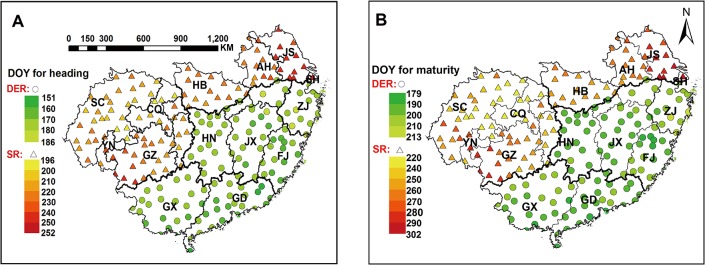
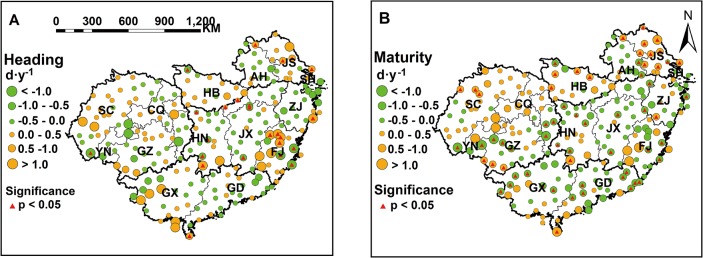
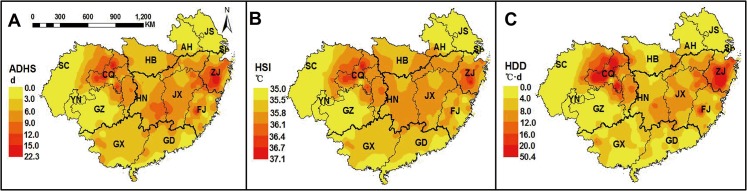
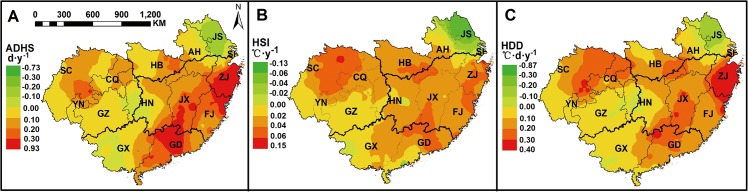
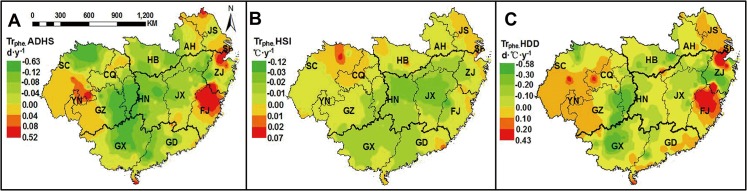
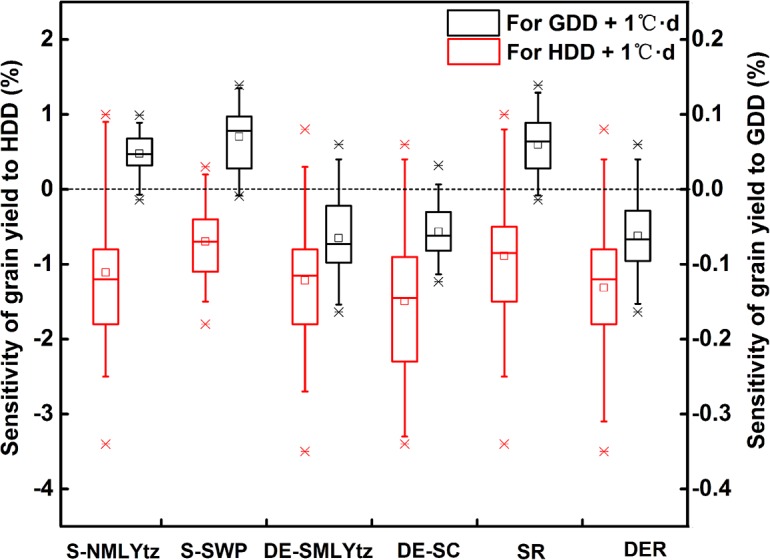
Frequent extreme heat events are the serious threat to rice production, but the historical trend of heat stress associated with phenology shift and its impact on rice yield over a long period are poorly known. Based on the analysis of observed climate and phenology data from 228 stations in South China during 1981-2010, the spatio-temporal variation of post-heading heat stress was investigated among two single-season rice sub-regions in the northern Middle and Lower Reaches of Yangtze River (S-NMLYtz) and Southwest Plateau (S-SWP), and two double-season early rice sub-regions in the southern Middle and Lower Reaches of Yangtze River (DE-SMLYtz) and Southern China (DE-SC). Post-heading heat stress was more severe in DE-SMLYtz, west S-NMLYtz and east S-SWP than elsewhere, because of rice exposure to the hot season during post-heading stage. The spatial variation of post-heading heat stress was greater in single-season rice region than in double-season early rice region due to the greater spatial variation of heading and maturity dates. Post-heading heat stress increased from 1981 to 2010 in most areas, with significant increases in the east of double-season early rice region and west S-SWP. Phenology shift during 1981-2010 mitigated the increasing trends of heat stress in most areas, but not in west S-SWP. Post-heading heat stress played a dominated role in the reduction of rice yield in South China. Grain yield was more sensitive to post-heading heat stress in double-season early rice region than that in single-season rice region. Rice yield decreased by 1.5%, 6.2%, 9.7% and 4.6% in S-NMLYtz, S-SWP, DE-SMLYtz and DE-SC, respectively, because of post-heading heat stress during 1981-2010, although there were some uncertainties. Given the current level and potential increase of post-heading heat stress in South China, the specific adaptation or mitigation strategies are necessary for different sub-regions to stabilize rice production under heat stress.
频繁的极端高温事件对水稻生产构成严重威胁,但长期以来与物候变化相关的热胁迫历史趋势及其对水稻产量的影响却鲜为人知。基于对1981 - 2010年中国南方228个站点观测到的气候和物候数据的分析,研究了长江中下游北部单季稻区(S - NMLYtz)和西南高原(S - SWP)两个单季稻亚区以及长江中下游南部双季早稻区(DE - SMLYtz)和华南(DE - SC)两个双季早稻亚区抽穗后热胁迫的时空变化。由于水稻在抽穗后阶段处于炎热季节,DE - SMLYtz、S - NMLYtz西部和S - SWP东部的抽穗后热胁迫比其他地方更严重。由于抽穗期和成熟期的空间变化更大,单季稻区抽穗后热胁迫的空间变化比双季早稻区更大。1981年至2010年,大多数地区抽穗后热胁迫增加,双季早稻区东部和S - SWP西部显著增加。1981 - 2010年期间的物候变化缓解了大多数地区热胁迫的增加趋势,但S - SWP西部除外。抽穗后热胁迫在中国南方水稻产量下降中起主导作用。双季早稻区的谷物产量对抽穗后热胁迫比单季稻区更敏感。尽管存在一些不确定性,但由于1981 - 2010年期间的抽穗后热胁迫,S - NMLYtz、S - SWP、DE - SMLYtz和DE - SC的水稻产量分别下降了1.5%、6.2%、9.7%和4.6%。鉴于中国南方目前抽穗后热胁迫的水平及其潜在增加,不同亚区需要采取具体的适应或缓解策略,以在热胁迫下稳定水稻生产。