Kitashoji Emi, Koizumi Nobuo, Lacuesta Talitha Lea V, Usuda Daisuke, Ribo Maricel R, Tria Edith S, Go Winston S, Kojiro Maiko, Parry Christopher M, Dimaano Efren M, Villarama Jose B, Ohnishi Makoto, Suzuki Motoi, Ariyoshi Koya
Department of Clinical Tropical Medicine, Institute of Tropical Medicine, Nagasaki University Graduate School of Biomedical Science, Sakamoto, Nagasaki, Japan.
Department of Bacteriology I, National Institute of Infectious Diseases, Toyama, Shinjuku-ku, Tokyo, Japan.
PLoS Negl Trop Dis. 2015 Jun 25;9(6):e0003879. doi: 10.1371/journal.pntd.0003879. eCollection 2015.
Leptospirosis is an important but largely under-recognized public health problem in the tropics. Establishment of highly sensitive and specific laboratory diagnosis is essential to reveal the magnitude of problem and to improve treatment. This study aimed to evaluate the diagnostic accuracy of a recombinant LigA protein based IgM ELISA during outbreaks in the clinical-setting of a highly endemic country.
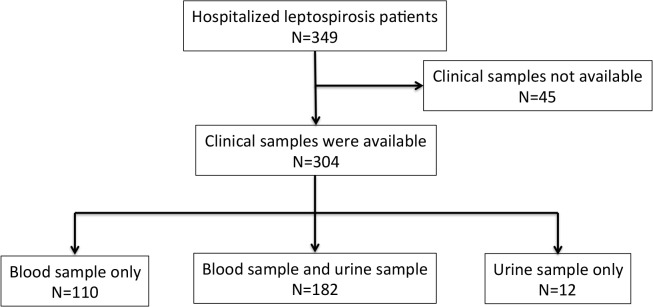
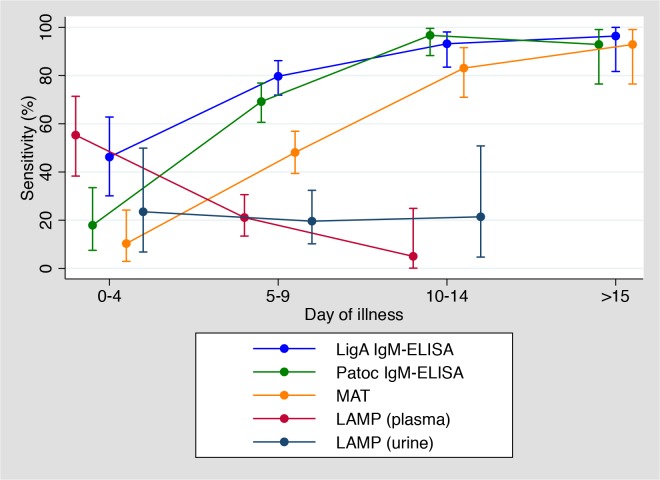
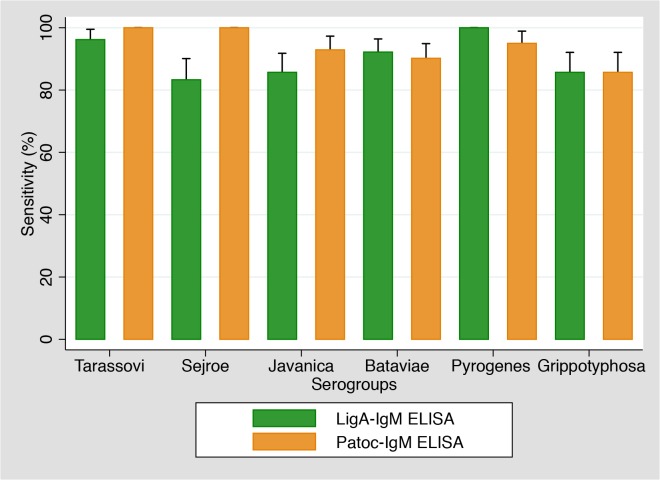
METHODOLOGY/PRINCIPAL FINDINGS: A prospective study was conducted from October 2011 to September 2013 at a national referral hospital for infectious diseases in Manila, Philippines. Patients who were hospitalized with clinically suspected leptospirosis were enrolled. Plasma and urine were collected on admission and/or at discharge and tested using the LigA-IgM ELISA and a whole cell-based IgM ELISA. Sensitivity and specificity of these tests were evaluated with cases diagnosed by microscopic agglutination test (MAT), culture and LAMP as the composite reference standard and blood bank donors as healthy controls: the mean+3 standard deviation optical density value of healthy controls was used as the cut-off limit (0.062 for the LigA-IgM ELISA and 0.691 for the whole cell-based IgM ELISA). Of 304 patients enrolled in the study, 270 (89.1%) were male and the median age was 30.5 years; 167 (54.9%) were laboratory confirmed. The sensitivity and ROC curve AUC for the LigA-IgM ELISA was significantly greater than the whole cell-based IgM ELISA (69.5% vs. 54.3%, p<0.01; 0.90 vs. 0.82, p<0.01) on admission, but not at discharge. The specificity of LigA-IgM ELISA and whole cell-based IgM ELISA were not significantly different (98% vs. 97%). Among 158 MAT negative patients, 53 and 28 were positive by LigA- and whole cell-based IgM ELISA, respectively; if the laboratory confirmation was re-defined by LigA-IgM ELISA and LAMP, the clinical findings were more characteristic of leptospirosis than the diagnosis based on MAT/culture/LAMP.
CONCLUSIONS/SIGNIFICANCE: The newly developed LigA-IgM ELISA is more sensitive than the whole cell-based IgM based ELISA. Although the final diagnosis must be validated by more specific tests, LigA-IgM ELISA could be a useful diagnostic test in a real clinical-setting, where diagnosis is needed in the early phase of infection.
钩端螺旋体病是热带地区一个重要但很大程度上未得到充分认识的公共卫生问题。建立高度敏感和特异的实验室诊断对于揭示问题的严重程度和改善治疗至关重要。本研究旨在评估一种基于重组LigA蛋白的IgM ELISA在一个高流行国家临床环境中疫情爆发期间的诊断准确性。
方法/主要发现:2011年10月至2013年9月在菲律宾马尼拉一家国家传染病转诊医院进行了一项前瞻性研究。纳入临床疑似钩端螺旋体病住院患者。入院时和/或出院时采集血浆和尿液,使用LigA-IgM ELISA和基于全细胞的IgM ELISA进行检测。以显微镜凝集试验(MAT)、培养和环介导等温扩增(LAMP)诊断的病例作为综合参考标准,以血库献血者作为健康对照,评估这些检测的敏感性和特异性:将健康对照的平均+3标准差光密度值用作截断值(LigA-IgM ELISA为0.062,基于全细胞的IgM ELISA为0.691)。在纳入研究的304例患者中,270例(89.1%)为男性,中位年龄为30.5岁;167例(54.9%)经实验室确诊。入院时,LigA-IgM ELISA的敏感性和ROC曲线AUC显著高于基于全细胞的IgM ELISA(69.5%对54.3%,p<0.01;0.90对0.82,p<0.01),但出院时并非如此。LigA-IgM ELISA和基于全细胞的IgM ELISA的特异性无显著差异(98%对97%)。在158例MAT阴性患者中,分别有53例和28例通过LigA-IgM ELISA和基于全细胞的IgM ELISA呈阳性;如果通过LigA-IgM ELISA和LAMP重新定义实验室确诊,则临床发现比基于MAT/培养/LAMP的诊断更具钩端螺旋体病特征。
结论/意义:新开发的LigA-IgM ELISA比基于全细胞的IgM ELISA更敏感。尽管最终诊断必须通过更特异的检测进行验证,但LigA-IgM ELISA在实际临床环境中可能是一种有用的诊断检测方法,在感染早期需要进行诊断。