Chang Yi Shin, Owen Julia P, Pojman Nicholas J, Thieu Tony, Bukshpun Polina, Wakahiro Mari L J, Berman Jeffrey I, Roberts Timothy P L, Nagarajan Srikantan S, Sherr Elliott H, Mukherjee Pratik
Department of Radiology and Biomedical Imaging, University of California San Francisco, San Francisco, California, United States of America.
Department of Radiology and Biomedical Imaging, University of California San Francisco, San Francisco, California, United States of America; Program in Bioengineering, University of California San Francisco, San Francisco, California, United States of America.
PLoS One. 2015 Jun 26;10(6):e0123656. doi: 10.1371/journal.pone.0123656. eCollection 2015.
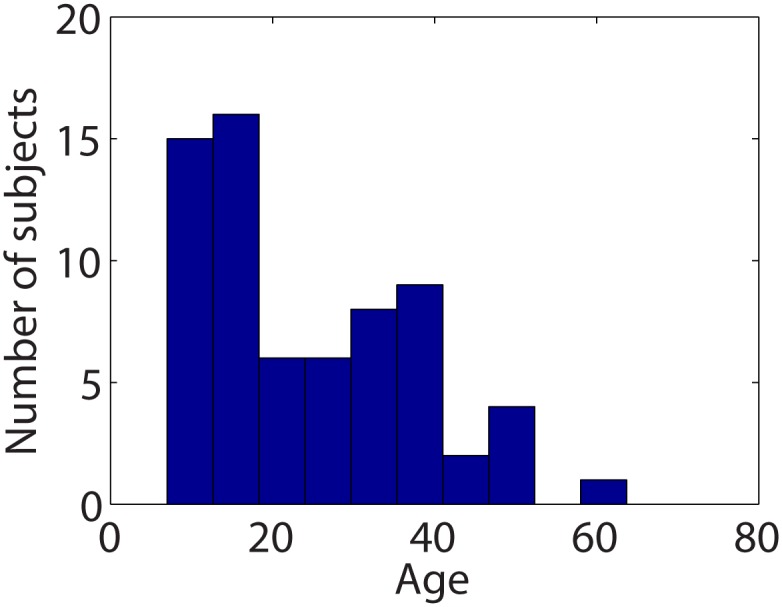
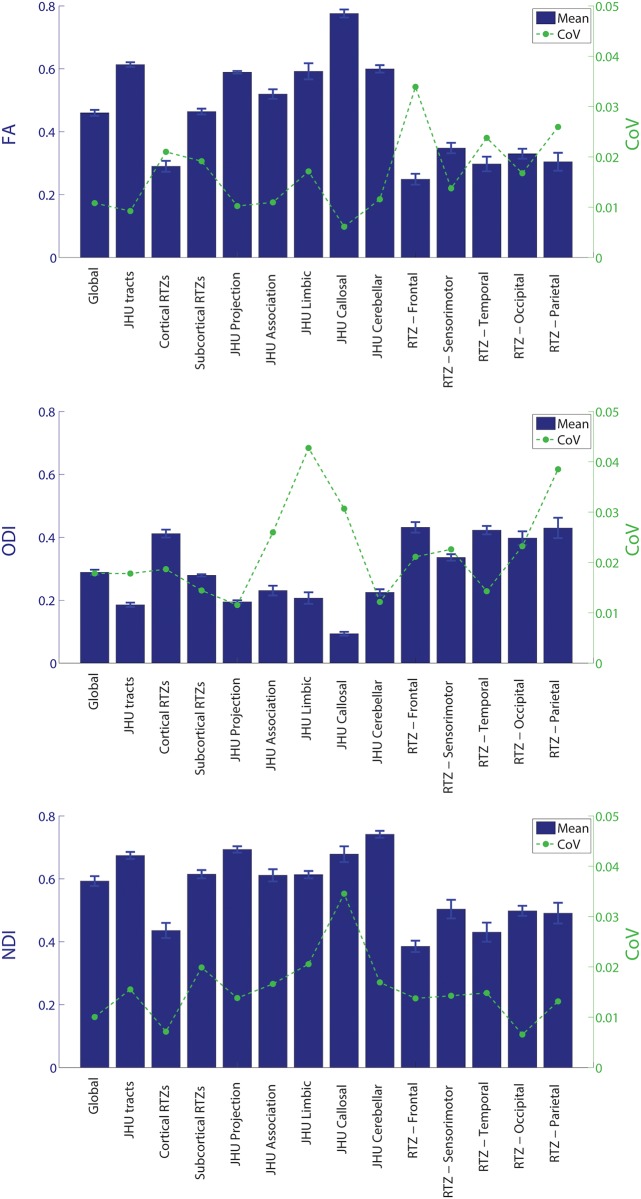
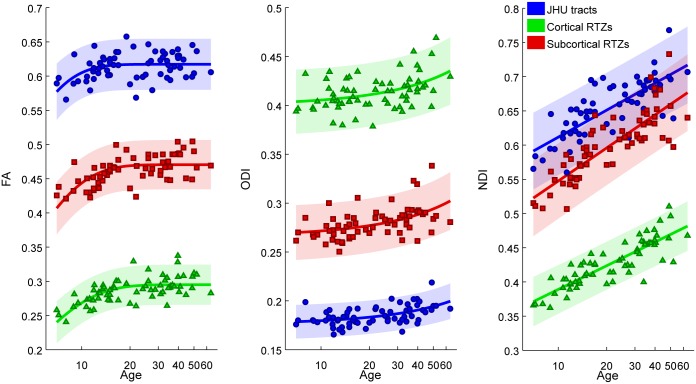
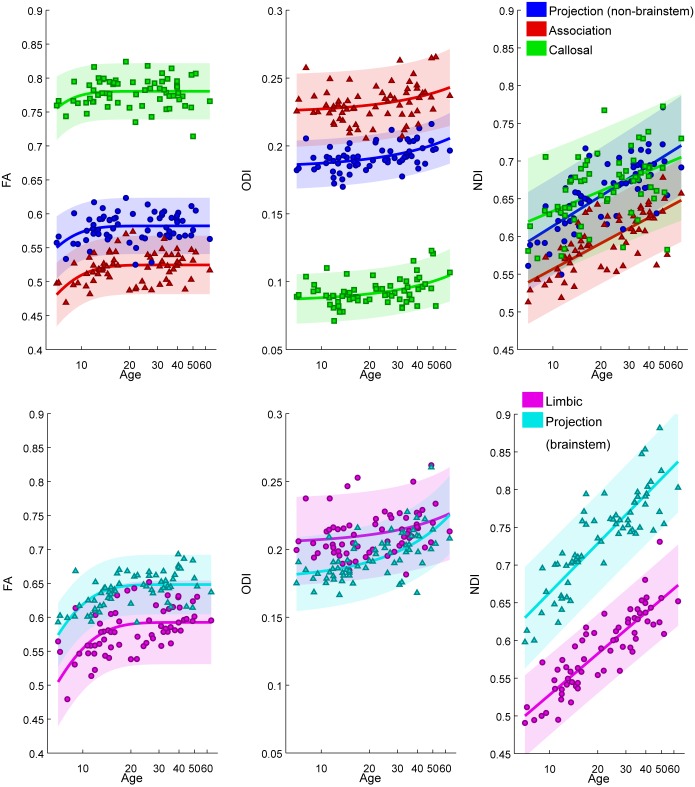
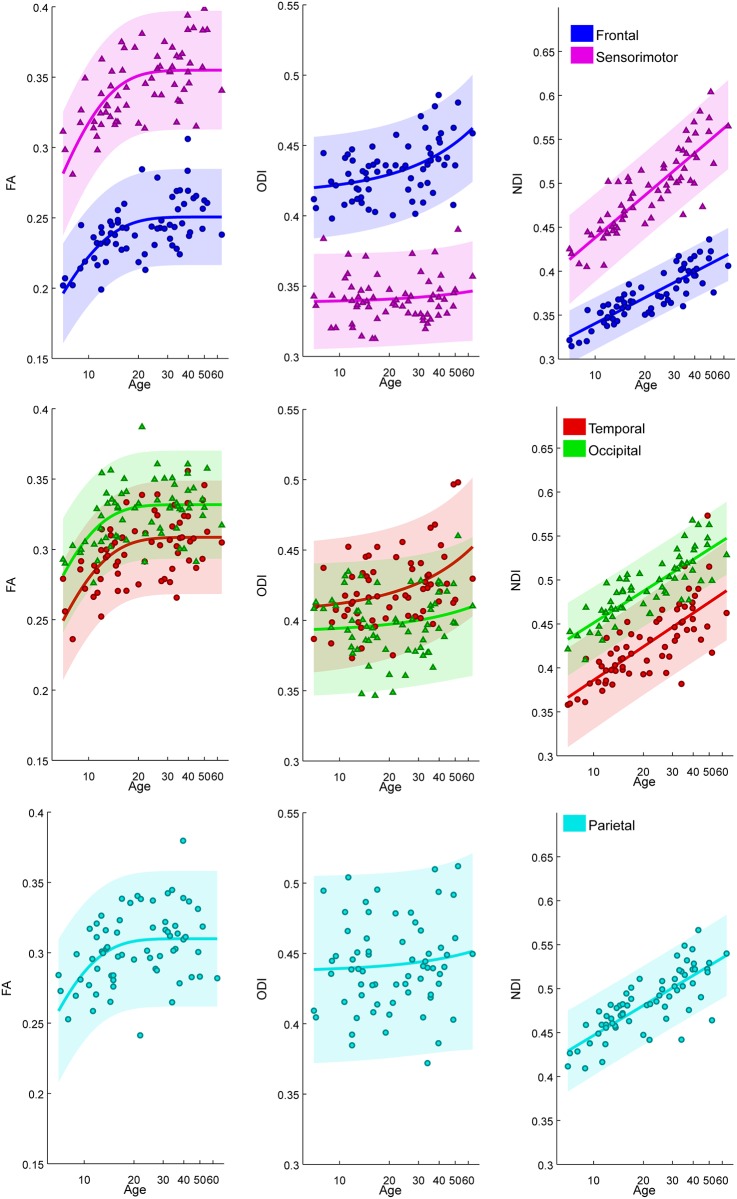
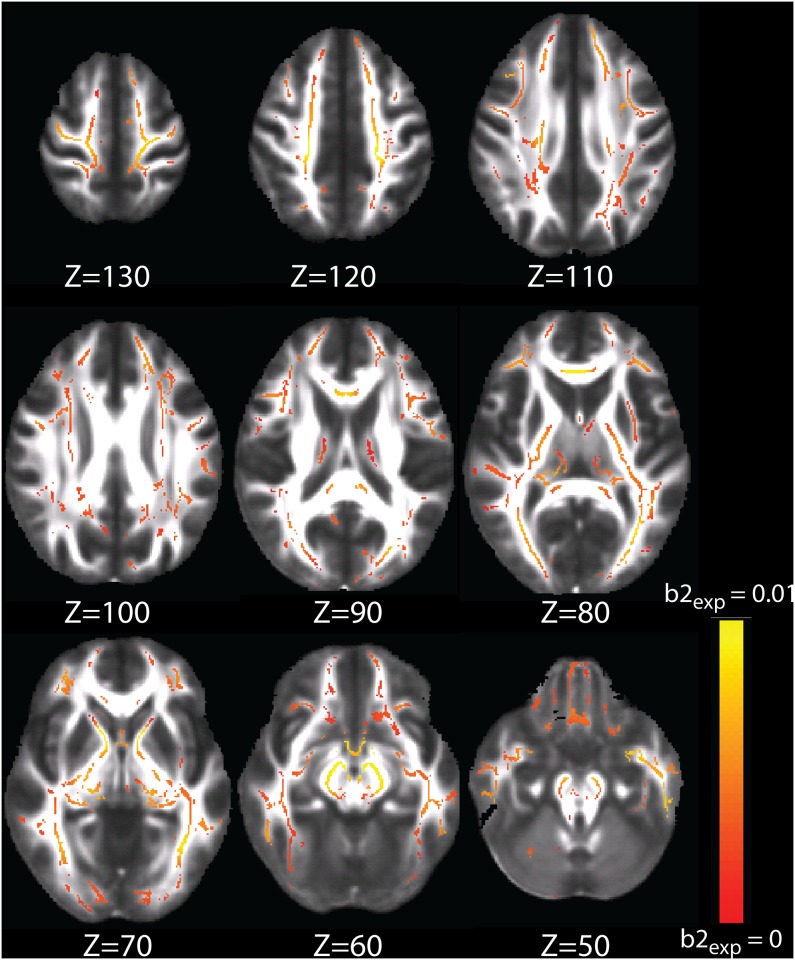
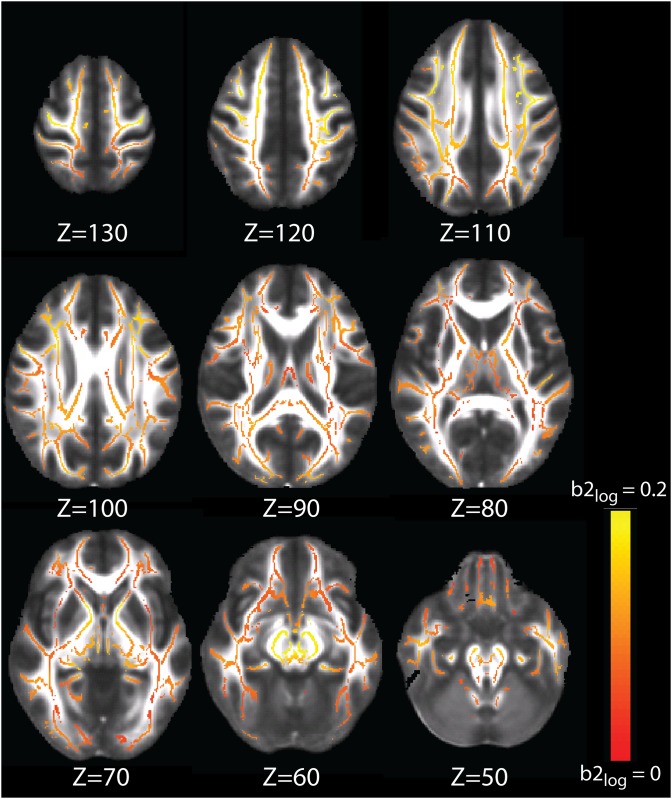
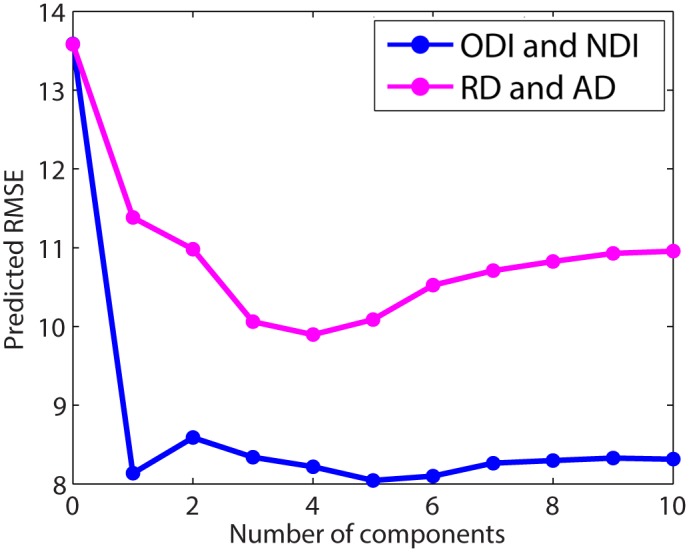
Diffusion tensor imaging (DTI) studies of human brain development have consistently shown widespread, but nonlinear increases in white matter anisotropy through childhood, adolescence, and into adulthood. However, despite its sensitivity to changes in tissue microstructure, DTI lacks the specificity to disentangle distinct microstructural features of white and gray matter. Neurite orientation dispersion and density imaging (NODDI) is a recently proposed multi-compartment biophysical model of brain microstructure that can estimate non-collinear properties of white matter, such as neurite orientation dispersion index (ODI) and neurite density index (NDI). In this study, we apply NODDI to 66 healthy controls aged 7-63 years to investigate changes of ODI and NDI with brain maturation, with comparison to standard DTI metrics. Using both region-of-interest and voxel-wise analyses, we find that NDI exhibits striking increases over the studied age range following a logarithmic growth pattern, while ODI rises following an exponential growth pattern. This novel finding is consistent with well-established age-related changes of FA over the lifespan that show growth during childhood and adolescence, plateau during early adulthood, and accelerating decay after the fourth decade of life. Our results suggest that the rise of FA during the first two decades of life is dominated by increasing NDI, while the fall in FA after the fourth decade is driven by the exponential rise of ODI that overcomes the slower increases of NDI. Using partial least squares regression, we further demonstrate that NODDI better predicts chronological age than DTI. Finally, we show excellent test-retest reliability of NODDI metrics, with coefficients of variation below 5% in all measured regions of interest. Our results support the conclusion that NODDI reveals biologically specific characteristics of brain development that are more closely linked to the microstructural features of white matter than are the empirical metrics provided by DTI.
对人类大脑发育的扩散张量成像(DTI)研究一直表明,在儿童期、青少年期直至成年期,白质各向异性普遍存在但呈非线性增加。然而,尽管DTI对组织微观结构的变化敏感,但它缺乏区分白质和灰质不同微观结构特征的特异性。神经突方向离散度和密度成像(NODDI)是最近提出的一种大脑微观结构的多室生物物理模型,它可以估计白质的非共线特性,如神经突方向离散度指数(ODI)和神经突密度指数(NDI)。在本研究中,我们将NODDI应用于66名年龄在7至63岁的健康对照者,以研究ODI和NDI随大脑成熟的变化,并与标准DTI指标进行比较。通过感兴趣区域分析和体素分析,我们发现NDI在所研究的年龄范围内呈现对数增长模式,显著增加,而ODI则呈指数增长模式上升。这一新颖的发现与整个生命周期中与年龄相关的FA变化相一致,FA在儿童期和青少年期增长,成年早期趋于平稳,在生命的第四个十年后加速下降。我们的结果表明,生命最初二十年中FA的上升主要由NDI的增加主导,而第四个十年后FA的下降则由ODI的指数上升驱动,ODI的上升超过了NDI较慢的增加。使用偏最小二乘回归,我们进一步证明NODDI比DTI能更好地预测实际年龄。最后,我们展示了NODDI指标出色的重测信度,所有测量的感兴趣区域的变异系数均低于5%。我们的结果支持以下结论:NODDI揭示了大脑发育的生物学特异性特征,这些特征比DTI提供的经验指标更紧密地与白质的微观结构特征相关。