Devi V, Ramnarayan K, Abraham R R, Pallath V, Kamath A, Kodidela S
Department of Pharmacology, Melaka Manipal Medical College, Manipal Camps, Manipal University, Manipal, Karnataka, India.
J Postgrad Med. 2015 Jul-Sep;61(3):163-8. doi: 10.4103/0022-3859.159315.
Participation in research during undergraduate studies may increase students' interest in research and inculcate research essentials in them.
The purpose of this study was to evaluate the effectiveness of the mentored student project (MSP) program.
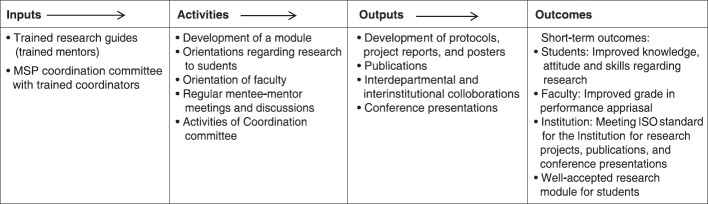
In the MSP program, students in groups (n = 3 to 5) undertook a research project, wrote a scholarly report, and presented the work as a poster presentation with the help of a faculty mentor. To begin with, the logic model of the program was developed to identify short-term outcomes of the program on students, mentors, and the institution. A quasi-experimental design was used to measure the outcomes.
A mixed method evaluation was done using a newly-developed questionnaire to assess the impact of the MSP on students' attitude, a multiple-choice question (MCQs) test to find out the impact on students' knowledge and grading of students' project reports and posters along with a survey to check the impact on skills. Students' satisfaction regarding the program and mentors' perceptions were collected using questionnaires. Evidence for validity was collected for all the instruments used for the evaluation.
Non-parametric tests were used to analyze data. Based on the scores, project reports and posters were graded into A (>70% marks), B (60-69% marks), and C (<59% marks) categories. The number of MSPs that resulted in publications, conference presentation and departmental collaborations were taken as impact on the institution.
Students' response rate was 91.5%. The students' attitudes regarding research changed positively (P = 0.036) and score in the MCQ test improved (P < 0.001) after undertaking MSP. Majority of project reports and posters were of grade A category. The majority of the items related to skills gained and satisfaction had a median score of 4. The MSPs resulted in inter-departmental and inter-institutional collaborations, 14 publications and 15 conference presentations. An area for improvement noted was to have the MSP implemented in the curriculum without increasing students' overall workload and stress.
The study identified strengths and weaknesses of the MSP program. Our model of undergraduate research project may be incorporated in undergraduate medical programs to foster positive attitude and knowledge base about scientific research and to instil research skills among students.
本科学习期间参与研究可能会提高学生对研究的兴趣,并向他们传授研究要点。
本研究的目的是评估指导学生项目(MSP)计划的有效性。
在MSP计划中,学生分组(每组3至5人)开展一个研究项目,撰写一份学术报告,并在教师导师的帮助下以海报展示的形式展示研究成果。首先,制定了该计划的逻辑模型,以确定该计划对学生、导师和机构的短期成果。采用准实验设计来衡量这些成果。
采用混合方法进行评估,使用新开发的问卷来评估MSP对学生态度的影响,通过多项选择题(MCQ)测试来了解对学生知识的影响以及对学生项目报告和海报的评分,并通过一项调查来检查对技能的影响。通过问卷收集学生对该计划的满意度以及导师的看法。为评估所用的所有工具收集了有效性证据。
使用非参数检验来分析数据。根据得分,将项目报告和海报分为A(>70分)、B(60 - 69分)和C(<59分)三类。将导致发表论文、会议展示和部门合作的MSP数量视为对机构的影响。
学生的回复率为91.5%。参与MSP后,学生对研究的态度发生了积极变化(P = 0.036),MCQ测试成绩有所提高(P < 0.001)。大多数项目报告和海报属于A类。与获得的技能和满意度相关的大多数项目的中位数得分为4。MSP促成了部门间和机构间的合作、14篇论文发表以及15次会议展示。指出的一个改进方面是在课程中实施MSP,同时不增加学生的总体工作量和压力。
该研究确定了MSP计划的优势和不足。我们的本科研究项目模式可纳入本科医学课程,以培养学生对科学研究的积极态度和知识基础,并向学生传授研究技能。