Piercy Brooke, Miovsky Nicole, Singh Harinder, Afghani Behnoosh, Schneider Margaret
Institute for Clinical and Translational Science, University of California, Irvine.
Res Sq. 2024 Aug 29:rs.3.rs-4830569. doi: 10.21203/rs.3.rs-4830569/v1.
The growing recognition of the need to incorporate scientific discoveries into healthcare decisions underscores an urgency for a robust physician-scientist workforce to advance translational research. Despite the correlation between medical students' research engagement and their academic productivity and success, significant gaps remain in the scientific workforce exacerbated by the "leaky pipeline" phenomenon from medical school to academic medicine, where potential physician-scientists veer away from research careers.The purpose of this study was to assess the effectiveness of a structured mentored research program for enhancing medical students' research competencies and sustaining their interest in research careers, thereby potentially enhancing the physician-scientist workforce.
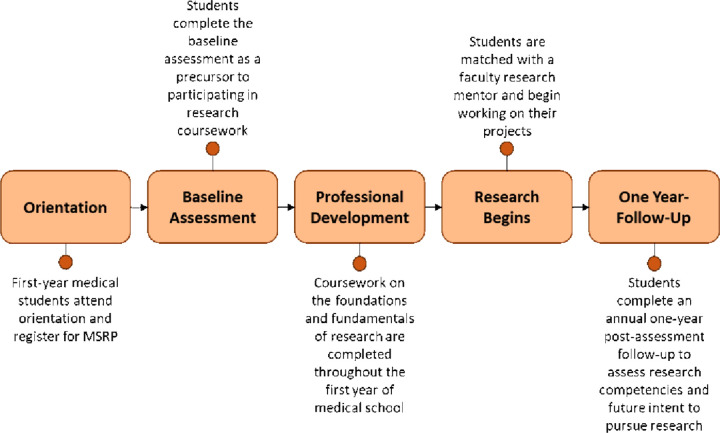
The Medical Student Research Program (MSRP) implemented at the University of California, Irvine (UCI) was designed to provide comprehensive research training and support to medical students through a series of structured lectures, mentorship by dedicated faculty, and administrative support for research activities. Students were surveyed upon enrollment and one year later to assess the change in research competencies from baseline to follow-up (paired samples t-test), students' intent to use research in clinical practice (paired samples t-test), and their intent to conduct research in the future (McNemar's test and McNemar Bowker test).
Preliminary evaluations indicated that the MSRP enhanced students' research competencies and has the potential to enhance medical students' research skills. However, similar to national trends, there was a decrease in students' intentions to engage with research in their future clinical career.
Our preliminary findings demonstrate MSRP students' enhanced research competencies during the first year of the program. However, the decline in students' intentions to engage in future research highlights the need for continued innovation in research training programs to sustain future intent to conduct research, in turn helping to address the "leaky pipeline" in the physician-scientist workforce. Future studies should focus on mid and long-term outcomes to fully assess research program impact on the physician-scientist pipeline and on integrating such programs more broadly into medical education.
越来越多的人认识到有必要将科学发现纳入医疗保健决策,这凸显了培养强大的医师-科学家队伍以推进转化研究的紧迫性。尽管医学生的研究参与度与其学术产出和成就之间存在关联,但从医学院到学术医学领域的“人才流失管道”现象加剧了科研队伍中的巨大差距,潜在的医师-科学家偏离了研究职业道路。本研究的目的是评估一个结构化的导师指导研究项目在提高医学生研究能力以及维持他们对研究职业的兴趣方面的有效性,从而有可能增加医师-科学家队伍。
加利福尼亚大学欧文分校(UCI)实施的医学生研究项目(MSRP)旨在通过一系列结构化讲座、专业教员的指导以及对研究活动的行政支持,为医学生提供全面的研究培训和支持。在入学时和一年后对学生进行调查,以评估从基线到随访时研究能力的变化(配对样本t检验)、学生在临床实践中运用研究的意愿(配对样本t检验)以及他们未来从事研究的意愿(McNemar检验和McNemar Bowker检验)。
初步评估表明,MSRP提高了学生的研究能力,并且有可能提升医学生的研究技能。然而,与全国趋势相似,学生未来在临床职业中参与研究的意愿有所下降。
我们的初步研究结果表明,MSRP项目的学生在项目的第一年研究能力有所提高。然而,学生未来从事研究的意愿下降凸显了研究培训项目持续创新的必要性,以维持未来从事研究的意愿,进而有助于解决医师-科学家队伍中的“人才流失管道”问题。未来的研究应关注中长期结果,以全面评估研究项目对医师-科学家人才输送渠道的影响,并将此类项目更广泛地融入医学教育。