Bergonzo Christina, Henriksen Niel M, Roe Daniel R, Cheatham Thomas E
Department of Medicinal Chemistry, College of Pharmacy, L.S. Skaggs Pharmacy Research Institute, University of Utah, Salt Lake City, Utah 84112, USA.
RNA. 2015 Sep;21(9):1578-90. doi: 10.1261/rna.051102.115. Epub 2015 Jun 29.
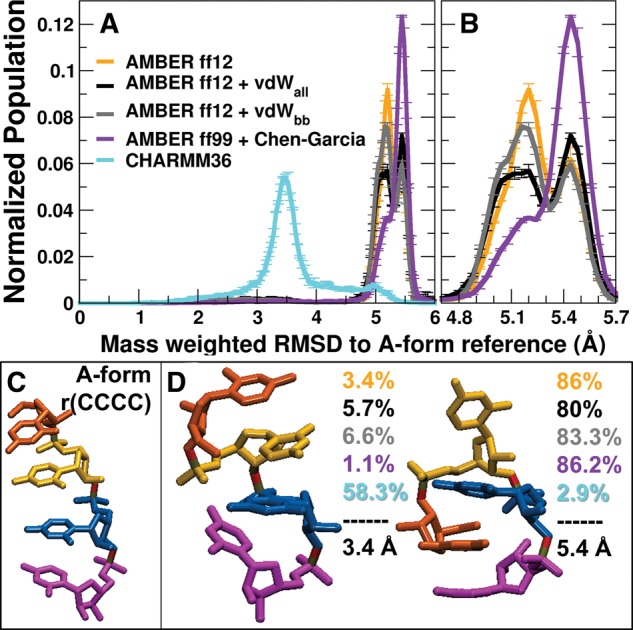
Recent modifications and improvements to standard nucleic acid force fields have attempted to fix problems and issues that have been observed as longer timescale simulations have become routine. Although previous work has shown the ability to fold the UUCG stem-loop structure, until now no group has attempted to quantify the performance of current force fields using highly converged structural populations of the tetraloop conformational ensemble. In this study, we report the use of multiple independent sets of multidimensional replica exchange molecular dynamics (M-REMD) simulations with different initial conditions to generate well-converged conformational ensembles for the tetranucleotides r(GACC) and r(CCCC), as well as the larger UUCG tetraloop motif. By generating what is to our knowledge the most complete RNA structure ensembles reported to date for these systems, we remove the coupling between force field errors and errors due to incomplete sampling, providing a comprehensive comparison between current top-performing MD force fields for RNA. Of the RNA force fields tested in this study, none demonstrate the ability to correctly identify the most thermodynamically stable structure for all three systems. We discuss the deficiencies present in each potential function and suggest areas where improvements can be made. The results imply that although "short" (nsec-μsec timescale) simulations may stay close to their respective experimental structures and may well reproduce experimental observables, inevitably the current force fields will populate alternative incorrect structures that are more stable than those observed via experiment.
标准核酸力场的最新修改和改进试图解决随着长时间尺度模拟变得常规化而观察到的问题。尽管先前的工作已显示出折叠UUCG茎环结构的能力,但直到现在,还没有团队尝试使用四环构象集合的高度收敛结构群体来量化当前力场的性能。在本研究中,我们报告了使用具有不同初始条件的多组独立的多维复制交换分子动力学(M-REMD)模拟,为四核苷酸r(GACC)和r(CCCC)以及更大的UUCG四环基序生成高度收敛的构象集合。通过生成据我们所知是这些系统迄今为止报道的最完整的RNA结构集合,我们消除了力场误差和由于采样不完整导致的误差之间的耦合,从而对当前表现最佳的RNA分子动力学力场进行了全面比较。在本研究中测试的RNA力场中,没有一个能证明有能力正确识别所有这三个系统中最热力学稳定的结构。我们讨论了每个势函数中存在的缺陷,并提出了可以改进的领域。结果表明,尽管“短”(纳秒至微秒时间尺度)模拟可能会接近其各自的实验结构,并且可能很好地重现实验观测值,但当前的力场不可避免地会填充比通过实验观察到的结构更稳定的替代错误结构。