Zeng R, Bscheider M, Lahl K, Lee M, Butcher E C
Laboratory of Immunology and Vascular Biology, Department of Pathology, Stanford University School of Medicine, Stanford, California, USA.
Program of Immunology, Stanford University School of Medicine, Stanford, California, USA.
Mucosal Immunol. 2016 Jan;9(1):183-93. doi: 10.1038/mi.2015.50. Epub 2015 Jul 1.
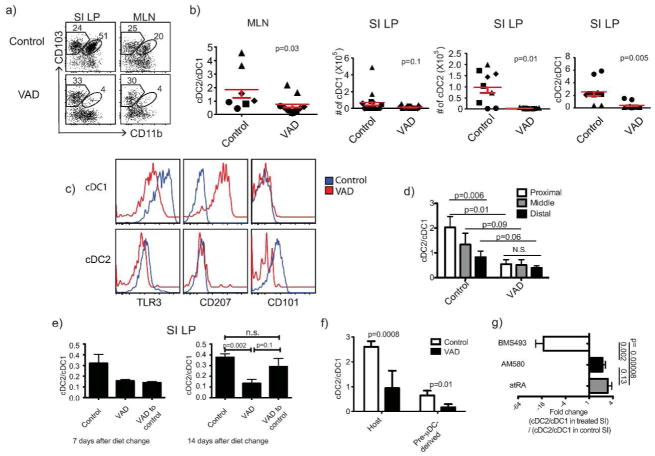
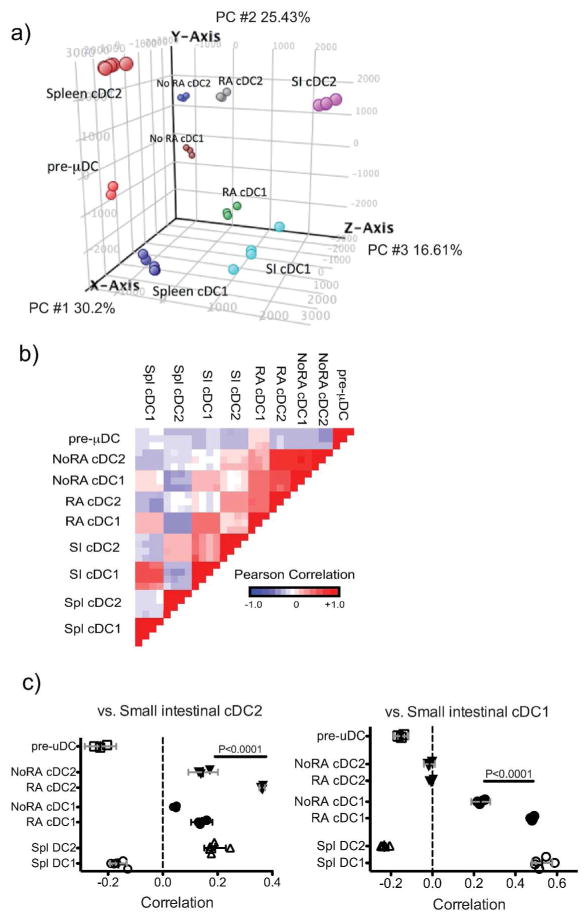
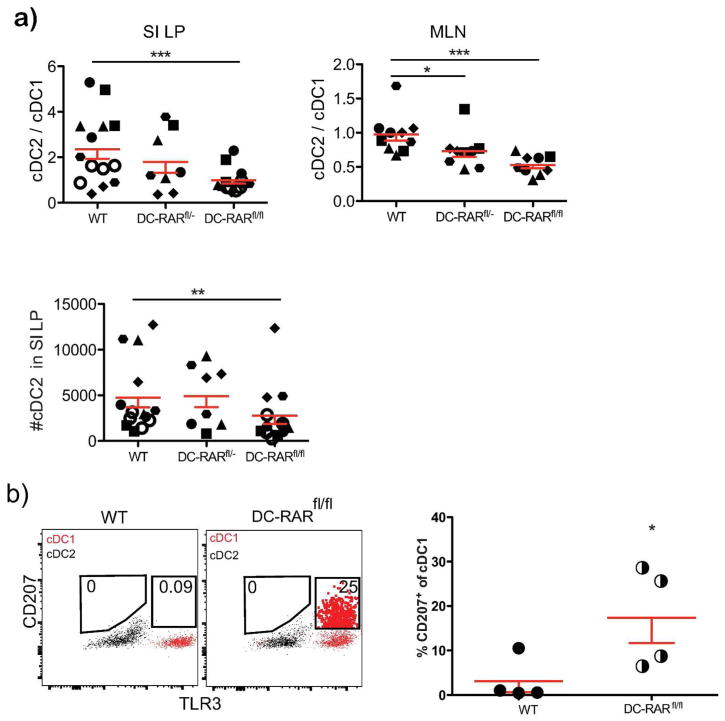
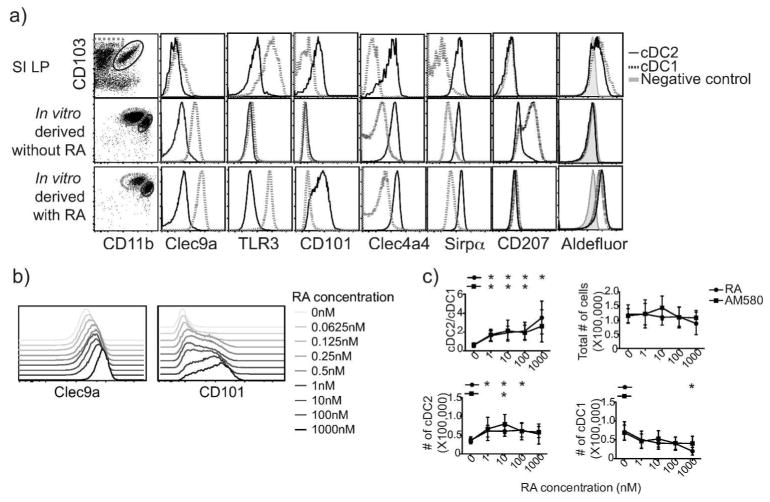
The vitamin A metabolite retinoic acid (RA) regulates adaptive immunity in the intestines, with well-characterized effects on IgA responses, Treg induction, and gut trafficking of T- and B-effector cells. It also controls the generation of conventional dendritic cell (cDC) precursors in the bone marrow and regulates cDC subset representation, but its roles in the specialization of intestinal cDC subsets are understudied. Here we show that RA acts cell intrinsically in developing gut-tropic pre-mucosal dendritic cell (pre-μDC) to effect the differentiation and drive the specialization of intestinal CD103(+)CD11b(-) (cDC1) and of CD103(+)CD11b(+) (cDC2). Systemic deficiency or DC-restricted antagonism of RA signaling resulted in altered phenotypes of intestinal cDC1 and cDC2, and reduced numbers of cDC2. Effects of dietary deficiency were most apparent in the proximal small intestine and were rapidly reversed by reintroducing vitamin A. In cultures of pre-μDC with Flt3L and granulocyte-macrophage colony-stimulating factor (GM-CSF), RA induced cDC with characteristic phenotypes of intestinal cDC1 and cDC2 by controlling subset-defining cell surface receptors, regulating subset-specific transcriptional programs, and suppressing proinflammatory nuclear factor-κB-dependent gene expression. Thus, RA is required for transcriptional programming and maturation of intestinal cDC, and with GM-CSF and Flt3L provides a minimal environment for in vitro generation of intestinal cDC1- and cDC2-like cDC from specialized precursors.
维生素A代谢产物视黄酸(RA)调节肠道中的适应性免疫,对IgA反应、调节性T细胞诱导以及T效应细胞和B效应细胞的肠道运输具有明确的作用。它还控制骨髓中常规树突状细胞(cDC)前体的生成并调节cDC亚群的组成,但它在肠道cDC亚群特化中的作用尚未得到充分研究。在这里,我们表明RA在发育中的肠道嗜性黏膜前树突状细胞(pre-μDC)中发挥细胞内在作用,以影响分化并驱动肠道CD103(+)CD11b(-) (cDC1)和CD103(+)CD11b(+) (cDC2)的特化。RA信号通路的全身缺陷或DC特异性拮抗导致肠道cDC1和cDC2的表型改变,以及cDC2数量减少。饮食缺乏的影响在近端小肠中最为明显,通过重新引入维生素A可迅速逆转。在含有Flt3L和粒细胞-巨噬细胞集落刺激因子(GM-CSF)的pre-μDC培养物中,RA通过控制定义亚群的细胞表面受体、调节亚群特异性转录程序以及抑制促炎核因子-κB依赖性基因表达,诱导出具有肠道cDC1和cDC2特征表型的cDC。因此,RA是肠道cDC转录编程和成熟所必需的,并且与GM-CSF和Flt3L一起为从特定前体体外生成肠道cDC1样和cDC2样cDC提供了一个基本环境。