Stein Jeffrey S, Koffarnus Mikhail N, Snider Sarah E, Quisenberry Amanda J, Bickel Warren K
Addictions Recovery Research Center, Virginia Tech Carilion Research Institute.
Exp Clin Psychopharmacol. 2015 Oct;23(5):377-86. doi: 10.1037/pha0000020. Epub 2015 Jul 6.
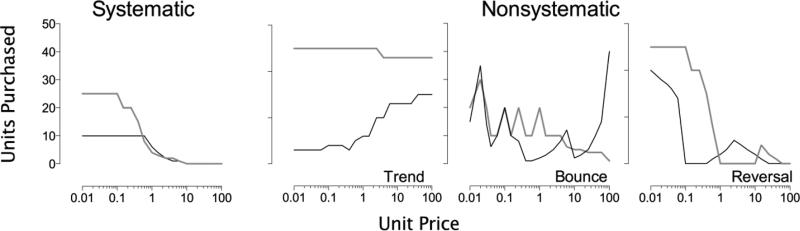
Experimental assessments of demand allow the examination of economic phenomena relevant to the etiology, maintenance, and treatment of addiction and other pathologies (e.g., obesity). Although such assessments have historically been resource intensive, development and use of purchase tasks-in which participants purchase 1 or more hypothetical or real commodities across a range of prices-have made data collection more practical and have increased the rate of scientific discovery. However, extraneous sources of variability occasionally produce nonsystematic demand data, in which price exerts either no or inconsistent effects on the purchases of individual participants. Such data increase measurement error, can often not be interpreted in light of research aims, and likely obscure effects of the variable(s) under investigation. Using data from 494 participants, we introduce and evaluate an algorithm (derived from prior methods) for identifying nonsystematic demand data, wherein individual participants' demand functions are judged against 2 general, empirically based assumptions: (a) global, price-dependent reduction in consumption and (b) consistency in purchasing across prices. We also introduce guidelines for handling nonsystematic data, noting some conditions in which excluding such data from primary analyses may be appropriate and others in which doing so may bias conclusions. Adoption of the methods presented here may serve to unify the research literature and facilitate discovery.
对需求的实验性评估有助于考察与成瘾及其他病症(如肥胖症)的病因、维持和治疗相关的经济现象。尽管从历史上看,此类评估资源消耗大,但购买任务的开发和使用——即参与者在一系列价格范围内购买一种或多种虚拟或真实商品——使数据收集更具可行性,并提高了科学发现的速度。然而,额外的变异性来源偶尔会产生非系统性需求数据,即价格对个体参与者的购买行为要么没有影响,要么影响不一致。此类数据会增加测量误差,往往无法根据研究目的进行解释,还可能掩盖所研究变量的影响。我们使用来自494名参与者的数据,引入并评估了一种(源自先前方法的)算法,用于识别非系统性需求数据,其中个体参与者的需求函数根据两个基于经验的一般假设进行判断:(a)总体上消费随价格下降,以及(b)跨价格购买的一致性。我们还介绍了处理非系统性数据的指导原则,指出了某些情况下将此类数据排除在主要分析之外可能是合适的,而在其他情况下这样做可能会使结论产生偏差。采用本文提出的方法可能有助于统一研究文献并促进发现。