Amlung Michael, Mackillop James
Department of Psychology, The University of Georgia Athens, GA, USA.
Front Psychiatry. 2012 Jul 2;3:65. doi: 10.3389/fpsyt.2012.00065. eCollection 2012.
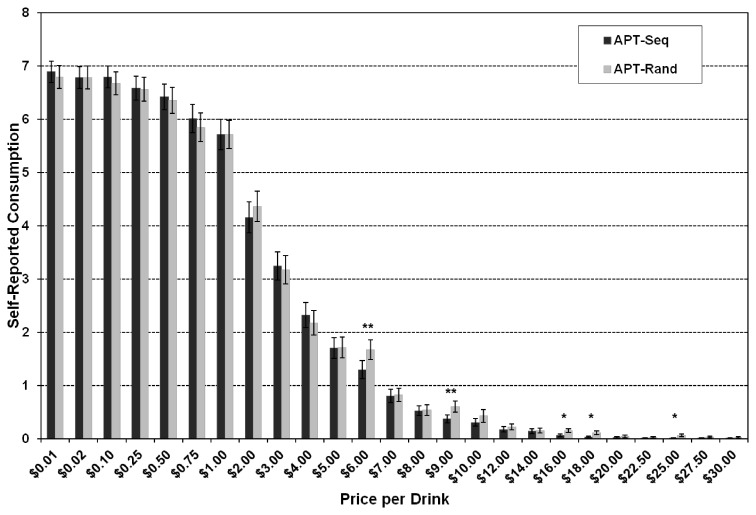
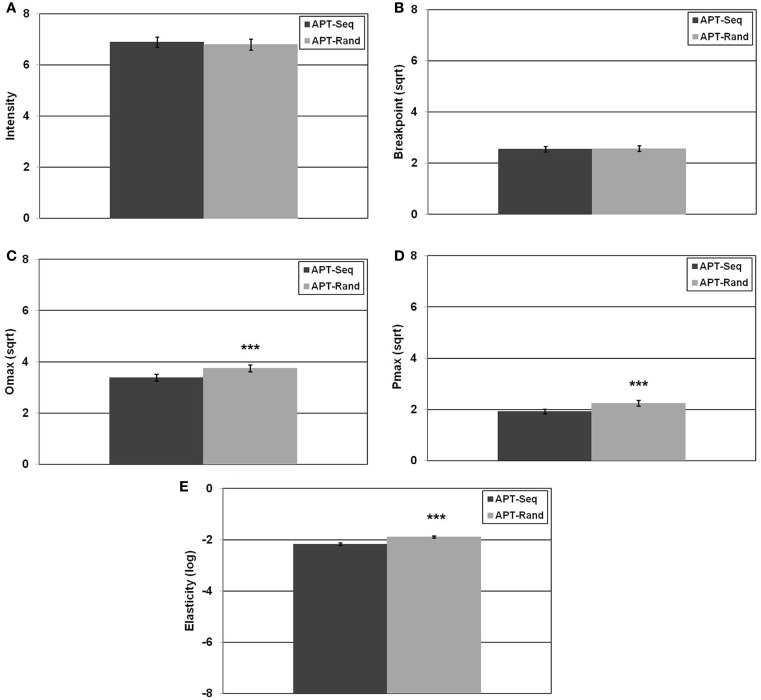
Behavioral economic demand for addictive substances is commonly assessed via purchase tasks that measure estimated drug consumption at a range of prices. Purchase tasks typically use escalating prices in sequential order, which may influence performance by providing explicit price reference points. This study investigated the consistency of value preferences on two alcohol purchase tasks that used either a randomized or sequential price order (price range: free to $30 per drink) in a sample of 91 young adult monthly drinkers. Randomization of prices significantly reduced relative response consistency (p < 0.01), although absolute consistency was high for both versions (>95%). Self-reported alcohol consumption across prices and indices of demand were highly similar across versions, although a few notable exceptions were found. These results suggest generally high consistency and overlapping performance between randomized and sequential price assessment. Implications for the behavioral economics literature and priorities for future research are discussed.
成瘾性物质的行为经济需求通常通过购买任务来评估,这些任务测量一系列价格下的估计药物消费量。购买任务通常按顺序使用递增价格,这可能通过提供明确的价格参考点来影响表现。本研究在91名年轻成年每月饮酒者的样本中,调查了两种酒精购买任务上价值偏好的一致性,这两种任务分别采用随机或顺序价格顺序(价格范围:每杯酒0美元至30美元)。价格随机化显著降低了相对反应一致性(p < 0.01),尽管两个版本的绝对一致性都很高(>95%)。尽管发现了一些显著例外,但不同版本间跨价格的自我报告酒精消费量和需求指数高度相似。这些结果表明,随机和顺序价格评估之间总体上具有高度一致性和重叠表现。讨论了对行为经济学文献的影响以及未来研究的重点。