Peltonen Garrett L, Harrell John W, Rousseau Cameron L, Ernst Brady S, Marino Mariah L, Crain Meghan K, Schrage William G
Bruno Balke Biodynamics Laboratory, Department of Kinesiology, University of Wisconsin-Madison, Madison, Wisconsin.
Bruno Balke Biodynamics Laboratory, Department of Kinesiology, University of Wisconsin-Madison, Madison, Wisconsin
Physiol Rep. 2015 Jul;3(7). doi: 10.14814/phy2.12451.
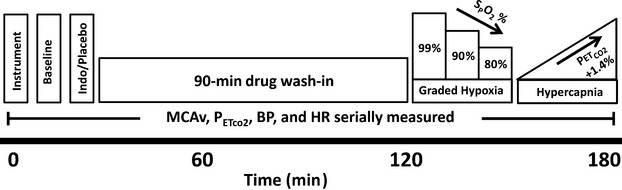
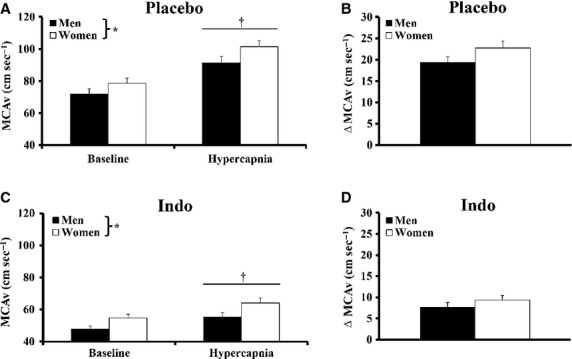
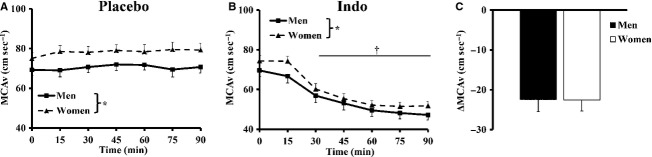
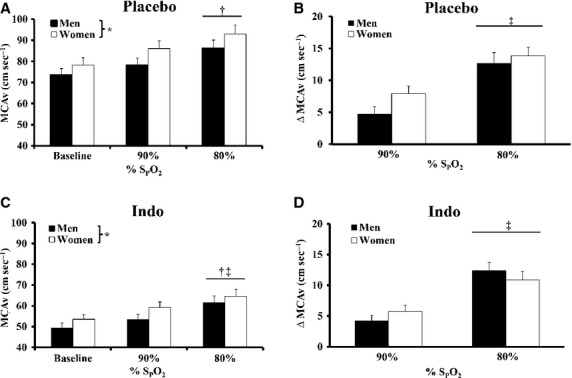
Greater cerebral artery vasodilation mediated by cyclooxygenase (COX) in female animals is unexplored in humans. We hypothesized that young, healthy women would exhibit greater basal cerebral blood flow (CBF) and greater vasodilation during hypoxia or hypercapnia compared to men, mediated by a larger contribution of COX. We measured middle cerebral artery velocity (MCAv, transcranial Doppler ultrasound) in 42 adults (24 women, 18 men; 24 ± 1 years) during two visits, in a double-blind, placebo-controlled design (COX inhibition, 100 mg oral indomethacin, Indo). Women were studied early in the follicular phase of the menstrual cycle (days 1-5). Two levels of isocapnic hypoxia (SPO2 = 90% and 80%) were induced for 5-min each. Separately, hypercapnia was induced by increasing end-tidal carbon dioxide (PETCO 2) 10 mmHg above baseline. A positive change in MCAv (ΔMCAv) reflected vasodilation. Basal MCAv was greater in women compared to men (P < 0.01) across all conditions. Indo decreased baseline MCAv (P < 0.01) similarly between sexes. Hypoxia increased MCAv (P < 0.01), but ΔMCAv was not different between sexes. Indo did not alter hypoxic vasodilation in either sex. Hypercapnia increased MCAv (P < 0.01), but ΔMCAv was not different between sexes. Indo elicited a large decrease in hypercapnic vasodilation (P < 0.01) that was similar between sexes. During the early follicular phase, women exhibit greater basal CBF than men, but similar vasodilatory responses to hypoxia and hypercapnia. Moreover, COX is not obligatory for hypoxic vasodilation, but plays a vital and similar role in the regulation of basal CBF (30%) and hypercapnic response (55%) between sexes.
环氧化酶(COX)介导的雌性动物大脑动脉血管舒张在人类中尚未得到研究。我们假设,与男性相比,年轻健康女性在缺氧或高碳酸血症期间会表现出更高的基础脑血流量(CBF)和更大的血管舒张,这是由COX的更大作用介导的。我们在一项双盲、安慰剂对照设计(COX抑制,口服100毫克吲哚美辛,Indo)中,对42名成年人(24名女性,18名男性;24±1岁)进行了两次访视,测量大脑中动脉速度(MCAv,经颅多普勒超声)。女性在月经周期的卵泡期早期(第1 - 5天)进行研究。分别诱导两种水平的等容性缺氧(SPO2 = 90%和80%),每次持续5分钟。另外,通过将呼气末二氧化碳(PETCO2)提高到比基线高10 mmHg来诱导高碳酸血症。MCAv的正向变化(ΔMCAv)反映血管舒张。在所有情况下,女性的基础MCAv均高于男性(P < 0.01)。Indo使基线MCAv降低(P < 0.01),两性之间情况相似。缺氧使MCAv增加(P < 0.01),但两性之间的ΔMCAv没有差异。Indo并未改变任何一种性别的缺氧性血管舒张。高碳酸血症使MCAv增加(P < 0.01),但两性之间的ΔMCAv没有差异。Indo引起高碳酸血症性血管舒张大幅降低(P < 0.01),两性之间情况相似。在卵泡期早期,女性的基础CBF高于男性,但对缺氧和高碳酸血症的血管舒张反应相似。此外,COX对于缺氧性血管舒张不是必需的,但在两性基础CBF(约30%)和高碳酸血症反应(约55%)的调节中起着至关重要且相似的作用。