Li Lei, Jiang Hong-kun, Li Yun-peng, Guo Yan-ping
Department of Orthopedics, Shengjing Hospital of China Medical University, Shenyang, 110004, China.
Department of Pediatrics, The First Affiliated Hospital of China Medical University, Shenyang, 110001, China.
J Biomed Sci. 2015 Jul 7;22(1):50. doi: 10.1186/s12929-015-0135-1.
Hydrogen sulfide (H2S), a novel gaseous mediator, has been recognized as an important neuromodulator and neuroprotective agent in the nervous system. The present study was undertaken to study the effects of exogenous H2S on ischemia/reperfusion (I/R) injury of spinal cord and the underlying mechanisms.
The effects of exogenous H2S on I/R injury were examined by using assessment of hind motor function, spinal cord infarct zone by Triphenyltetrazolium chloride (TTC) staining. Autophagy was evaluated by expressions of Microtubule associated protein 1 light chain 3 (LC3) and Beclin-1 which were determined by using Quantitative Real-Time PCR and Western blotting, respectively.
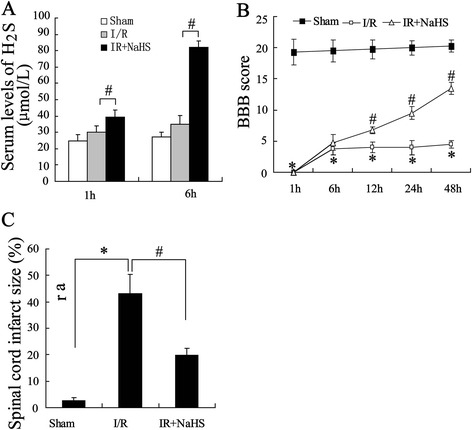
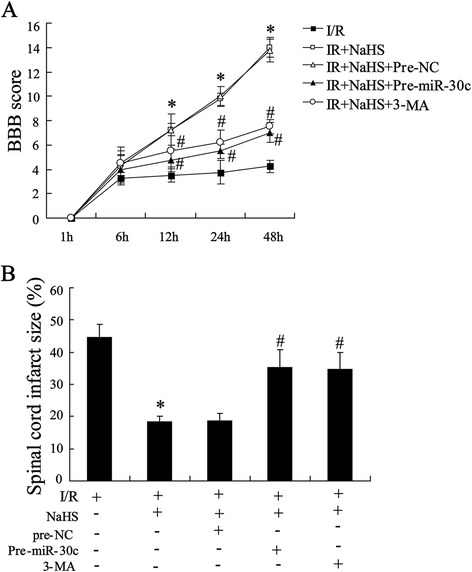
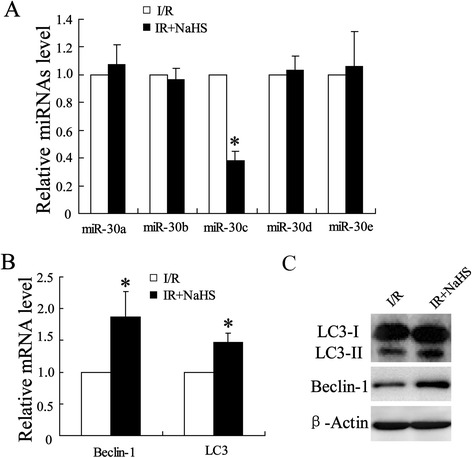
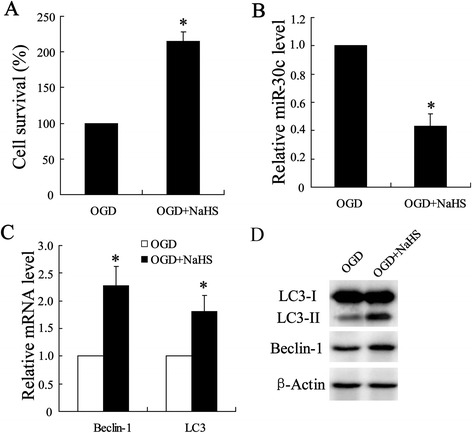
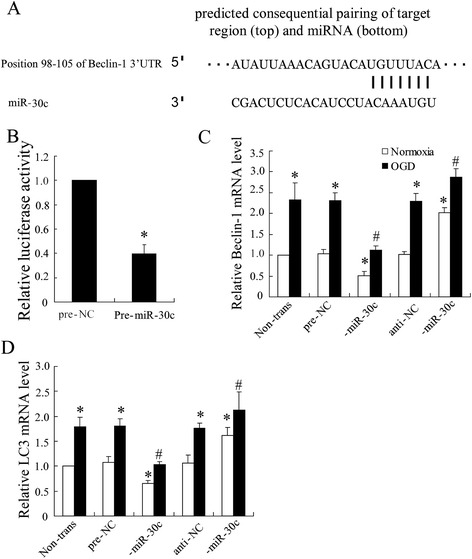
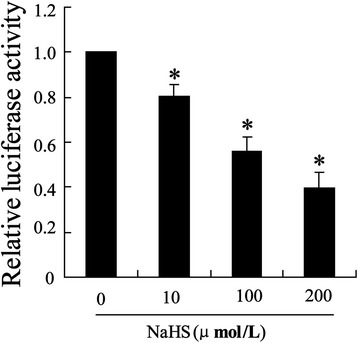
Compared to I/R injury groups, H2S pretreatment had reduced spinal cord infarct zone, improved hind motor function in rats. Quantitative Real-Time PCR or Western blotting results showed that H2S pretreatment also downregulated miR-30c expression and upregulated Beclin-1 and LC3II expression in spinal cord. In vitro, miR-30c was showed to exert negative effect on Beclin-1 expression by targeting its 3'UTR in SY-SH-5Y cells treated with Oxygen, Glucose Deprivation (OGD). In rat model of I/R injury, pretreatment of pre-miR-30c or 3-MA (an inhibitor for autophagy) can abrogated spinal cord protective effect of H2S.
H2S protects spinal cord and induces autophagy via miR-30c in a rat model of spinal cord hemia-reperfusion injury.
硫化氢(H₂S)作为一种新型气体介质,已被公认为神经系统中一种重要的神经调节剂和神经保护剂。本研究旨在探讨外源性H₂S对脊髓缺血/再灌注(I/R)损伤的影响及其潜在机制。
通过评估后肢运动功能、用氯化三苯基四氮唑(TTC)染色检测脊髓梗死区,来研究外源性H₂S对I/R损伤的影响。分别采用定量实时PCR和蛋白质免疫印迹法检测微管相关蛋白1轻链3(LC3)和Beclin-1的表达,以评估自噬情况。
与I/R损伤组相比,H₂S预处理可减小大鼠脊髓梗死区面积,改善后肢运动功能。定量实时PCR或蛋白质免疫印迹结果显示,H₂S预处理还可下调脊髓中miR-30c的表达,并上调Beclin-1和LC3II的表达。在体外,在氧糖剥夺(OGD)处理的SY-SH-5Y细胞中,miR-30c通过靶向Beclin-1的3'UTR对其表达发挥负性作用。在I/R损伤大鼠模型中,预处理前体miR-30c或3-MA(一种自噬抑制剂)可消除H₂S对脊髓的保护作用。
在脊髓半切再灌注损伤大鼠模型中,H₂S通过miR-30c保护脊髓并诱导自噬。