Hersch Micha, Hachet Olivier, Dalessi Sascha, Ullal Pranav, Bhatia Payal, Bergmann Sven, Martin Sophie G
Department of Medical Genetics, University of Lausanne, Lausanne, Switzerland Swiss Institute of Bioinformatics, Lausanne, Switzerland.
Department of Fundamental Microbiology, University of Lausanne, Lausanne, Switzerland.
Mol Syst Biol. 2015 Jul 6;11(7):818. doi: 10.15252/msb.20145996.
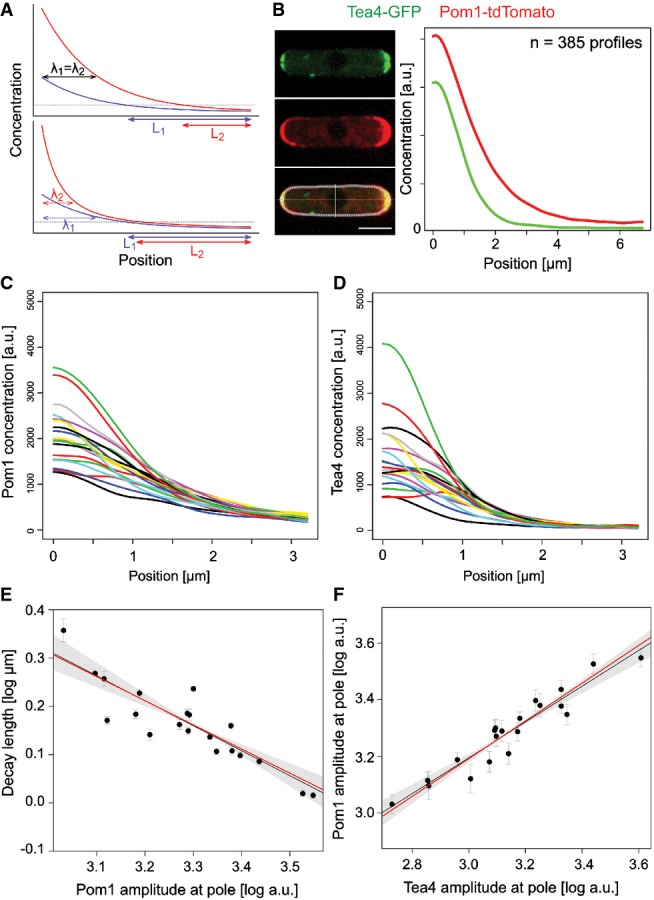
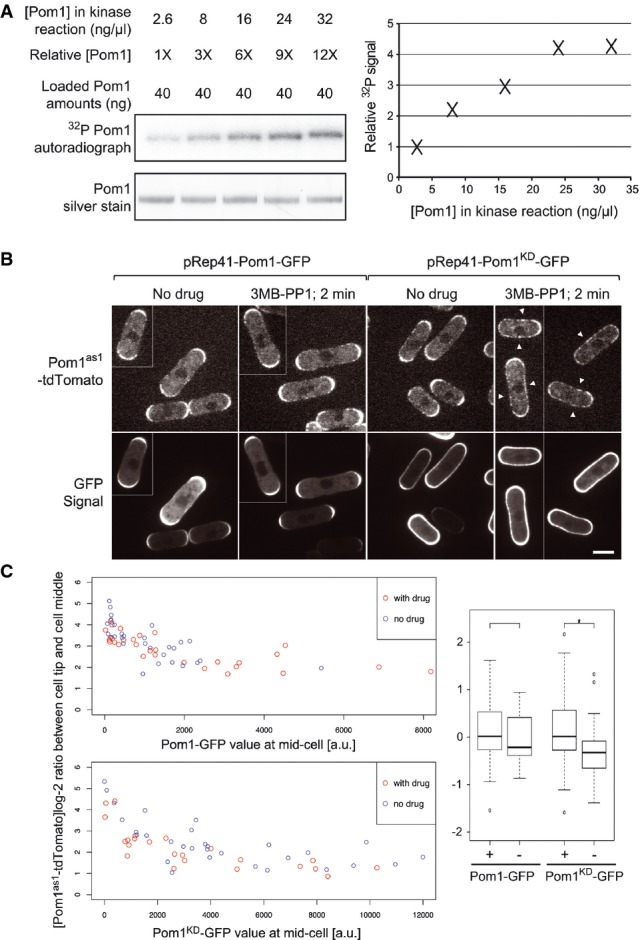
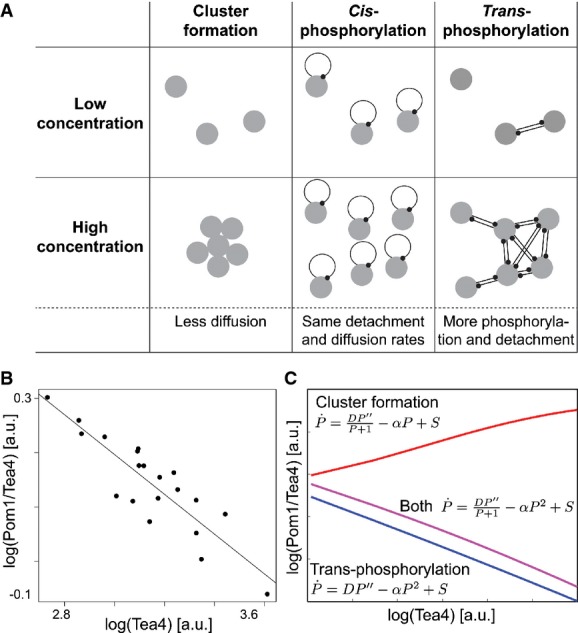
Concentration gradients provide spatial information for tissue patterning and cell organization, and their robustness under natural fluctuations is an evolutionary advantage. In rod-shaped Schizosaccharomyces pombe cells, the DYRK-family kinase Pom1 gradients control cell division timing and placement. Upon dephosphorylation by a Tea4-phosphatase complex, Pom1 associates with the plasma membrane at cell poles, where it diffuses and detaches upon auto-phosphorylation. Here, we demonstrate that Pom1 auto-phosphorylates intermolecularly, both in vitro and in vivo, which confers robustness to the gradient. Quantitative imaging reveals this robustness through two system's properties: The Pom1 gradient amplitude is inversely correlated with its decay length and is buffered against fluctuations in Tea4 levels. A theoretical model of Pom1 gradient formation through intermolecular auto-phosphorylation predicts both properties qualitatively and quantitatively. This provides a telling example where gradient robustness through super-linear decay, a principle hypothesized a decade ago, is achieved through autocatalysis. Concentration-dependent autocatalysis may be a widely used simple feedback to buffer biological activities.
浓度梯度为组织模式形成和细胞组织提供空间信息,其在自然波动下的稳健性是一种进化优势。在杆状粟酒裂殖酵母细胞中,DYRK家族激酶Pom1梯度控制细胞分裂的时间和位置。经Tea4磷酸酶复合物去磷酸化后,Pom1在细胞两极与质膜结合,并在自磷酸化后扩散并脱离。在这里,我们证明Pom1在体外和体内均发生分子间自磷酸化,这赋予了梯度稳健性。定量成像通过两个系统特性揭示了这种稳健性:Pom1梯度幅度与其衰减长度呈负相关,并能缓冲Tea4水平的波动。通过分子间自磷酸化形成Pom1梯度的理论模型对这两个特性进行了定性和定量预测。这提供了一个生动的例子,即通过超线性衰减实现梯度稳健性这一十年前提出的原理是通过自催化实现的。浓度依赖性自催化可能是一种广泛使用的简单反馈,用于缓冲生物活性。