Department of Biochemistry and Cell Biology, The Geisel School of Medicine at Dartmouth, Hanover, United States.
Elife. 2019 May 3;8:e46003. doi: 10.7554/eLife.46003.
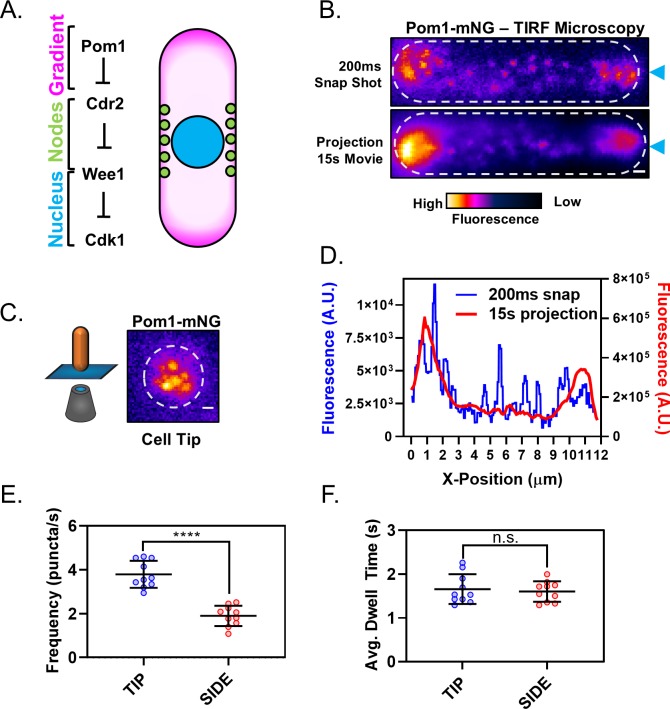
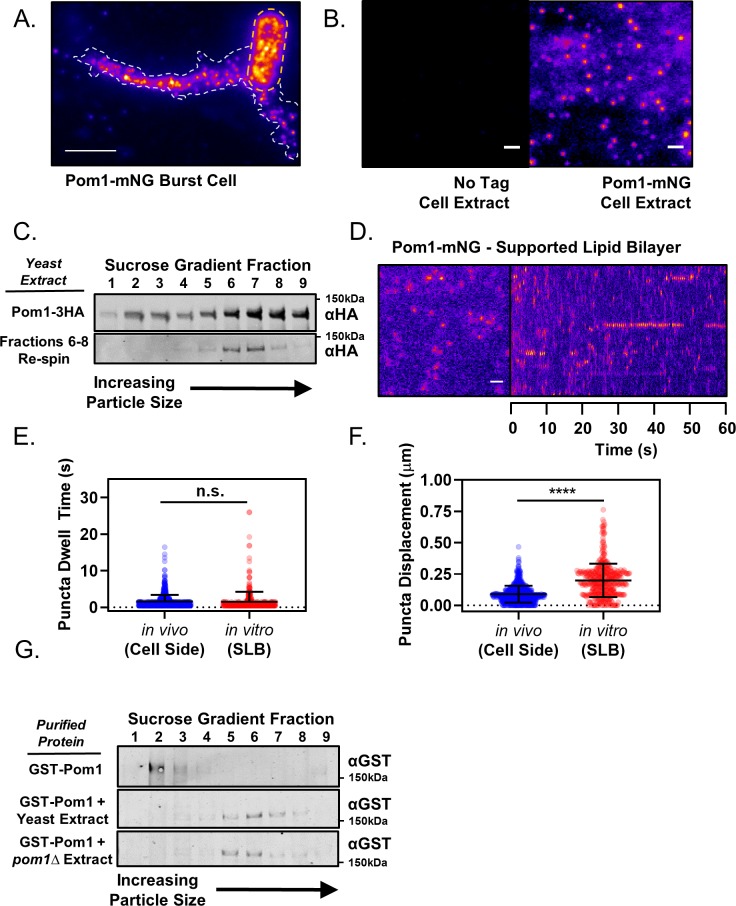
Control of cell size requires molecular size sensors that are coupled to the cell cycle. Rod-shaped fission yeast cells divide at a threshold size partly due to Cdr2 kinase, which forms nodes at the medial cell cortex where it inhibits the Cdk1-inhibitor Wee1. Pom1 kinase phosphorylates and inhibits Cdr2, and forms cortical concentration gradients from cell poles. Pom1 inhibits Cdr2 signaling to Wee1 specifically in small cells, but the time and place of their regulatory interactions were unclear. We show that Pom1 forms stable oligomeric clusters that dynamically sample the cell cortex. Binding frequency is patterned into a concentration gradient by the polarity landmarks Tea1 and Tea4. Pom1 clusters colocalize with Cdr2 nodes, forming a glucose-modulated inhibitory threshold against node activation. Our work reveals how Pom1-Cdr2-Wee1 operates in multiprotein clusters at the cortex to promote mitotic entry at a cell size that can be modified by nutrient availability.
细胞大小的控制需要与细胞周期相偶联的分子大小传感器。杆状的裂殖酵母细胞在一个阈值大小处分裂,部分原因是 Cdr2 激酶在细胞中部皮层形成节点,在那里它抑制 Cdk1 抑制剂 Wee1。Pom1 激酶使 Cdr2 磷酸化并抑制 Cdr2,并且从细胞极形成皮质浓度梯度。Pom1 抑制 Cdr2 向 Wee1 的信号传导,特别是在小细胞中,但它们的调控相互作用的时间和地点尚不清楚。我们表明,Pom1 形成稳定的寡聚体簇,这些簇可以动态地对细胞皮层进行采样。结合频率通过极性地标 Tea1 和 Tea4 被设计成浓度梯度。Pom1 簇与 Cdr2 节点共定位,形成葡萄糖调节的抑制阈值,以防止节点激活。我们的工作揭示了 Pom1-Cdr2-Wee1 如何在皮层的多蛋白簇中发挥作用,以促进细胞大小的有丝分裂进入,而细胞大小可以通过营养物质的可用性来修饰。